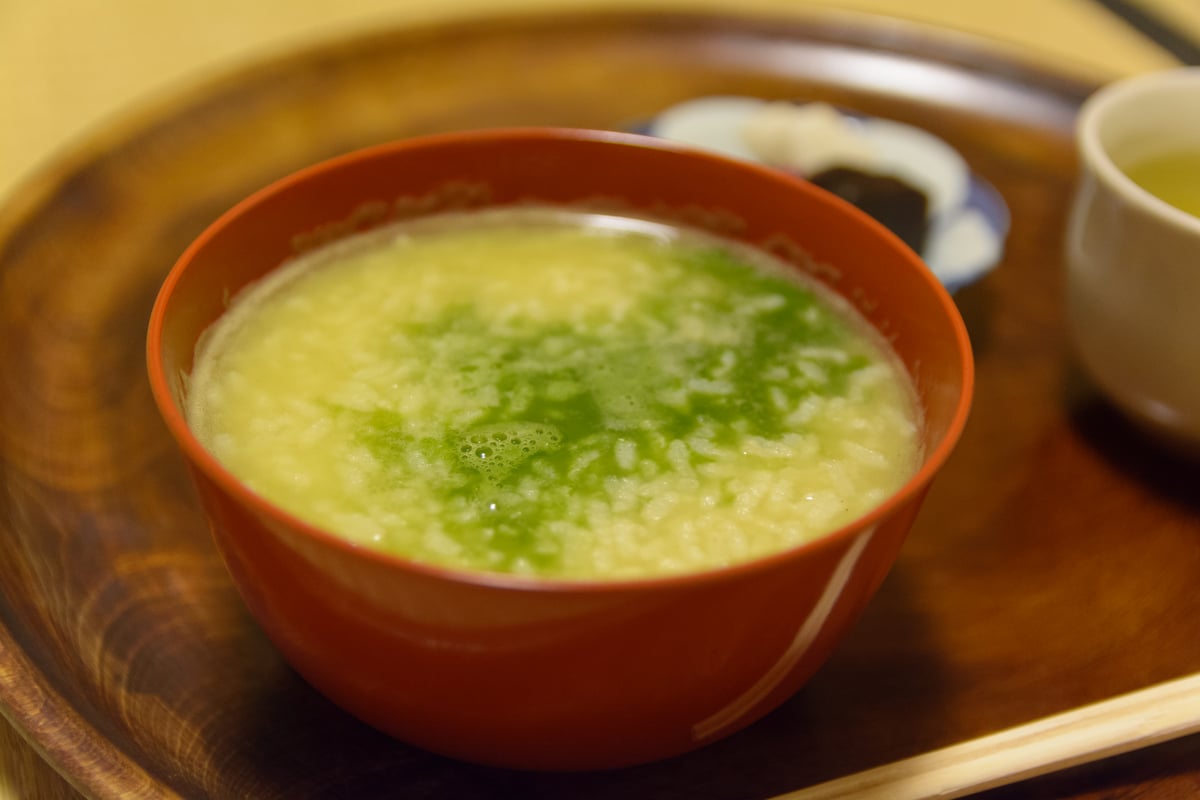
Image: Wikimedia Commons
Yamato Chagayu is a signature home-style dish of Nara made by cooking rice in tea — typically hojicha (roasted green tea) — brewed into a broth. It is so deeply rooted in daily life that people say 'a Yamato morning begins with chagayu.' Its origins are said to lie in temples such as Todai-ji and Kofuku-ji, where monks are believed to have eaten it between periods of ascetic practice, and it has a deep connection to the Shuni-e ritual at Todai-ji's Nigatsu-do hall, known for the Omizutori water-drawing ceremony. The tea is boiled in a cotton tea bag, and rice is added and cooked quickly over high heat until the grains open up like blossoms — a state called 'hana ga saku' ('the flowers bloom') that is considered ideal. Its light, thin texture, without the thickening seen in chagayu from other regions (often made with potato starch), is one of its defining features. It is also said to have spread as a way for monks and ordinary people to stretch their rice supply, and today this humble yet flavorful dish, deeply rooted in Nara's climate and culture, remains a beloved staple in homes and restaurants alike.
Origin
Yamato Chagayu is said to have originated in Nara temples such as Todai-ji and Kofuku-ji, where monks ate it between periods of ascetic practice. This temple food culture gradually spread to ordinary people's daily lives, and chagayu became so firmly established as an everyday dish in Nara that people came to say, 'a Yamato morning begins with chagayu.'
History
The origins of Yamato tea are said to trace back to 806, when the Buddhist monk Kukai brought tea seeds back from Tang China and planted them in Nara and Uda, introducing tea-making methods. Tea culture, closely tied to Buddhism, spread from there, centered on the temples. Chagayu is also closely connected to the Shuni-e ritual (Omizutori) at Todai-ji's Nigatsu-do hall, and Edo-period records note that Yamato farming families ate chagayu multiple times a day.
Features
The defining method is to brew tea such as hojicha in a cotton tea bag, then add rice and cook it quickly over high heat for about 10 to 15 minutes. It is finished when the grains open up in the 'hana ga saku' state, and unlike chagayu from other regions, no potato starch or other thickener is added, giving it a distinctly light, thin texture.
Food Culture
As the saying 'a Yamato morning begins with chagayu' suggests, this dish has long been a breakfast staple in Nara. Today, several restaurants around the Naramachi district still serve Yamato Chagayu to visitors.
Famous Shops
塔の茶屋
奈良県奈良市南城戸町18
Founded in 1963, a long-established restaurant near Kofuku-ji that has served chagayu for decades. Chagayu bento is 2,530 yen; chagayu kaiseki courses start at 5,500 yen (reservation required).