Image: Wikimedia Commons
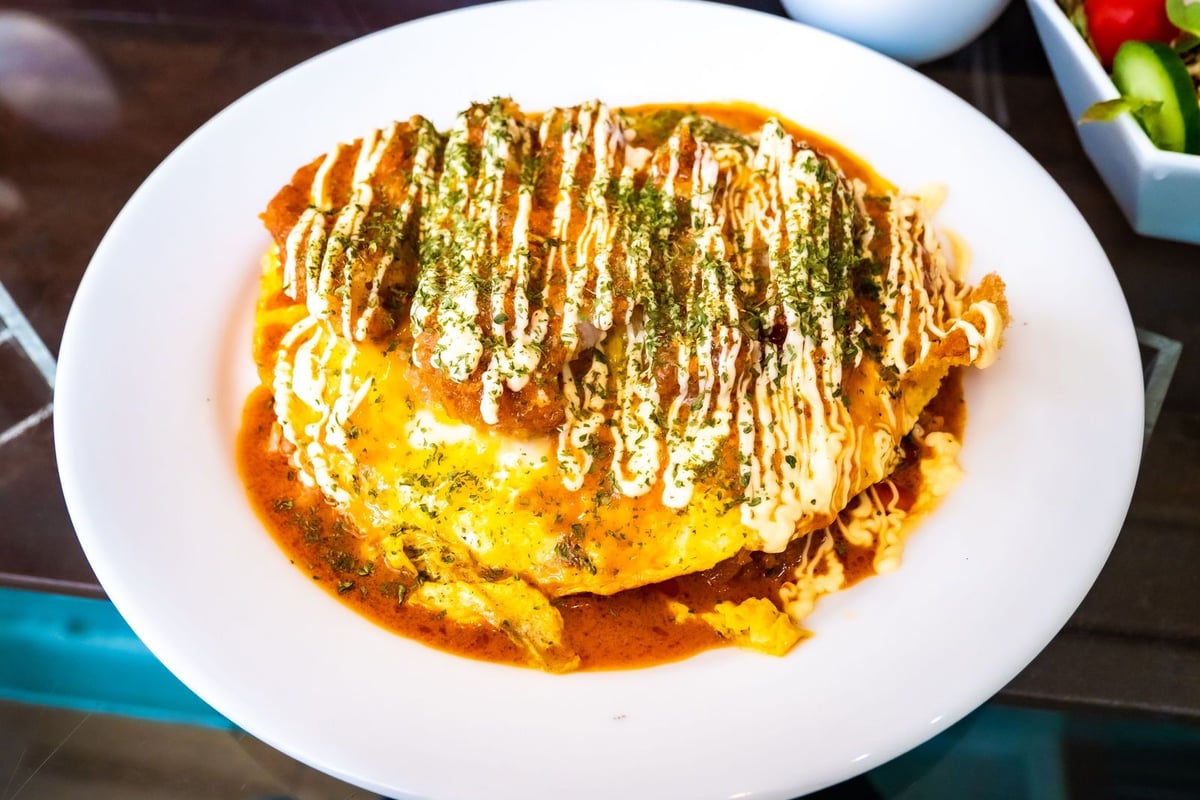
Volga Rice is a local specialty of Echizen City, Fukui Prefecture, consisting of omurice (omelet rice) topped with a tonkatsu (pork cutlet) and covered in sauce. It is said to have been enjoyed for more than 30 years in the Takefu district of Echizen City, which corresponds to the former Takefu City. Locally, it has been eaten not as a special dish but as an entirely ordinary Western-style meal (yoshoku). There is no set recipe, and a major characteristic is that the preparation and flavor differ from restaurant to restaurant. Besides ketchup rice, some restaurants use pilaf or fried rice for the rice inside. The cutlet also varies, from pork loin or fillet to minced meat cutlet (menchi katsu), and the sauces are just as distinctive, including demi-glace and tomato sauce. The origin of the name 'Volga' is unclear, and various theories are told. In 2010, Echizen City employees and others formed the 'Japan Volgaler Association' and have worked to promote the town. The number of restaurants serving it has grown from about five at first to more than 20, and it has also appeared in school lunches.
Origin
How Volga Rice originated is unclear. The leading candidates for its birthplace in Takefu are three restaurants: 'Cafe de Imari', 'Jam House', and 'Edoya'. There is also a theory that a dish created in the 1950s at a Western-style restaurant in Asakusa, Tokyo, was passed on to a coffee shop that opened in Takefu in 1986. As it was served at coffee shops and diners in Takefu, it spread as a local staple of Western-style cuisine.
History
Prompted by a newspaper article, three volunteers who were Echizen City employees formed the 'Japan Volgaler Association' in 2010. The association carried out promotional activities, such as commissioning a poster from Ikegami Ryoichi, a manga artist from the area. The number of restaurants serving it has grown from five at the time the association was founded to more than 20. Since around 2012 it has also been served in Echizen City school lunches, and related products such as sauce for Volga Rice have been created.
Features
The basic components are three: omurice, tonkatsu, and sauce. Because there is no set recipe, the combination of rice, cutlet, and sauce varies greatly from restaurant to restaurant. Some pair ketchup rice with a light tomato sauce, while others use a rich demi-glace sauce. A soba restaurant also serves a Japanese-style Volga Rice using dashimaki tamago (rolled omelet with dashi) and grilled chikuwa (tube-shaped fish cake).
Main Ingredients
Food Culture
In Echizen City, it is used in tourism promotion as a local specialty alongside Echizen Oroshi Soba and others. It has also appeared in school lunches and is enjoyed by people of all ages, from children to adults. Today it can be enjoyed not only in Echizen City but also at restaurants in various parts of the prefecture, including Fukui City, Awara City, and Ono City.
Famous Shops
ジャムハウス
福井県越前市芝原5-20-24
A Western-style restaurant said to be one of the places where the dish originated. It serves the classic version, pairing a lean pork loin cutlet with light ketchup rice, and Volga Rice costs from around 840 yen.
越前めん処 江戸屋
福井県越前市高瀬2-6-15
A soba restaurant cited as a leading candidate for the birthplace of the dish. It serves a Japanese-style plate using grilled chikuwa, Japanese-style dashimaki tamago, and a miso and sesame sauce, from around 1,000 yen. Sizes can be chosen from mini up to a five-person portion.
FAQ
Q. Where does the name 'Volga' come from?
A. It is not clearly known. Theories that have been introduced include that it derives from a Russian egg dish called 'Volga', that its appearance evokes a volcano, and that it is named after the Volga-Don Canal in Russia.