Utsubuki Koen Dango (Kurayoshi Three-Color Dumplings)
Utsubuki Koen Dango (Kurayoshi Three-Color Dumplings)
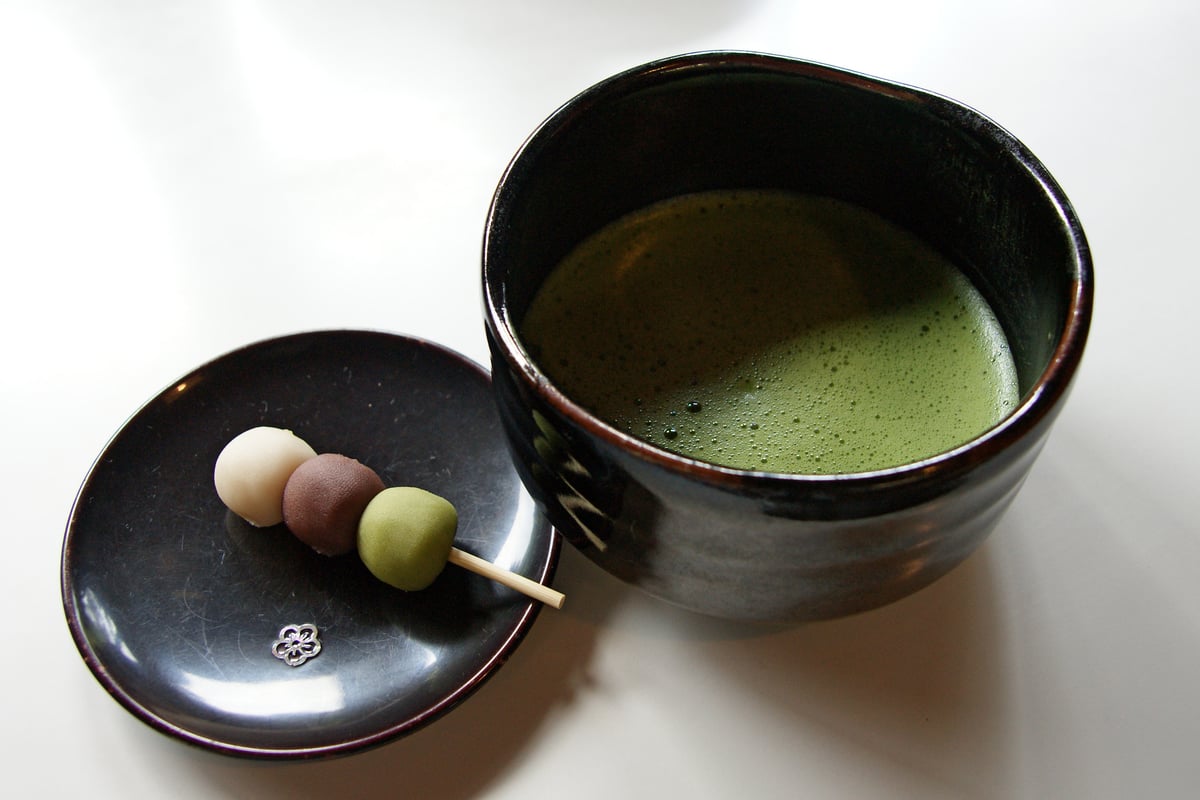
Image: Wikimedia Commons
Utsubuki Koen Dango are three-color skewered dumplings made by 石谷精華堂 (Ishitani Seikado) in Kurayoshi City, Tottori Prefecture. Small pieces of mochi are wrapped in three kinds of bean paste, white bean paste made from tebo (a type of white kidney bean), azuki bean paste, and matcha bean paste, and threaded onto skewers. Locally they are affectionately known as 'Koen Dango' (park dumplings), and they are one of Tottori's representative souvenir sweets. It is said that in Meiji 13 (1880), the founder, 石谷すま, began making them in connection with the story that Nawa Nagatoshi presented amacha (sweet tea) dango to Emperor Go-Daigo. Utsubuki Park, which gives the dango their name, is a park at the foot of Mount Utsubuki in Kurayoshi City and has been selected as one of Japan's 'Top 100 Cherry Blossom Spots.' They are made from local glutinous rice flour mixed with syrup, by repeating the process of kneading and steaming. The maker states that no additives have been used since its founding, and the use-by period is short, at about three days.
Origin
According to 石谷精華堂, the business was founded in Meiji 13 (1880). In Genko 3 (1333), Emperor Go-Daigo escaped from Oki, where the emperor had been exiled. There is a story that the local magnate Nawa Nagatoshi welcomed the emperor at Mount Senjo and presented amacha dango. The founder, 石谷すま, is said to have been inspired by this story to begin making dango. It is said that at first they were simple ankoro mochi, merely coated with bean paste.
History
In Meiji 40 (1907), the Crown Prince (later Emperor Taisho) made an official visit to the San'in region. 石谷精華堂 states that, prompted by the improvement of Utsubuki Park carried out in connection with this visit, it refined its dango through repeated ingenuity and completed the current three-color dango. Some sources date the current form to the mid-Meiji era. It is reported that in Showa 36 (1961) the dango received the Honorary Mukansa Award (an honorary award exempt from judging) at the 15th National Confectionery Exposition, and that in Showa 40 (1965) they were presented to Emperor Showa and Empress Kojun.
Features
Small dumplings are wrapped in three colors of bean paste, white bean paste made from tebo, azuki bean paste, and matcha bean paste, and threaded onto skewers. The mochi is made by adding syrup to local glutinous rice flour and kneading it, steaming and kneading it again, and then steaming it further over a long time. The combination of soft mochi and smooth bean paste is a distinctive feature. Because no additives such as preservatives are used, the use-by period is short, at about three days, making this a sweet to enjoy as soon as possible.
Main Ingredients
Food Culture
Locally they are called by the nickname 'Koen Dango' and are cherished as a famous confection representing the town of Kurayoshi. They are sold not only at the main store but also at shops in stations and airports in the prefecture, and have become a standard gift to bring when returning home or traveling.
Famous Shops
石谷精華堂 本店
鳥取県倉吉市幸町459-1
The maker of Utsubuki Koen Dango, founded in Meiji 13. The store has an attached café, and it is reported that ordering a drink comes with one skewer of Utsubuki Koen Dango, with additional skewers at about 120 yen each (January 2026 article). It is open every day of the year except New Year's Day.
View details →| 打吹公園だんご (Utsubuki Koen Dango) | Three-color dango with white bean paste, azuki bean paste, and matcha bean paste, available in packs of 5, 10, 20, and other sizes. At 石谷精華堂's online shop, a pack of 10 is about 1,296 yen and a pack of 5 about 681 yen. Because the use-by period is short, at about three days, it is best to eat them soon.Where to buy →PR |
|---|