Image: Wikimedia Commons
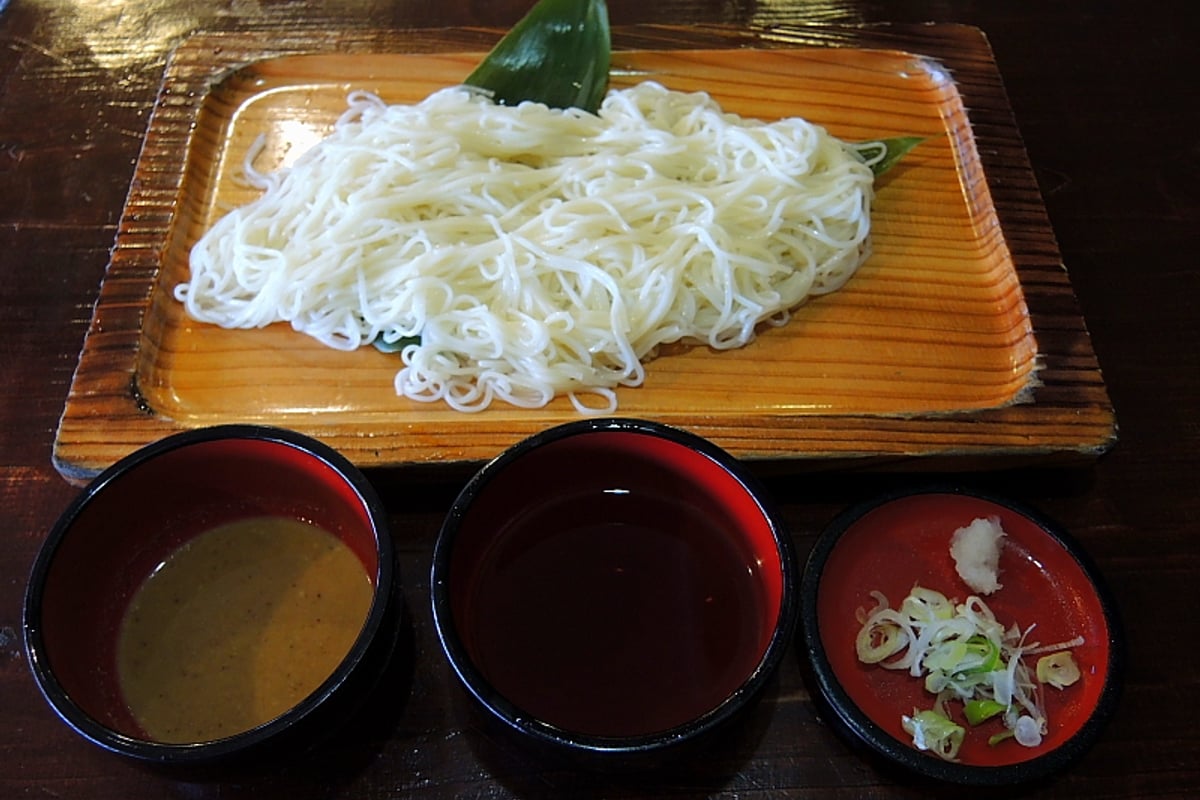
Shiroishi umen (oil-free noodles) is a type of thin wheat noodle that has been made around Shiroishi City, Miyagi Prefecture, since the early Edo period, roughly 400 years ago, distinguished by a manufacturing method that uses no oil at all. The most widely told origin story is one of filial devotion: Suzuki Asaemon, who lived in the castle town of Shiroishi, worried about his father, who was suffering from a stomach ailment and could barely eat. Having learned from a traveling monk of a way to make noodles without oil, he prepared them, warmed them, and fed them to his father, and it is said that his father's condition improved. When Katakura Kojuro, the lord of Shiroishi Castle, heard this story, he is said to have named the noodles 'unmen' (umen), meaning 'warm noodles,' in honor of Asaemon's devotion to his father, and to have allowed Asaemon to take the name 'Miemon.' Because no oil is used, the noodles are considered gentle on the stomach and easy to digest, and they are also cut somewhat shorter than ordinary somen, to about 9 cm. Passed down for more than 400 years as a local industry of Shiroishi, and designated as a production area by the National Federation of Dried Noodle Cooperative Associations, it is a dried noodle representative of Miyagi Prefecture.
Origin
In the early Edo period, Suzuki Asaemon, who lived in the castle town of Shiroishi, worried about his father, who had to fast for days on end due to a stomach ailment. It is said that Asaemon made noodles using an oil-free method he had learned from a traveling monk. After being warmed and fed to his father, his father's condition is said to have improved.
History
When Katakura Kojuro, the lord of Shiroishi Castle, heard the story of Asaemon's filial devotion, he is said to have named these noodles 'unmen' (umen, meaning 'warm noodles') in honor of his devotion to his father, and Asaemon was allowed to take the name 'Miemon.' Since then, it has been passed down for more than 400 years as a local industry of Shiroishi, and it is now designated as a production area by the National Federation of Dried Noodle Cooperative Associations.
Features
Because no oil is used in production, the noodles are considered gentle on the stomach and easy to digest; they are also said to be cut somewhat shorter than somen, to about 9 cm, out of consideration for their role as a recuperative food. Known for their light, smooth texture, they can be enjoyed either in a hot noodle soup or chilled and dipped in sauce. They are also a standard ingredient in 'okuzukake,' a local dish of southern Miyagi.
Main Ingredients
Food Culture
Long valued as an easily digestible noodle, it has also been treasured as food for the sick and as a gift for hospital visits. It remains a standard gift item and souvenir from Shiroishi City today, and it is an indispensable ingredient in 'okuzukake,' a local dish of southern Miyagi.
How It Differs from Home Cooking
At home, it is often eaten simply, as dried noodles boiled and combined with dipping sauce, whereas specialty shops take pride in their own hand-stretched noodles, offering a richer texture and smoother mouthfeel.
Famous Shops
はたけなか製麺
宮城県白石市大手町4-11
A long-established noodle maker founded in Meiji 23 (1890). Alongside Shiroishi Ichi umen, prices range widely from around 1,000 yen to over 5,000 yen.
View details →きちみ製麺(直営店 つりがね庵)
宮城県白石市本町46
A company specializing in Shiroishi umen, founded in Meiji 30 (1897). A set of 6 bundles of hand-stretched Shiroishi umen costs around 1,534 yen (tax included).
View details →FAQ
Q. Why is '温麺' read as 'umen'?
A. It is said that Suzuki Asaemon, worried about his father's stomach ailment, made noodles meant to be eaten warm, and that Katakura Kojuro, the lord of Shiroishi Castle, named them '温麺' (unmen) as a result. Locals have long read this as 'umen.'
Q. How is Shiroishi umen different from somen?
A. The biggest difference is whether oil is used in production. Ordinary somen is stretched with oil applied during drying, but Shiroishi umen is made using a method that uses no oil at all, so it is considered gentle on the stomach and easy to digest.