Image: Wikimedia Commons
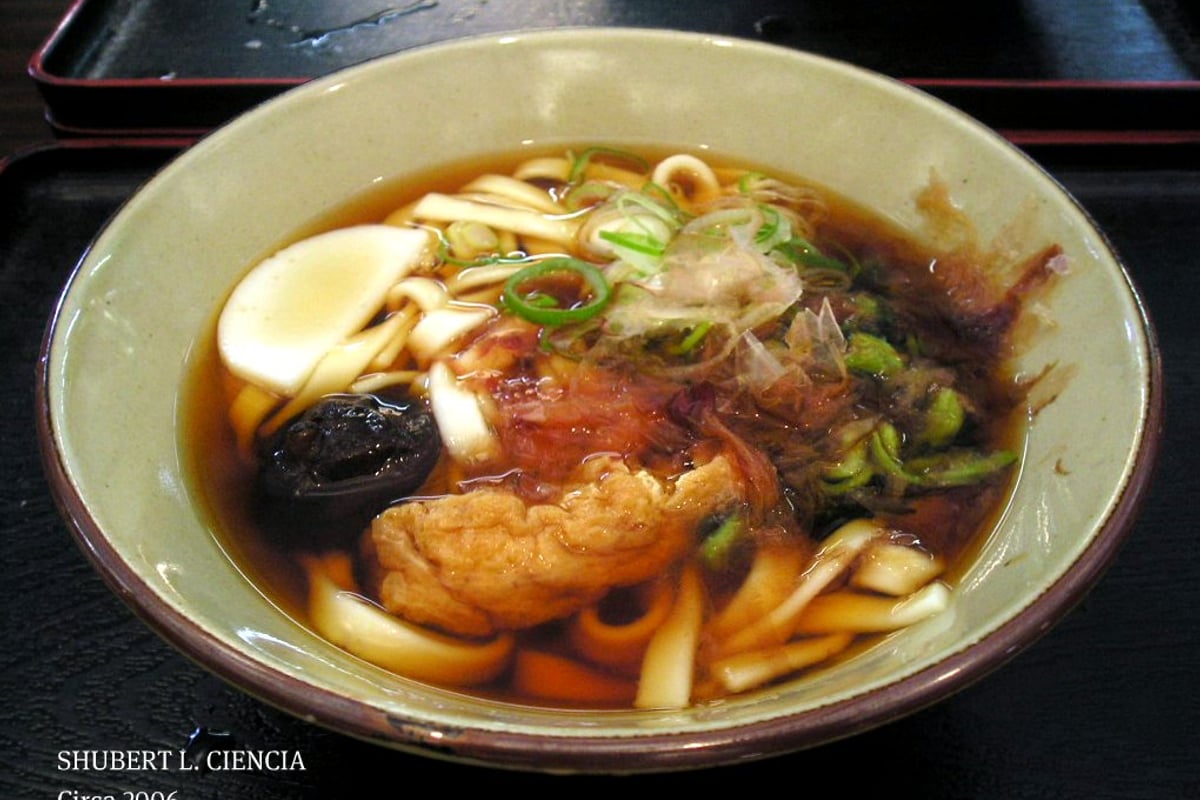
Kishimen is a Nagoya specialty of flat udon noodles, about 7-8mm wide and roughly 1mm thick, served in a soy-sauce-based broth flavored with bonito, topped with fried tofu, kamaboko fish cake, greens, and bonito flakes. A poem referencing kishimen already appears in the 1728 haiku collection Futae-bukuro, showing that it was enjoyed by ordinary people by at least the early 18th century. Several theories explain the origin of the name, including that it comes from kijimen, noodles shaped like go stones and eaten with roasted soybean flour, or from kijimen, a udon dish with pheasant meat once favored by the lords of Owari. Making the noodles flat is also said to have shortened boiling time and saved fuel, and kishimen is still widely served today at specialty shops around Nagoya Station and Atsuta Shrine.
Origin
The name kishimen appears in the haiku collection Futae-bukuro, published in 1728 (Kyoho 13), in a verse that reads roughly 'even hidden away, kishimen gives off its aroma' — suggesting the noodle dish was already well established among ordinary people by this time. Several theories are passed down about the origin of the name, including that it derives from kijimen, noodles shaped like go stones and coated with roasted soybean flour.
History
The Owari region had long been a major wheat-producing area, and flat noodles developed as an everyday food for ordinary people. Making the noodles thin and flat is said to have shortened boiling time and saved fuel, one reason the shape of kishimen became established. Today, specialty shops such as Miya Kishimen on the grounds of Atsuta Shrine and Kishimen-tei at Nagoya Station serve it as a local specialty.
Features
The noodles are flat, about 7-8mm wide and roughly 1mm thick, with a firm bite yet a smooth, slippery texture. The classic way to serve it is in a soy-sauce broth flavored with bonito, topped with fried tofu, kamaboko fish cake, greens such as komatsuna, and bonito flakes; it is offered in a wide range of settings, from station stand-and-eat counters to seating at specialty restaurants.
Main Ingredients
Food Culture
Around Nagoya Station and Atsuta Shrine, kishimen is served everywhere from stand-and-eat counters to specialty restaurants, and it has become a Nagoya specialty that worshippers and travelers alike can easily enjoy. It is also widely sold as dried noodles for souvenirs.
Famous Shops
宮きしめん 神宮店
愛知県名古屋市熱田区神宮一丁目1番1号(熱田神宮境内)
Founded in 1923. A beloved spot for worshippers on the grounds of Atsuta Shrine. Kishimen for around 750 yen.
View details →きしめん亭 エスカ店
愛知県名古屋市中村区椿町6-9 エスカ地下街
A specialty shop one minute's walk from Nagoya Station. Kakiage kishimen (with tempura fritter) for around 950 yen.
View details →FAQ
Q. What is the origin of the name kishimen?
A. There are several theories with no settled answer, including that it comes from kijimen, noodles shaped like go stones eaten with roasted soybean flour, or from kijimen, a udon dish with pheasant meat once favored by the lords of Owari.