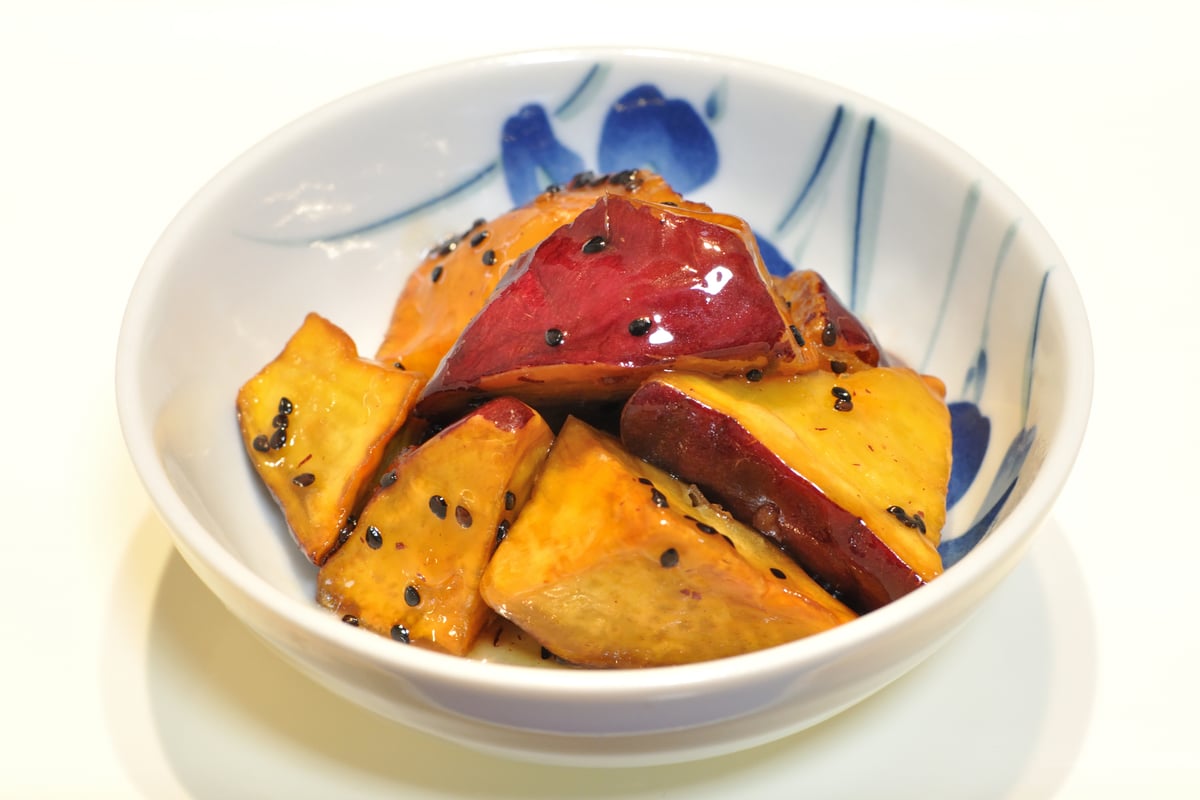
Image: Wikimedia Commons
Kawagoe imo ryori is a general term for daigaku-imo (candied sweet potato), dried sweet potato, and other sweet potato confections made using 'Kawagoe imo,' a sweet potato long cultivated around Kawagoe City in Saitama Prefecture. The Musashino Plateau where the Kawagoe domain was located is covered in Kanto loam, and cultivation that makes use of its well-drained soil and fallen-leaf compost has long been known to produce sweet potatoes with a strong sweetness and rich flavor. In the Edo period, the distance from Kawagoe to Nihonbashi in Edo was thirteen ri (about 52 km), and this became linked to a pun on 'kuri (chestnut) yori (than) umai (delicious)' -- nine ri plus four ri makes thirteen ri -- giving rise to the popular saying 'tastier than chestnuts, thirteen ri away,' which spread the fame of Kawagoe sweet potatoes. Today, Kashiya Yokocho, Kawagoe's iconic sightseeing spot, is lined with shops selling sweet potato confections centered on daigaku-imo, and Kawagoe imo remains beloved as one of Saitama's representative food cultures.
Origin
The Musashino Plateau where the Kawagoe domain was located is covered in Kanto loam, and applying fallen-leaf compost to its well-drained soil produced sweet potatoes with a strong sweetness. In the Edo period, because the distance from Kawagoe to Nihonbashi in Edo was thirteen ri (about 52 km), the witty phrase 'tastier than chestnuts (kuri, nine ri) plus four ri -- thirteen ri' became popular in Edo, spreading the fame of Kawagoe sweet potatoes.
History
Kashiya Yokocho originated in the Edo period, when a few confectioners near the gate of Yojuin Temple began making 'unpretentious dagashi to suit Edo tastes.' In the early Meiji era, the confectioner Tozaemon Suzuki opened 'Matsumotoya,' and the street of shops formed through subsequent branch shops set up by his apprentices. When the Great Kanto Earthquake of 1923 struck many dagashi wholesalers in Tokyo, disrupting supply, demand from the southern Kanto region rushed to Kawagoe, which had suffered comparatively little damage. This brought an unprecedented economic boom, and at its peak in the early Showa era, about 70 shops lined the street, making it a major production area.
Features
Daigaku-imo made with Kawagoe imo is characterized by its glaze of sweet syrup and a cooking method that brings out the flavor of the sweet potato itself. There are several theories about the origin of the name 'daigaku-imo' (literally 'university potato'), including one that it was first sold in the early Taisho era by an ice shop called 'Mikawaya' near the Akamon gate of Tokyo Imperial University and became popular among students and professors, and another that students selling it themselves to earn tuition money coined the name. In 1898, Ichi Yamada, a housewife in Harigaya, Kizaki Village on the Omiya Plateau, discovered a new, bright-red mutant variety, which was named 'Beniaka' and spread the fame of Kawagoe sweet potatoes nationwide. Centered on Kashiya Yokocho, a wide variety of sweet potato confections are made, including dried sweet potato, imo kenpi (fried sweet potato sticks), and sweet potato tarts.
Main Ingredients
Food Culture
Praised in Edo as 'tastier than chestnuts, thirteen ri away,' Kawagoe imo became popular, and sweet potato dishes and confections developed as a food culture tied to Kawagoe tourism. Kashiya Yokocho, with its nostalgic Showa-era streetscape, is a well-known spot bustling with tourists seeking sweet potato confections.
Famous Shops
A daigaku-imo specialty shop carrying on a tradition founded in 1926. A 200g serving of daigaku-imo starts at around 580 yen.