Image: Wikimedia Commons
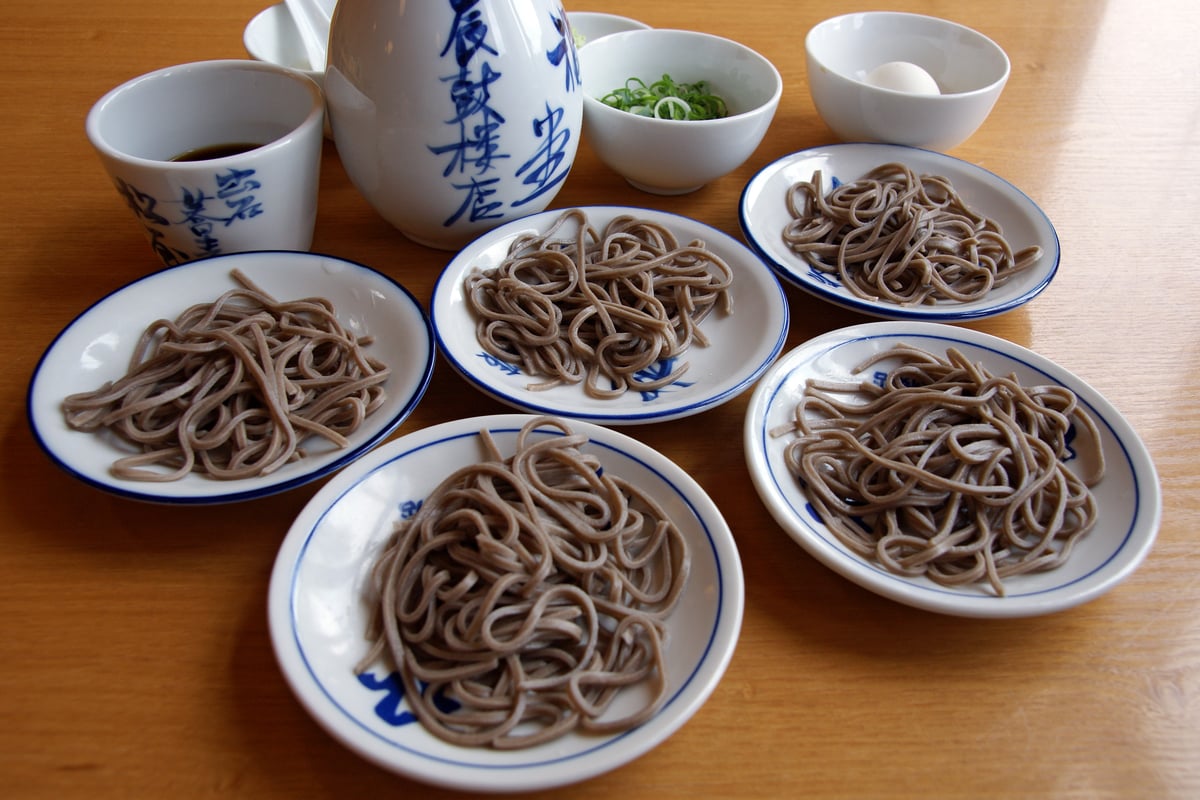
Izushi sara soba is soba served portioned onto small plates, a tradition of Izushi-cho in Toyooka City, Hyogo Prefecture. In the castle town of Izushi, boiled soba is served a little at a time on small plates of Izushi-yaki, a white porcelain. A standard serving is five plates, and diners can add as many more as they like, one plate at a time. It comes with dipping broth in a tokkuri (a small flask) and condiments such as green onion, wasabi, egg, and grated yam (tororo). It is said to have begun in 1706 (Hoei 3). According to tradition, the start came when the domain lord 仙石政明, transferred to Izushi from Ueda in Shinshu (present-day Ueda City, Nagano Prefecture), brought soba makers along. Serving it on small plates began around the end of the Edo period, and is said to have started with the use of small, shallow plates that were easy to carry at street stalls. Over more than 300 years, craftspeople have kept refining it, and today it is a specialty of Izushi, with about 40 shops in the town (as of 2021).
Origin
In 1706 (Hoei 3), 仙石政明, the lord of the Ueda Domain in Shinshu, was transferred to Izushi in an exchange with the Matsudaira family of the Izushi Domain. Bringing soba makers from Shinshu at this time is said to be the beginning of Izushi soba. Shinshu's soba-making techniques were handed down in Izushi and refined by craftspeople over more than 300 years. Some shops serve dark, aromatic soba made by grinding buckwheat seeds together with their hulls.
History
Around the end of the Edo period, serving soba on small, shallow teshio-zara plates, which were easy to carry when selling soba at street stalls, is said to be the beginning of 'sara soba' (plate soba). Later, small plates of locally fired white porcelain Izushi-yaki came to be used. The present form of sara soba is said to have been established in the Showa 30s (1955–1964). In 2008 (Heisei 20), the Izushi Sara Soba Cooperative was established, and it has worked on registering a Regional Collective Trademark and holding the 'New Soba Festival', among other activities.
Features
The basic style is to serve bite-sized portions of soba on small white plates of Izushi-yaki, five plates per serving. Locally it is also said that 'when the empty plates are stacked as high as a pair of chopsticks, that is one adult man's serving'. Diners pour the broth from the tokkuri into a soba choko (dipping cup) and first taste the soba with only the broth. Then they add condiments such as green onion, wasabi, grated yam, and egg, changing the flavor from plate to plate. Finally, they dilute the remaining broth with soba-yu (the water the soba was boiled in) and drink it. Another highlight is that the painted designs on the plates differ from shop to shop.
Main Ingredients
Food Culture
In Izushi, sara soba is eaten regardless of season, and some tourists visit the shops while strolling around the castle town. The Izushi Sara Soba Cooperative holds the 'New Soba Festival' every November. Every April, the 'Izushi Specialty Soba-Eating Contest' is held at the Izushi Castle ruins, where participants compete over the number of plates they eat.
How It Differs from Home Cooking
Ordinary zaru soba is served all together on a single seiro (bamboo-slatted tray), but Izushi sara soba is portioned out in small amounts on small plates. Using egg and grated yam as condiments and eating while changing the flavor from plate to plate are also unique to Izushi.
Famous Shops
近又
兵庫県豊岡市出石町本町99
A popular shop whose Kyoto machiya-style storefront conveys a sense of history. Its dark soba, made by grinding whole buckwheat seeds with a stone mill, is flavorful and very firm. The broth uses Rishiri kombu and saba-bushi (dried mackerel flakes), and the shop is also known for broth that does not easily become diluted as diners eat. It has also been listed in the Michelin Guide.
さらそば 甚兵衛
兵庫県豊岡市出石町小人14-16
An Izushi sara soba specialty shop where three generations of one family preserve the traditional flavor. Its guiding principle is 'san-tate': freshly milled, freshly made, and freshly boiled. It is a calm shop with a garden where nishikigoi (ornamental carp) swim, and it has been selected for the Michelin Guide's Bib Gourmand. It closes once the soba runs out.
FAQ
Q. Why is it served on small plates?
A. It is said to have begun around the end of the Edo period, when soba served at street stalls was placed on small, shallow teshio-zara plates that were convenient to carry. Later, the local pottery, white porcelain Izushi-yaki, came to be used. Dividing it into small portions lets diners enjoy freshly boiled soba a little at a time, and also gave rise to the pleasure of changing condiments with each plate.
Q. How many plates make one serving of Izushi sara soba?
A. Five plates is the standard serving, and diners can order more one plate at a time from there. Locally it is said that when the empty plates are stacked as high as a pair of chopsticks, that is one adult man's serving. Since the amount of soba differs by shop, finding the right amount for yourself by adding plates is part of the fun.