Image: Wikimedia Commons
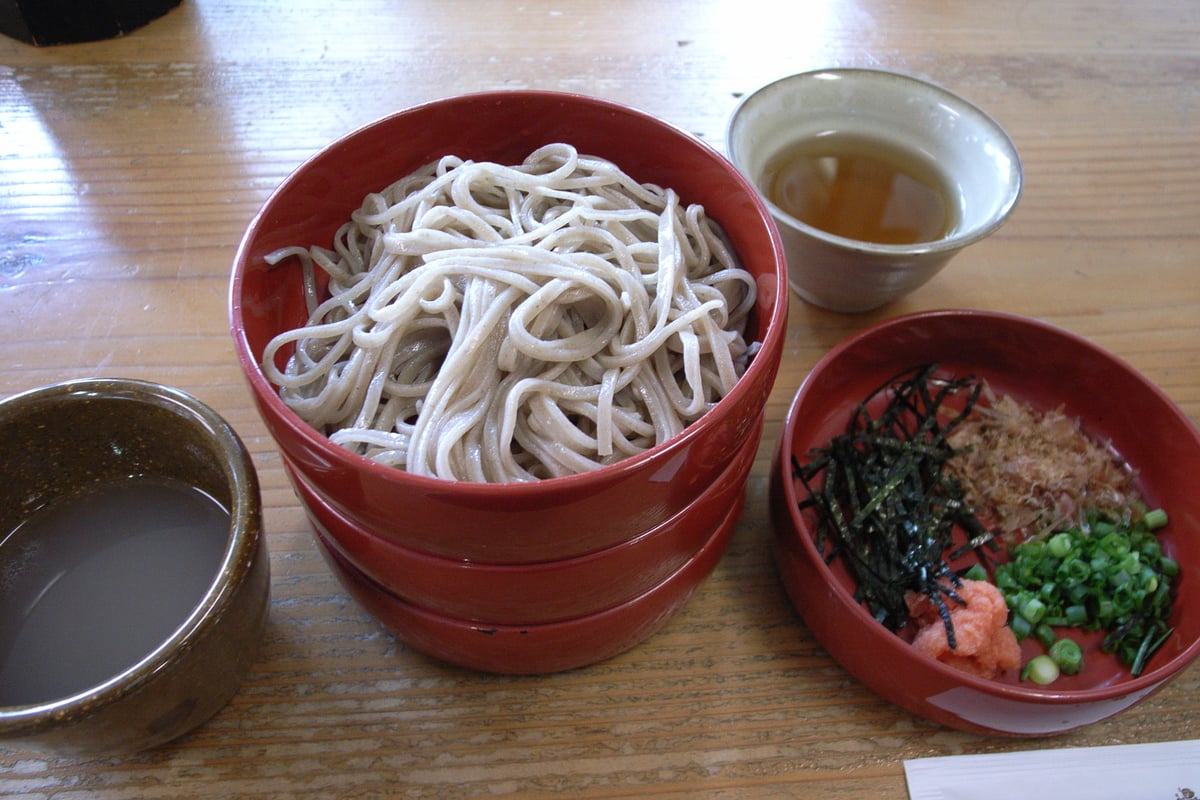
Wanko soba is a local dish of Morioka City and Hanamaki City, Iwate Prefecture, in which servers call out phrases like 'Hai, jan-jan!' while continuously refilling a bowl with bite-sized portions of soba (buckwheat noodles) until the guest places the lid on the bowl to signal they are finished. One widely known origin story tells that in the early Edo period, when the lord of the Nanbu domain, Nanbu Toshinao, stopped at Hanamaki Castle, it was considered discourteous to serve him from the same large bowl used by commoners, so the noodles were served in small portions in a lacquered bowl instead — and he enjoyed it so much that he asked for refill after refill. Part of the fun lies in the exchange with the server, as diners vary the flavor with a wide range of condiments such as green onion, nori seaweed, katsuobushi (dried bonito flakes), grated daikon radish, sashimi, and grated yam. Far from being a simple eating contest, it remains a beloved food culture among tourists today as an embodiment of Japanese hospitality.
Origin
There are several theories about the origin of wanko soba. The best known tells that in the early Edo period, when the lord of the Nanbu domain, Nanbu Toshinao, visited Hanamaki Castle, it was considered discourteous to serve him from the same large bowl used by commoners, so the noodles were served in small, bite-sized portions in a lacquered bowl instead — and he enjoyed it so much that he asked for refill after refill. The name 'wanko soba' is said to come from the Iwate dialect word 'owanko,' meaning 'little bowl.'
History
According to another theory pointing to Morioka as the origin, statesman Hara Takashi is said to have served 'wanko soba' with condiments to entertain townspeople at a celebration of his mother's 88th birthday. It is also said that around 1947–1948, after the war, Saito Ichitaro, a native of Hanamaki, opened a restaurant called 'Wankoya' in Morioka and registered it as a trademark. With multiple origin stories overlapping, the dish became established as a local specialty, and in 2021 it was certified as one of the Agency for Cultural Affairs' '100-Year Foods.'
Features
The defining feature is its distinctive style: servers keep refilling the bowl with soba while calling out 'Jan-jan!' or 'Don-don!', and the refills continue until the guest places the lid on the bowl. Since each serving is just a single bite, diners can keep eating without growing tired of it by alternating among a wide range of condiments — green onion, nori, katsuobushi, grated daikon, sashimi, grated yam, and tempura. At some restaurants, guests who finish more than 100 bowls receive a commemorative certificate.
Main Ingredients
Food Culture
The exchange with servers, who keep guests entertained rather than letting the meal grow tedious, is itself at the core of this food culture — it developed not as a simple eating competition but as an occasion to enjoy hospitality and conversation. In recent years, it has also become a popular experience-style menu for tourists.
How It Differs from Home Cooking
While soba eaten at home is typically served as a single portion in a regular bowl, wanko soba differs greatly in that it is served bite by bite in small bowls, with servers continuously refilling them — a style that developed as something unique to specialty restaurants.
Famous Shops
東家(あずまや)本店
岩手県盛岡市中ノ橋通1-8-3
Founded in Meiji 40 (1907). Wanko soba starts at 2,920 yen with 7 condiments and 3,460 yen with 9 condiments (tax included). Guests who finish 100 bowls receive a certificate.
View details →やぶ屋 花巻総本店
岩手県花巻市吹張町7-17
Founded in Taisho 12 (1923), a long-established restaurant said to have been a favorite of writer Miyazawa Kenji. Wanko soba costs 3,980 yen (tax included).
View details →FAQ
Q. Does 'wanko' refer to a dog?
A. No, it has nothing to do with dogs. The name comes from the Iwate dialect word 'owanko,' meaning a small bowl. Because the dish is served in these small bowls, it came to be called 'wanko soba.'