Honnoji Manju (Sake Bun Branded with the Character Hon)
Honnoji Manju (Sake Bun Branded with the Character Hon)
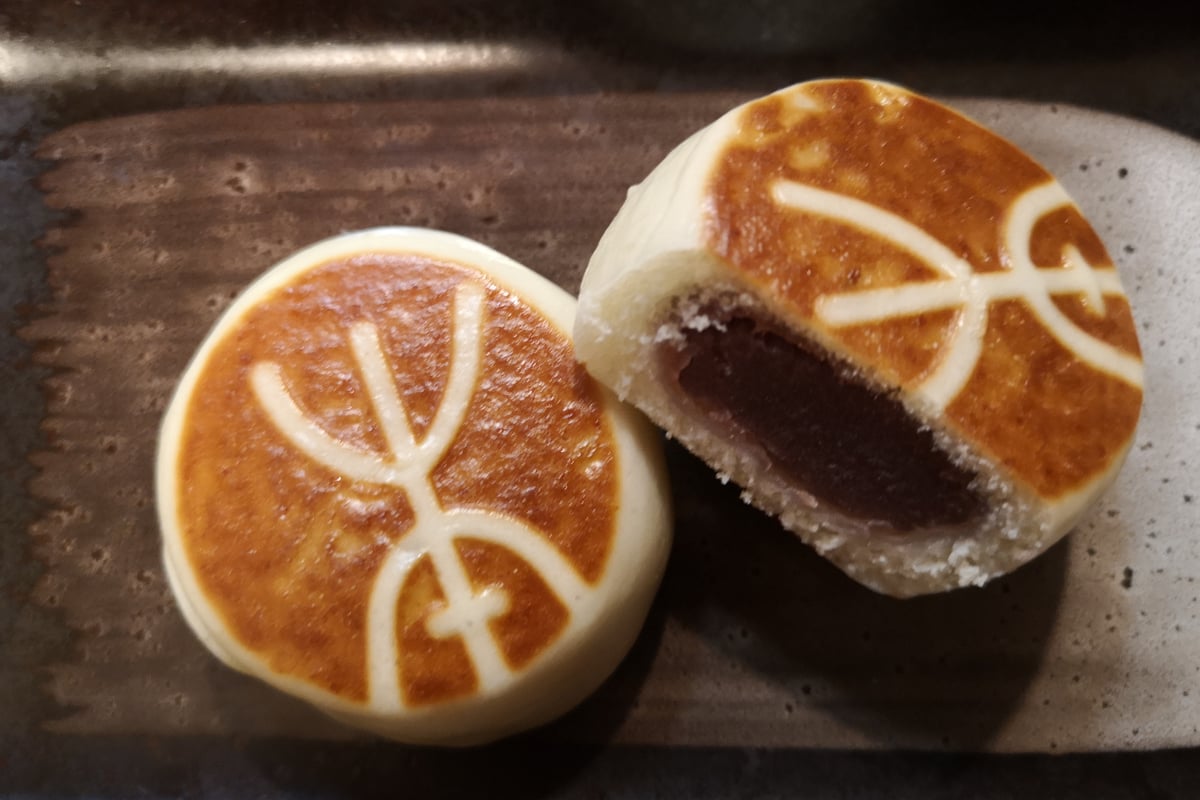
Image: Wikimedia Commons
Honnoji manju is a sakamanju (sake-leavened bun) made by 総本家駿河屋, a long-established wagashi (Japanese confectionery) shop in Wakayama City. Smooth koshi-an (strained red bean paste) is wrapped in dough fermented with rice koji and steamed, and the surface is stamped with a branded mark (yakiin) of the character 本 (hon) in seal script (tenshotai). It is characterized by a faint aroma of sake and the gentle sweetness of the koshi-an. 駿河屋 is said to have been founded as '鶴屋' in Fushimi, Kyoto, in 1461 (Kansho 2), during the Muromachi period. It later followed Tokugawa Yorinobu, founder of the Kishu Tokugawa family, to Wakayama and became confectioner by appointment to the Kishu Tokugawa family. The most widely accepted theory is that the character 本 comes from the teaching 'Make honesty your foundation (moto),' which the Kishu Domain preached to its people. During the Edo period, successive lords of the Kishu Domain are said to have taken the buns with them to Edo during sankin-kotai (alternate attendance). Made over about four days from fermentation to steaming, it is one of Wakayama's representative confections.
Origin
駿河屋 is said to have begun in 1461 (Kansho 2), when its first head, 岡本善右衛門, opened a manju shop under the name '鶴屋' in Fushimi, Kyoto. Tokugawa Yorinobu, founder of the Kishu Tokugawa family, is said to have loved 鶴屋's confections as a child in Fushimi. When Yorinobu moved from Suruga to Kii, 鶴屋 followed, and in 1619 (Genna 5) it was granted a residence in 駿河町 in Wakayama and opened a shop there. Honnoji manju is regarded as a product that carries on the methods used since the shop's founding.
History
In 1685 (Jokyo 2), when Tsuruhime (鶴姫), daughter of Shogun Tokugawa Tsunayoshi, was to marry into the Kishu Tokugawa family, the shop changed its name to '駿河屋' out of deference to Tsuruhime's name. Successive lords of the Kishu Domain are said to have taken Honnoji manju with them to Edo during sankin-kotai. In 2014 (Heisei 26), 駿河屋 filed for proceedings under the Civil Rehabilitation Act and temporarily closed. Afterward, under a new company, it reopened its stores one after another from 2015 (Heisei 27) and continues to carry on its traditional flavor.
Features
A distinctive feature is that glutinous rice makes up about one-third of the dough, which is fermented naturally with rice koji. The dough, fermented in a barrel since the previous day, is kneaded, wrapped around koshi-an, and left to rest, then fermented again in a hoiro (a device that applies heat to promote fermentation). After being steamed in a seiro (bamboo steamer), each bun is finished with a branded mark of the character 本. Because natural yeast is used, the number of buns produced is said to vary depending on how the fermentation goes that day.
Main Ingredients
Food Culture
In Wakayama, the faint aroma of sake and the sweetness of the koshi-an are cherished as a somehow nostalgic taste of home. 総本家駿河屋 has stores in various parts of the prefecture, centered on Wakayama City, and also has a shop in Fushimi, Kyoto, where it was founded.
Famous Shops
総本家駿河屋善右衛門 駿河町本舗
和歌山県和歌山市駿河町12
The main store in 駿河町, where the shop is said to have been granted a residence by the Kishu Tokugawa family in 1619 (Genna 5). In addition to Honnoji manju, it sells wagashi such as neri-yokan (firm red bean jelly), said to have been devised by the fifth-generation head. It is open from 9:00 to 18:00.
総本家駿河屋善右衛門 本社工場小倉店
和歌山県和歌山市小倉25
A store attached to the head office factory where Honnoji manju and other confections are made. Honnoji manju is said to take about four days to complete, going through fermentation and a second fermentation. Because natural yeast is used, the number made varies from day to day, and you can buy this labor-intensive confection at this store near the factory.
| 総本家駿河屋 'Honnoji Manju' | The signature confection of 総本家駿河屋, in which the aroma of sake and the sweetness of koshi-an are in harmony. It can be purchased at stores throughout the prefecture, such as 駿河町本舗 in Wakayama City and 近鉄和歌山店. If the skin becomes a little hard, warming it in a microwave is said to bring out the sake aroma. |
|---|
FAQ
Q. Why is it stamped with the character 本 (hon)?
A. The most widely accepted theory is that the character 本 was taken from 'Make honesty your foundation (moto),' part of the teachings the Kishu Domain preached to its people. It is also explained as coming from the words of the 'Fubojo,' in which Tokugawa Yorinobu set out the principles for governing the domain. There are various theories about its origin.