 1 / 2
Image: Wikimedia Commons
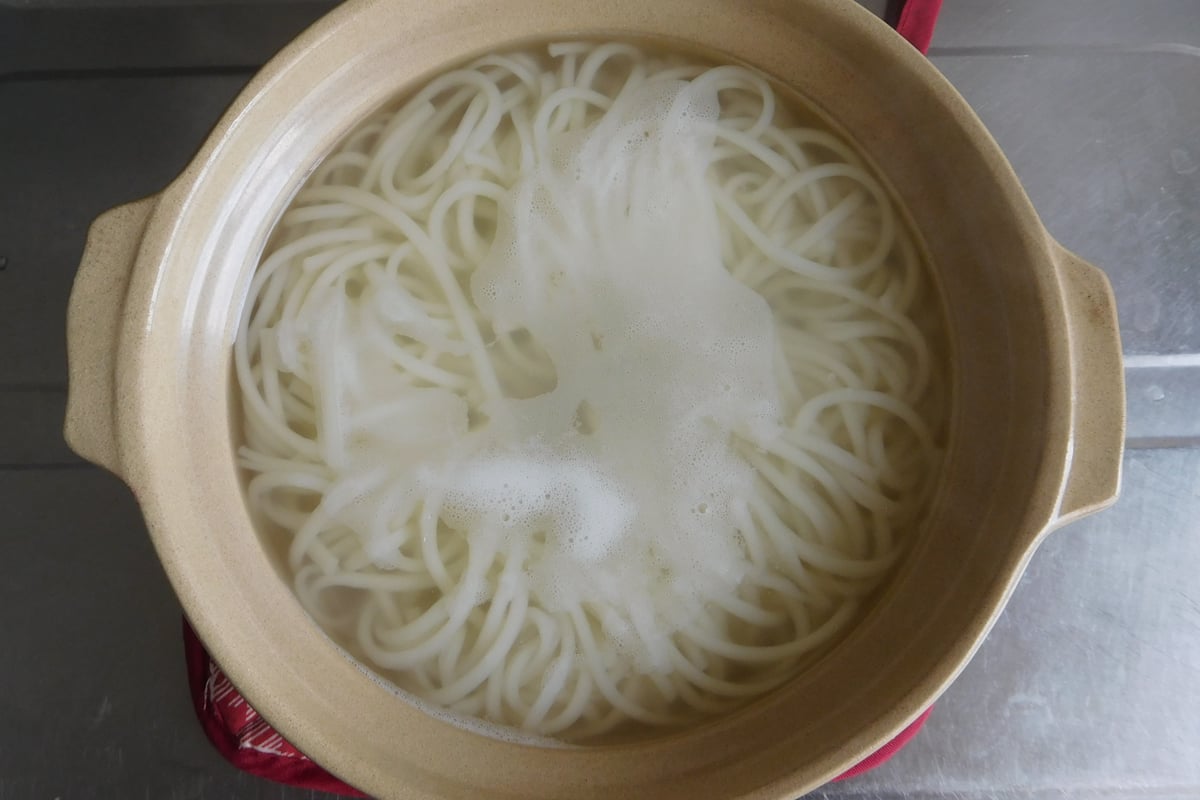
Goto udon is a hand-stretched dried udon made in the Goto Islands, which lie in the sea west of Nagasaki Prefecture. The main production area is Shinkamigoto Town in Kamigoto. Its most distinctive feature is that camellia oil, a specialty of the islands, is applied to the dough as it is stretched. The boiled noodles are thin and round, and are said to be prized for their firm, chewy texture and smooth slurp. The standard local way of eating them is 'jigokudaki'. Udon boiled vigorously in a large pot is scooped directly out of the pot and eaten dipped in 'ago dashi' (flying fish broth) or coated in egg. As for its origin, a legend that it was brought by envoys to Tang China (kentoshi) who called at Goto is well known. In fiscal 2024 (Reiwa 6), it was certified as a '100-Year Food' by the Agency for Cultural Affairs. It is sometimes counted, along with Sanuki udon and Inaniwa udon, as one of Japan's Three Great Udon.
Origin
Goto was once a port of call for the ships of the envoys to Tang China. For this reason, it is said that envoys who had learned many things in Tang China brought the prototype of udon. The Ministry of Agriculture, Forestry and Fisheries and the Agency for Cultural Affairs also introduce this theory, but there are no historical documents to support it, and it seems best to regard it as a legend. Camellias grow wild on Goto, and the oil pressed from them has been used both in noodle making and in cooking.
History
Goto has many noodle factories, and udon has been enjoyed not only as home cooking but also as a festive dish eaten by many people gathered around a pot. According to the Ministry of Agriculture, Forestry and Fisheries, about 80 percent of the noodles produced are now shipped off the islands. The Nagasaki Prefecture Goto Hand-Stretched Udon Promotion Council, formed by local noodle factories, works to improve quality and brand strength. In fiscal 2024, the Goto udon of Shinkamigoto Town was selected as a '100-Year Food', a program in which the Agency for Cultural Affairs certifies food cultures that have been handed down in their regions.
Features
The basic ingredients are wheat flour, salt and camellia oil. Camellia oil is applied to dough kneaded with salt water, and it is stretched thin while being twisted. Resting (maturing) and stretching are repeated many times, and finally the noodles are hung up to dry. Repeated maturing and drying make noodles that are firm and hard to break even though they are thin. Because the surface is coated with camellia oil, they are said not to go soggy easily even when boiled. This property makes them well suited to jigokudaki, in which they are eaten straight from a boiling pot.
Main Ingredients
Food Culture
Jigokudaki is the standard Goto way of eating udon: dried noodles are boiled vigorously in an iron pot and scooped directly out of the pot to eat. The basic dipping broth is ago dashi made from flying fish. There is also a way of eating them coated in beaten egg mixed with green onions, katsuobushi and soy sauce. Because the noodles are hard to pick up with chopsticks, a dedicated 'udon sukui-bo' (udon scooping stick) is used.
Famous Shops
うどん茶屋 遊麺三昧(五島うどんの里)
長崎県南松浦郡新上五島町有川郷428-31
The dining spot of 'Goto Udon no Sato', which houses a tourist information center and a local specialty shop. Its popular jigokudaki udon can be enjoyed with two kinds of dipping sauce: ago dashi and raw egg. A travel guide lists it at 880 yen. It is open for lunch only and closes irregularly. Prices are subject to change.
View details →竹酔亭
長崎県南松浦郡新上五島町七目郷56-1
A Goto udon restaurant run directly by a noodle factory. Its jigokudaki is eaten with two kinds of dipping sauce: ago dashi and egg with soy sauce. A 2024 travel magazine lists the jigokudaki set with two pieces of inari-zushi at 1,000 yen. It also has an attached shop selling udon to take home and udon scooping sticks. Prices are subject to change.
View details →| Goto Hand-Stretched Udon by ますだ製麺 | Goto hand-stretched udon made by a noodle factory in Shinkamigoto Town. Products include 'Shima Otome', thin noodles made with domestic wheat, and sets that combine noodles with dipping sauce for jigokudaki and an udon scooper. All are offered as return gifts for Shinkamigoto Town's furusato nozei (hometown tax donation) program.Where to buy →PR |
|---|
FAQ
Q. Was Goto udon really brought by envoys to Tang China?
A. There is no reliable record, and it is regarded as a legend. There is also a theory that its root is suomian (索麺), noodles with a very similar production method handed down in Yongjia County, Zhejiang Province, China. In addition, there are theories that it was learned from prisoners taken during the Mongol invasions and that it was learned from mainland Japan in the Edo period, and the time and circumstances of its introduction have not been settled.
Q. Where does the name 'jigokudaki' come from?
A. No clear origin has been handed down. A well-known theory is that it was named because the iron pot boiling and bubbling looks like a cauldron of hell (jigoku). The name may sound a little frightening, but it is a lively dish in which everyone gathers around a large pot and shares freshly boiled udon.
Q. Is Goto udon one of 'Japan's Three Great Udon'?
A. It is sometimes counted, along with Sanuki udon and Inaniwa udon, as one of Japan's Three Great Udon. However, this is not officially defined. In some cases Mizusawa udon of Gunma Prefecture is listed instead of Goto udon, and the way of counting them is not fixed.