Image: Wikimedia Commons
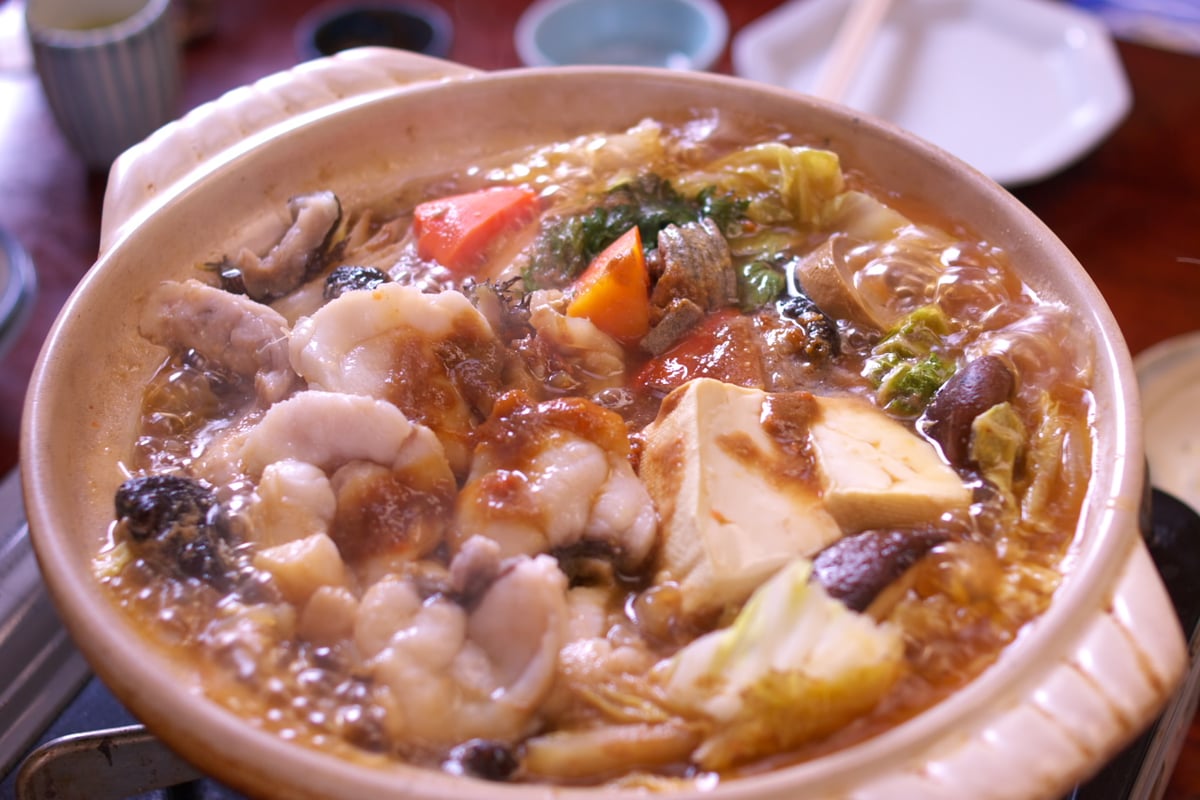
Anko Nabe is a hot pot dish centered on monkfish landed at fishing ports such as Oarai Town, Hirakata and Otsu in Kitaibaraki City, and Nakaminato in Hitachinaka City, and it is a representative winter hot pot of Ibaraki Prefecture. In the Edo period, monkfish was a prized delicacy, ranked among the five great delicacies known as 'san-cho ni-gyo' (three birds, two fish) alongside crane, skylark, moorhen, and sea bream, and records remain showing that it was presented as tribute from the Mito Tokugawa family to the shogunate. Almost nothing of the monkfish goes to waste except the bones, and the dish makes full use of what are known as the 'seven tools of the monkfish' — nuno (ovaries), gills, tomo (fins), suibukuro (stomach), liver, yanagi-niku (flesh), and skin. Said to have originated from dobu-jiru, a stew fishermen made on board their boats without using fresh water, the dish today features flesh and organs simmered in a rich miso-based broth enriched with dissolved monkfish liver, and it is cherished as a signature winter hospitality dish of Ibaraki.
Origin
In the Edo period, monkfish was a prized delicacy, counted among the five great delicacies known as 'san-cho ni-gyo' (three birds, two fish) alongside crane, skylark, moorhen, and sea bream. Records remain showing that monkfish was presented as tribute from the Mito Tokugawa family, rulers of the Mito Domain, to the shogunate, and Ibaraki's monkfish is said to have long been treated as a valuable tribute item and delicacy.
History
At fishing ports with thriving monkfish fisheries, such as Hirakata, Otsu, Kuji, and Nakaminato, fishermen have long eaten dobu-jiru, a stew prepared on board between hauls. Made using the monkfish's own moisture rather than the fresh water that was precious at sea, this cooking method is still passed down at a few shops today and is considered a nearly legendary local dish. This fishermen's dish is said to be the origin of the Anko Nabe now served in Oarai and Kitaibaraki.
Features
Almost nothing of the monkfish goes to waste except the bones, and the dish makes full use of the 'seven tools of the monkfish' — nuno (ovaries), gills, tomo (fins), suibukuro (stomach), liver, yanagi-niku (flesh), and skin — as ingredients for the pot. The especially prized version is a rich, dobu-jiru-style hot pot in which monkfish liver is dissolved into the broth, simmered together with napa cabbage, shungiku (garland chrysanthemum), tofu, and other ingredients in a miso-based broth.
Main Ingredients
Food Culture
During the peak season from around November to March, inns and restaurants in Oarai Town and Kitaibaraki City serve Anko Nabe and dobu-jiru hot pot as a winter delicacy to entertain visitors, and the dish has been selected among the Ministry of Agriculture, Forestry and Fisheries' (MAFF) '100 Local Dishes of Rural, Mountain, and Fishing Villages.'
How It Differs from Home Cooking
At home, hard-to-obtain parts such as the liver are often omitted, resulting in a simpler hot pot made with a miso- or soy-sauce-based broth, whereas specialty restaurants take the time to prepare all seven parts of the monkfish separately and serve a rich dobu-jiru-style pot with liver dissolved into the broth.
Famous Shops
水戸 山翠
茨城県水戸市泉町2-2-40
A long-established restaurant known for its 'original Anko Nabe.' The winter-only original Anko Nabe is priced at around 4,100 yen (tax included).
View details →味処 大森
茨城県東茨城郡大洗町磯浜町3152-1
A local restaurant near the fishing port in Oarai. Anko Nabe (October-March) is priced at around 3,500 yen, and dobu-jiru nabe (reservation required) at around 4,200 yen.
View details →FAQ
Q. What is the difference between Anko Nabe and dobu-jiru?
A. Dobu-jiru is a rich hot pot in which monkfish liver is dissolved into the broth, made with little to no fresh water; it originated as a dish fishermen prepared on board their boats. Standard Anko Nabe is a more easily prepared style of hot pot, using a miso- or soy-sauce-based broth to simmer the flesh and vegetables, suited to home cooking and restaurant service.