Image: Wikimedia Commons
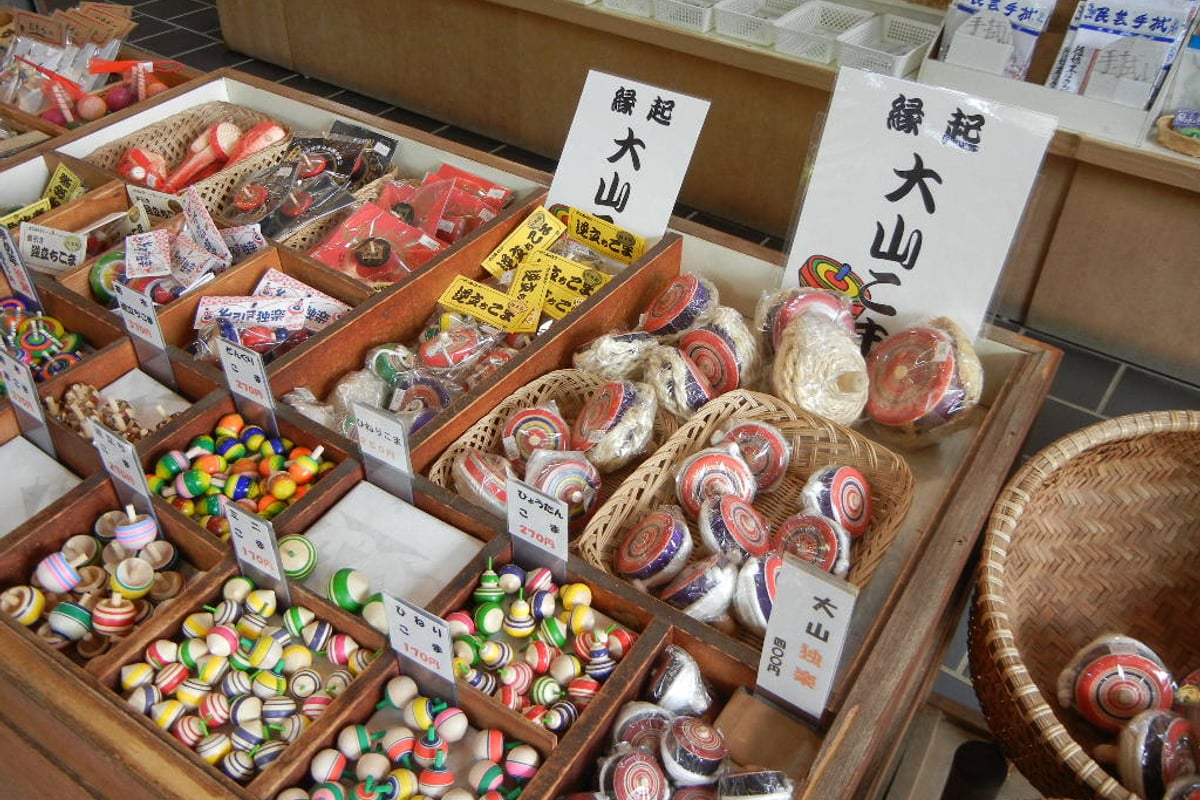
Oyama-koma are wooden spinning tops passed down at the foot of Mt. Oyama in Isehara City, Kanagawa Prefecture, which developed as souvenirs of the 'Oyama pilgrimage' that flourished in the mid-Edo period. Local mizuki wood is turned on a lathe by woodturners and finished in a plain wood base painted in bold bands of vermilion, indigo, and purple that blend together as the top spins. Their thick, long axle and rounded, substantial shape are designed, through a construction in which a separate piece of hard wood is inserted into the axle, to withstand use as 'fighting tops' knocked hard against one another, and because they 'spin well,' they have long been cherished as lucky charms believed to bring good fortune and business prosperity. Many woodturners and top shops once lined the pilgrimage approach, giving rise to the street's name 'Koma-sando' (Top Approach), but as lifestyles changed the number of makers declined, and today only a few shops along the approach carry the tradition forward. In 2023, 'the techniques for making Oyama-koma' were selected as a national Intangible Folk Cultural Property requiring documentation.
Origin
The origins of Oyama-koma trace back to the mid-Edo period. As the 'Oyama pilgrimage' to the sacred mountain of Oyama grew popular among ordinary people, woodturners along the pilgrimage approach began selling lathe-turned spinning tops as souvenirs. Many top shops and woodturners' shops lined the approach, which is also the origin of the name 'Koma-sando,' the street that later leads to the cable car station. For nearly 300 years since, Oyama-koma have continued to be made as a signature souvenir of the Oyama pilgrimage.
History
At its peak, around 1955, some twenty-odd woodturners are said to have made tops across about thirty workshops. However, demand declined as toys diversified and lifestyles changed, and the number of woodturners gradually fell. In recent years, while a shortage of successors has become an issue, efforts to pass on the traditional techniques have continued, and in January 2023, following a report from the Council for Cultural Affairs, 'the techniques for making Oyama-koma' were selected as a national Intangible Folk Cultural Property requiring documentation.
Features
Oyama-koma are made from mizuki wood and are characterized by a thick, long axle and a rounded, substantial shape. The axle is made by inserting a separate piece of hard wood into the body, giving it a structure resistant to breaking even when used as a 'fighting top' knocked forcefully against others. The plain wood body is painted in bands of vermilion, indigo, and purple, and because the three colors blend beautifully as the top spins, it is considered a symbol that 'spins well' means 'good fortune,' cherished as a lucky charm for household safety and business prosperity. Boring the hole for the axle — a step called 'shin-biki' — is considered the most difficult process, done entirely by a woodturner's experience and instinct, without using a ruler.
Materials Used
Production Process
- 1
Drying
Freshly cut mizuki wood is dried for about a year until it reaches a condition suited to woodturning.
- 2
Rough turning
The wood is set on a lathe and roughly shaved into a cylindrical shape.
- 3
Shin-biki (core boring)
The most critical process, in which a hole for the axle is bored while the wood spins. If the hole is not straight, the top will not spin properly, so it is done entirely by the woodturner's experience and instinct, without a ruler.
- 4
Coloring
The plain wood body is painted in bands of vermilion, indigo, and purple.
- 5
Finishing
The surface is polished with wax to bring out its shine, completing the top.
| Main Production Areas |
|
|---|
How to Buy
- 金子屋支店
- A souvenir shop located along 'Koma-sando,' the approach leading to the Oyama cable car station. It mainly carries Oyama-koma made by an Isehara City-designated holder of cultural property techniques, along with original items such as the 'Hyotan kara Koma' portable top strap.Where to buy →PR
Hands-on Experiences
金子屋支店(ひねりこま絵つけ体験)
神奈川県伊勢原市大山585
Offers a hand-spun top painting experience where visitors can create their own original design. Sold only in-store, with no mail order available; holders of the Tanzawa-Oyama Free Pass receive a 5% discount on all items.
View details →FAQ
Q. Why are Oyama-koma considered lucky charms?
A. Because a top that 'spins well' is associated with things going smoothly, such as good fortune and business prosperity, pilgrims visiting Oyama came to buy them as lucky charms for household safety and business success.
Q. Where can I buy Oyama-koma?
A. They can be bought at souvenir shops along 'Koma-sando,' the approach leading to the Oyama cable car station. Pieces made by an Isehara City-designated holder of cultural property techniques are also sold in stores there.