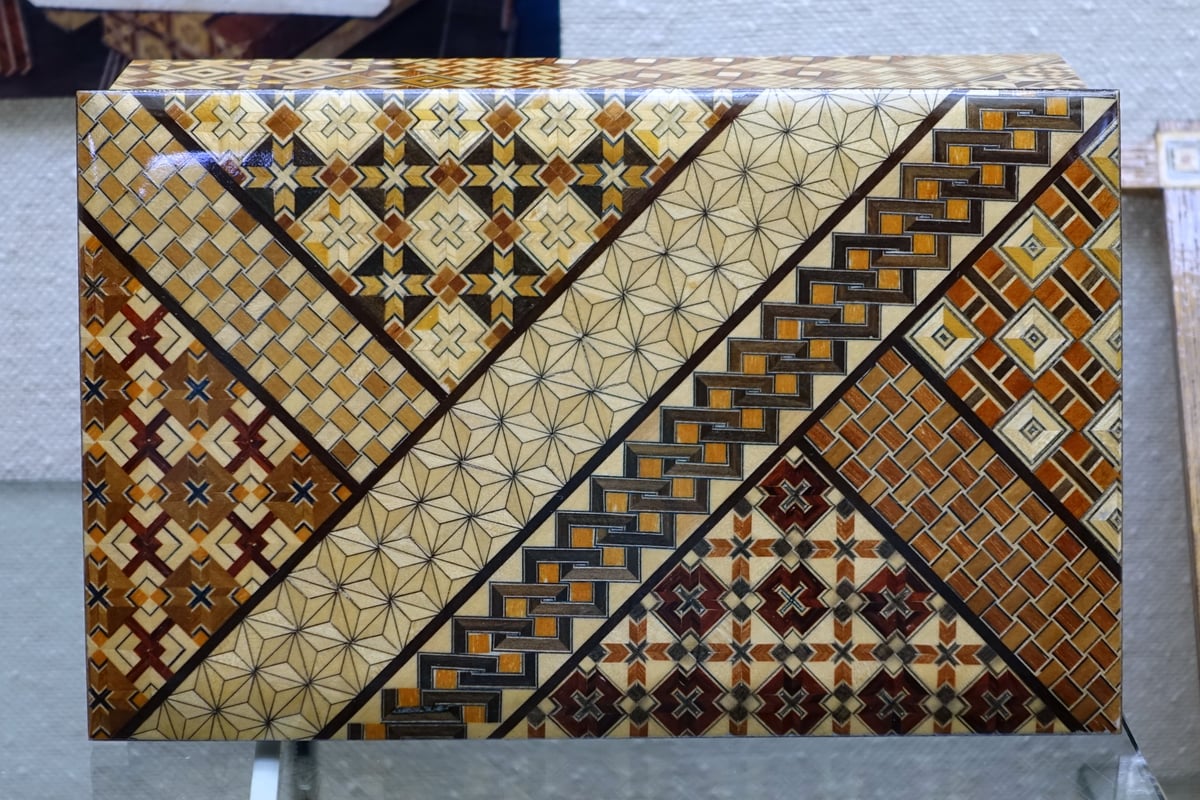
Image: Wikimedia Commons
Hakone Yosegi-zaiku is a traditional woodworking craft from Hakone, Kanagawa Prefecture, that assembles geometric patterns from the natural colors and grain of different woods, with no dyeing involved. It is said to have begun in the late Edo period, when Ishikawa Nihei of Hatajuku, noting the wide variety of tree species found in the mountains of Hakone, began combining pieces of wood with different colors and grains to make trays and boxes. In the Meiji era, marquetry techniques from the Shizuoka region were incorporated, giving rise to more intricate geometric patterns. The himitsu-bako (puzzle box), fitted with a trick-opening mechanism, became a popular souvenir among travelers on the Tokaido and visitors to the hot springs, and it remains a signature Hakone souvenir today. Designated a national Traditional Craft in 1984, the technique is still carried on today, centered on workshops and museums in Hatajuku, the craft's birthplace.
Origin
Hakone Yosegi-zaiku is said to have begun around the Koka era (1845–1848) of the late Edo period, when Ishikawa Nihei of Hatajuku, taking note of the abundant variety of trees in the mountains of Hakone, began combining woods of different colors and grains to make trays and boxes. Records already mention the existence of yosegi marquetry as early as 1820, and the opening of the port of Yokohama in 1859 expanded its markets, helping the craft develop into a distinct production area.
History
In the Meiji era, marquetry techniques introduced from the Shizuoka region were incorporated, and Hakone Yosegi-zaiku, until then dominated by simple randomly arranged patterns and basic repeating motifs, began to feature more complex and intricate geometric designs. Around this time the himitsu-bako trick box was also devised, applying mechanisms from Edo-period ship and cart chests to create a puzzle-opening box that became a popular souvenir among travelers on the Tokaido and hot-spring visitors. It was designated a national Traditional Craft in 1984.
Features
Its greatest characteristic is the way it assembles geometric patterns purely from the natural colors of a wide variety of woods, with no dyeing involved. There are two main techniques: zuku-bari, in which a thinly shaved veneer bearing the pattern is applied as a surface finish, and muku-zukuri, in which the patterned block of wood itself is carved into shape. Craftspeople combine the natural tones of woods such as white-toned aohada and mizuki, yellow-toned urushi and haze, and brown-toned enju and sakura to produce a wide range of items, from trays and boxes to himitsu-bako puzzle boxes.
Techniques
Zuku-bari (Veneer Application)
A long-standing traditional technique in which a patterned block (tane-ita) made by combining pieces of different-colored wood is planed down to a thin sheet, roughly 0.15–0.25mm thick, and applied as a decorative veneer to the surface of boxes and other wooden items.
Muku-zukuri (Solid-Block Carving)
A technique attributed to Katsuetsu Kanezashi, in which the patterned block of wood itself is worked on a lathe or hollowed out, finishing it into a three-dimensional form while preserving the pattern. It is also used for bold sculptural pieces, such as the winner's trophy for the Hakone Ekiden relay race.
Materials Used
Production Process
- 1
Making the Patterned Block (Tane-ita)
Wood that has been naturally air-dried for several years after felling is sorted by color and grain, combined, and glued together to form the tane-ita, the patterned block that becomes the basis of the design.
- 2
Working the Patterned Block
For zuku-bari, the block is planed into a thin sheet; for muku-zukuri, the block itself is worked into a three-dimensional shape on a lathe or by hollowing.
- 3
Application and Shaping
The planed veneer is applied to the surface of a box or tray, or the solid patterned block is shaped into the finished form of the product.
- 4
Finishing
The surface is polished and finished with wiped lacquer or similar treatments, bringing out the natural wood tones and the beauty of the geometric pattern.
| Main Production Areas |
|
|---|
Artisans & Workshops
本間木工所・本間寄木美術館
A workshop adjoining the museum, where craftspeople devoted solely to yosegi work, including certified traditional craftsman Noboru Homma, produce pieces. The workshop can be viewed through glass, carrying on the techniques of Hakone Yosegi-zaiku that have continued since the Edo period.
Official site →How to Buy
- 本間木工所 寄木オンラインショップ
- An online shop operated by the direct-sale store of Honma Mokkosho and the Honma Yosegi Museum. It carries everything from standard yosegi products to original and limited items, as well as yosegi and wood-inlay artworks.Where to buy →PR
- 畑宿寄木会館
- An exhibition and sales facility located in Hatajuku, the birthplace of yosegi marquetry. Visitors can watch craftspeople give live production demonstrations and purchase souvenirs such as himitsu-bako puzzle boxes.Where to buy →PR
Hands-on Experiences
畑宿寄木会館
神奈川県足柄下郡箱根町畑宿103
Admission free. A yosegi coaster-making experience costs 1,200 yen (tax included); reservation required. Open 9:30–16:30; closed Mondays and during the New Year holidays.
View details →本間木工所・本間寄木美術館
神奈川県足柄下郡箱根町湯本84
Admission is 500 yen for adults and 300 yen for children. Open 10:00–16:00; visitors can view the yosegi workshop, and the schedule for hands-on classes can be checked on the official website.
View details →