Image: Wikimedia Commons
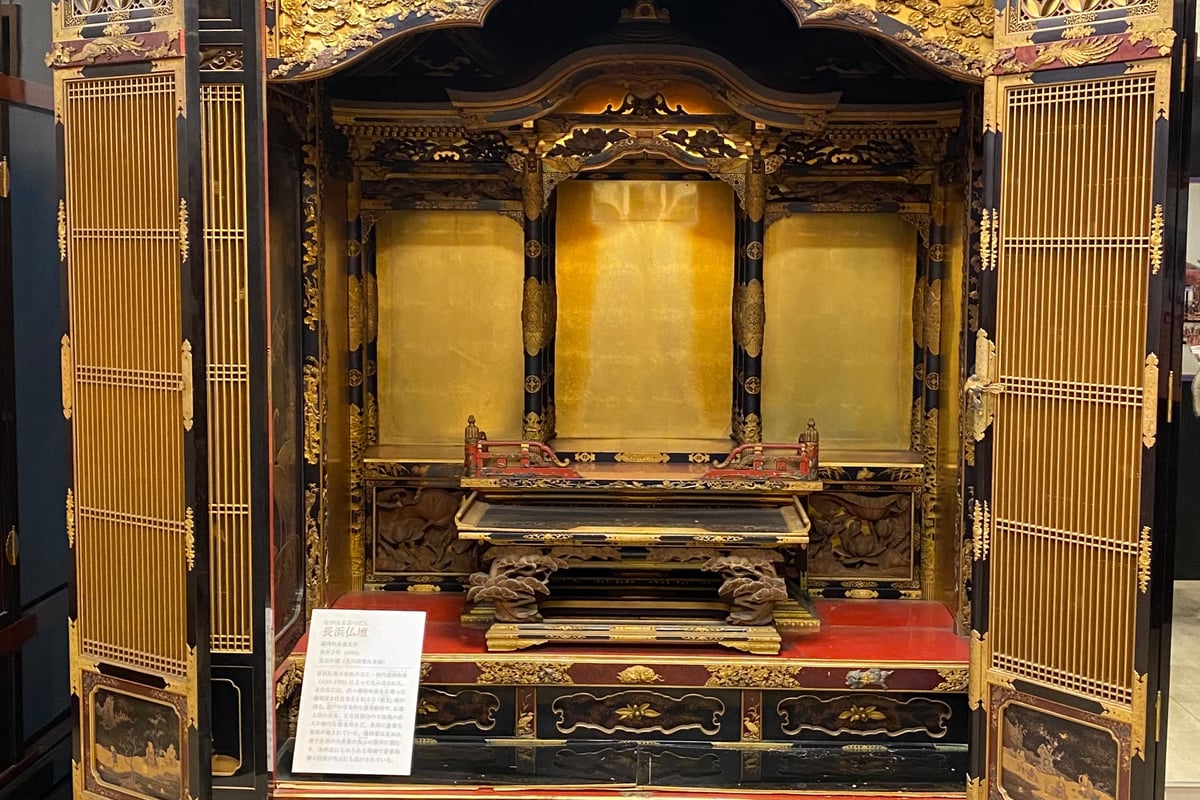
Nagahama Butsudan are gold-lacquered Buddhist altars (kin-butsudan) made mainly in Nagahama City, Shiga Prefecture, and are recognized as a production center distinct from Hikone Butsudan. It is said that altar-making spread to various regions during the Muromachi period, carried by craftsmen who had moved out from Kyoto's 'Hachi-busho,' a group of Buddhist image and altar makers, and that in Nagahama — a region with deep devotion to Jodo Shinshu Buddhism — Fujioka Izumi laid the foundations of the local industry. The oldest surviving example bears a date corresponding to 1680 (Enpo 8), showing that the production center was already established by the mid-17th century. Altars are made through a division of labor across seven processes — woodworking, the kuden (miniature shrine housing the principal image), carving, metal fittings, lacquering, maki-e (lacquer decoration), and gold-leaf application — a collaborative art involving multiple craftsmen such as woodworkers, metal-fitting artisans, lacquerers, and maki-e artists. The kokashiki (frame-assembly) technique, which joins parts without adhesives or nails, allows altars to be disassembled and repaired even after completion, so they can be used for generations. The woodworking, carving, and metalwork skills cultivated in building the floats for the Nagahama Hikiyama Festival have long supported the local altar-making industry.
Origin
The origins of Nagahama Butsudan are said to trace back to the Muromachi period, when craftsmen from the 'Hachi-busho,' a group in Kyoto responsible for making Buddhist images and ritual implements, moved out to various regions, giving rise to altar-making industries in each area. In Nagahama, a region with deep devotion to Jodo Shinshu Buddhism, Fujioka Izumi is said to have laid the foundations of the craft. The oldest surviving altar bears an inscription dated 1680 (Enpo 8) and is attributed to Fujioka Jinbei (Shigemitsu). This example suggests that the foundations of Nagahama as a production center were already established by the mid-17th century.
History
Nagahama was developed as a castle town by Hashiba (later Toyotomi) Hideyoshi, and against a backdrop of temple construction and the townspeople's strong religious devotion, altar-making developed as a local industry. The woodworking, carving, metal-fitting, lacquering, and maki-e techniques also used in building the floats for the Nagahama Hikiyama Festival were applied to altar-making, forming a system of division of labor among multiple craftsmen — woodworkers, metal-fitting artisans, lacquerers, and maki-e artists. While Hikone Butsudan advanced toward mass production and incorporation as companies, Nagahama has continued to this day with small-scale production of high-grade altars, made by craftsmen at family-run altar shops.
Features
The defining feature of Nagahama Butsudan is the kokashiki (frame-assembly) technique, in which parts are joined without relying on adhesives or nails. This structure allows the altar to be disassembled for repair and cleaning even after completion, so it can be used across generations. Carving is typically done in full relief (marubori) using plain, unlacquered zelkova or Japanese cypress wood, and the craft retains a strong character as a collaborative art in which carving, metal fittings, lacquering, maki-e, and gold-leaf application are each finished by specialized craftsmen through a division of labor.
Techniques
Kokashiki (frame-assembly construction)
A technique in which parts are joined using joinery such as mortise-and-tenon, without adhesives or nails. Even after completion, the altar can be disassembled for repair and cleaning, allowing it to withstand long-term use.
Materials Used
Production Process
- 1
Kiji (woodworking)
The framework and parts of the altar body are assembled from zelkova and Japanese cypress wood.
- 2
Kuden
The roofed housing that enshrines the principal image is made.
- 3
Carving
Flowers, plants, and narrative scenes are carved in full relief onto the transoms, pillars, and other parts.
- 4
Metal fittings
Metal is worked and shaped into decorative fittings.
- 5
Lacquering
Lacquer is applied in many layers to produce a deep, rich luster.
- 6
Maki-e and gold-leaf application
Patterns are drawn in lacquer and dusted with gold or silver powder, and gold leaf is applied for a solemn, splendid finish.
| Main Production Areas |
|
|---|
Artisans & Workshops
お仏壇の内藤
Founded in 1921 (Taisho 10), this long-established Nagahama shop has made and sold Hama Butsudan altars for nearly a century. It continues to pass on altar-making that draws on the traditional division-of-labor techniques.
Official site →How to Buy
- お仏壇の内藤
- A long-established shop based in Nagahama City that makes and sells Hama Butsudan altars using traditional techniques. It also handles repairs and consultations.Where to buy →PR
Hands-on Experiences
長浜市曳山博物館
滋賀県長浜市元浜町14-8
Exhibits historic examples of Nagahama Butsudan, including an altar made in 1680 (Enpo 8). Admission is around 600 yen for adults and 300 yen for children.
View details →FAQ
Q. How does Nagahama Butsudan differ from Hikone Butsudan?
A. Although both are gold-lacquered Buddhist altars from Shiga Prefecture, Nagahama Butsudan is centered on small-batch, high-grade altars made through division of labor at family-run altar shops, whereas Hikone Butsudan has been produced in relatively larger quantities through a division-of-labor system organized around incorporated companies.