Image: Wikimedia Commons
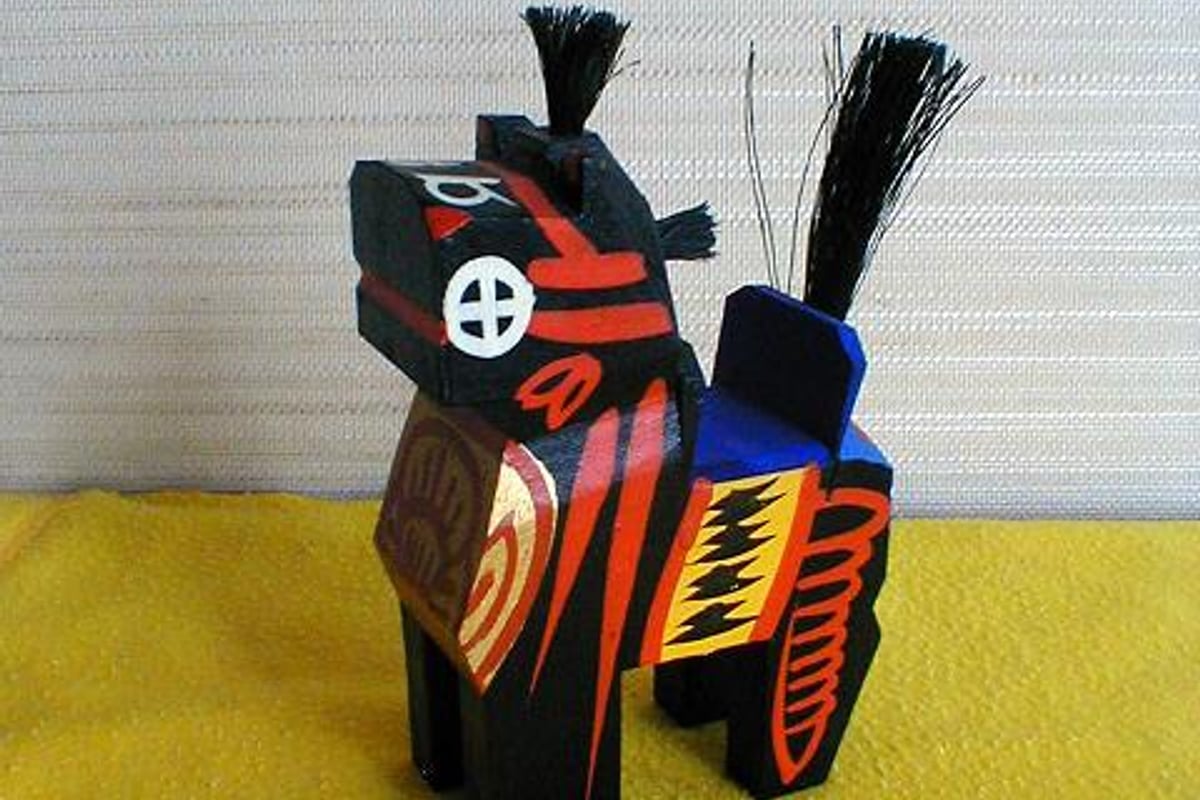
Miharu Koma are carved wooden horse folk toys that originated in what is now Nishida-Takashiba, Koriyama City, and are counted among the 'Three Great Horses of Japan' alongside Aomori Prefecture's Yawata-uma and Miyagi Prefecture's Kinoshita-goma. According to legend, the toy traces back to the Heian-period general Sakanoue no Tamuramaro, who around the year 791 was struggling during his campaign to subdue the Emishi when a wooden horse appeared out of nowhere and came to his aid; in tribute, a children's toy called kosodate mokuba (子育木馬, 'child-rearing wooden horse') was said to have first been made. In the Edo period, the Miharu domain, known as a horse-breeding region, gave the name 'Miharu Koma' to a fine breed developed from wild horses, and the name spread to the toy as well. The toys come as white horses and black horses, painted in red, black, and gold; the black horse is considered a charm for fertility, safe childbirth, and child-rearing, while the white horse is believed to bring peace in old age and protection against senility. In 1954 it was even chosen as the design for Japan's first New Year's postage stamp, making it a nationally known folk toy.
Origin
According to legend, the Heian-period general Sakanoue no Tamuramaro was struggling during his campaign to subdue the Emishi when a wooden horse appeared out of nowhere and came to his aid; in tribute, a children's toy called kosodate mokuba (子育木馬, 'child-rearing wooden horse') is said to have first been made. This wooden horse was also known as Takashiba mokuba (高柴木馬) after its birthplace, and at the time it was not yet called 'Miharu Koma.'
History
The name 'Miharu Koma' took hold in the Edo period. The Miharu domain, known as a horse-breeding region, pursued a policy of improving wild horses into fine breeding stock, and the resulting prized horses were given the name 'Miharu Koma.' This name is said to have then been carried over to the wooden horse toys made by artisans in Takashiba, spreading into the name used today. Production once died out during the Meiji era, but a folk-craft workshop in Takashiba revived it in the Showa era, and the techniques have been passed down to the present day.
Features
Miharu Koma come as white horses and black horses, painted in red, black, and gold, with a sturdy body and the plain texture of the wood grain as their defining charm. The black horse is considered a charm for fertility, safe childbirth, and child-rearing, while the white horse is believed to bring peace in old age and protection against senility, and the toys have long been displayed in homes as lucky charms. Chosen as the design for Japan's first New Year's postage stamp (part of the folk-craft series) in 1954, it remains one of Japan's best-known folk toys nationwide.
Materials Used
Production Process
- 1
Cutting the wood
A log is cut into pieces sized for the horse's body and legs.
- 2
Carving
A small knife and chisels are used to carve out the rough shape of the horse.
- 3
Assembly
The legs and head are fitted to the body, and the overall horse shape is refined.
- 4
Painting
The body and saddle are painted with red, black, gold, and other pigments to finish the piece.
| Main Production Areas |
|
|---|
Artisans & Workshops
彦治民芸
A workshop in Takashiba Dekoyashiki said to be the sole remaining maker of authentic carved-wood Miharu Koma. It is also known as the first workshop in Fukushima Prefecture to offer a hands-on painting experience.
Official site →How to Buy
- 彦治民芸
- Carved wooden Miharu Koma and Miharu hariko dolls can be purchased at the direct-sale shop inside Takashiba Dekoyashiki, at 80-1 Takashiba-Tateno, Nishida-machi, Koriyama City.Where to buy →PR
Hands-on Experiences
彦治民芸
福島県郡山市西田町高柴舘野80-1
Reservation required. Painting a Miharu Koma or hariko doll costs from around 1,000 yen and takes about an hour. Known as Fukushima Prefecture's first hands-on painting workshop.
View details →