Image: Wikimedia Commons
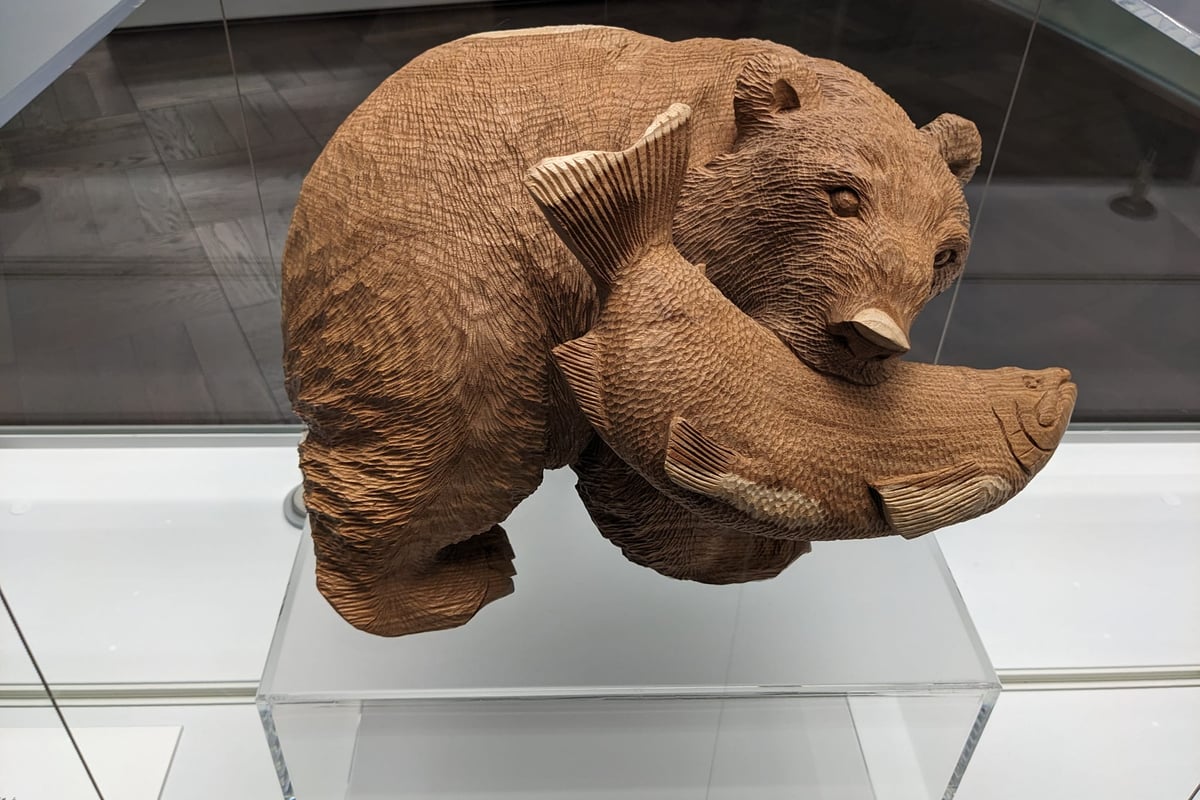
Kibori-guma (wood-carved bear) is a carved wooden statue of a bear, widely known as a representative wood-carving craft of Hokkaido. Its origin is attributed to Yakumo Town on the Oshima Peninsula. Tokugawa Yoshichika, 19th head of the Owari Tokugawa family, brought back folk-craft items including wood-carved bears that he had seen while stopping in Switzerland during a 1921-1922 tour of Europe, and encouraged local farmers to make similar carvings as winter side work at the Yakumo Farm that he operated. A work carved by dairy farmer Ito Masao based on the imported piece is regarded as the first wood-carved bear made in Hokkaido, and was exhibited at the Yakumo Rural Art and Craft Exhibition in 1924. In Yakumo, two styles of expression developed: the delicate 'kebori' (fur-carving) technique established by Nihonga painter Tokura Kinnosuke, and the powerful 'menbori' (facet-carving, or hatsuri-bori) technique established by Shibasaki Shigeyuki. Meanwhile, in Asahikawa, around 1926, Ainu bear hunter Matsui Umetaro carved a bear based on his own experience, giving rise to a distinct lineage that developed into the 'Asahikawa style,' characterized by abstract forms created with facets. Today it is known nationwide as a classic Hokkaido souvenir.
Origin
The birthplace of the wood-carved bear is said to be Yakumo Town on the Oshima Peninsula. Tokugawa Yoshichika, 19th head of the Owari Tokugawa family, toured Europe from 1921 to 1922, and while stopping in Switzerland in April 1922, saw folk-craft items (peasant art) including wood-carved bears. Yoshichika, who ran the Yakumo Farm, thought wood carving would be well suited as winter side work or a hobby, and brought these pieces back, encouraging local farmers to make similar carvings. A wood-carved bear made by dairy farmer Ito Masao, modeled on the Swiss piece, is regarded as the first one made in Hokkaido, and was exhibited at the Yakumo Rural Art and Craft Exhibition on March 26, 1924.
History
In 1927, Ito Masao's wood-carved bear won first prize at the Hokkaido and Six Tohoku Prefectures Joint Side-work Exhibition, and in 1928 the 'Yakumo Farmers' Art Research Society' was established. In Yakumo, Nihonga painter Tokura Kinnosuke established the delicate 'kebori' technique, while Shibasaki Shigeyuki, who came from a farming family, perfected his own 'menbori' (facet-carving, also called hatsuri-bori or Shibasaki-bori) technique, which made the most of the raw power of the wood grain. Separately from Yakumo, in Asahikawa around 1926, Ainu bear hunter Matsui Umetaro carved a bear based on his experience fighting a bear, and the practice spread from there. In Asahikawa, home to the Army's 7th Division, the carvings were distributed as souvenirs for soldiers through Ainu craft shops, giving rise to a distinct 'Asahikawa style.'
Features
A key characteristic of wood-carved bears is that the style of expression varies greatly depending on the place of production and the maker. Yakumo's 'kebori' is a delicate style that carefully carves the fur strand by strand, while Yakumo's 'menbori' (facet-carving) is defined by bold, faceted forms that look as if split with an axe. The Asahikawa style is characterized by abstract forms created with a makiri (small knife), establishing a distinct approach different from Yakumo's. The now-familiar pose of a bear on all fours holding a salmon in its mouth is a design that spread in later years, and does not appear in the early works from Yakumo, the craft's place of origin.
Techniques
Kebori (Fur Carving)
A technique established by Nihonga painter Tokura Kinnosuke, incorporating methods from Japanese painting. It carefully carves each strand of fur one at a time to create a realistic, delicate texture, and is regarded as a style descended from the Swiss originals.
Menbori (Facet Carving / Hatsuri-bori)
A technique perfected by Shibasaki Shigeyuki, who came from a farming family, characterized by bold, faceted forms that look as if the wood had been split with an axe. Rather than carving individual fur strands, it makes full use of the raw power of the wood grain to express the bear's form, creating a distinctive style.
Asahikawa-style Facet Carving
In Asahikawa, a distinctive style developed using a makiri (small knife) to carve the bear's form out of a block of wood using facets. It is known as a lineage distinct from Yakumo's kebori and hatsuri-bori styles.
Materials Used
| Main Production Areas |
|
|---|
Artisans & Workshops
柴崎重行(八雲)
A wood-carving artist who came from a farming family. He continually pursued his own carving style, establishing hatsuri-bori (Shibasaki-bori), a type of bold 'menbori' (facet carving) that looks as if split with an axe, and is known for having attracted many enthusiasts.
Official site →How to Buy
- 八雲町木彫り熊資料館 周辺の土産店
- Souvenir shops selling wood-carved bears are dotted around the area near the Yakumo Town Wood-carved Bear Museum, the birthplace of the craft, where visitors can purchase works made by local artists.Where to buy →PR
Hands-on Experiences
八雲町木彫り熊資料館
北海道二海郡八雲町末広町154番地
Admission is free. Visitors can see the first wood-carved bear made in Yakumo along with the actual Swiss-made bear that served as its model, as well as works from other areas of Hokkaido, including Asahikawa.
View details →FAQ
Q. Since when have wood-carved bears been depicted holding a salmon?
A. The early wood-carved bears from Yakumo Town, the craft's birthplace, do not hold a salmon. The pose of a bear on all fours holding a salmon in its mouth is said to be a design that spread later through a different lineage and became a standard type.