Image: Wikimedia Commons
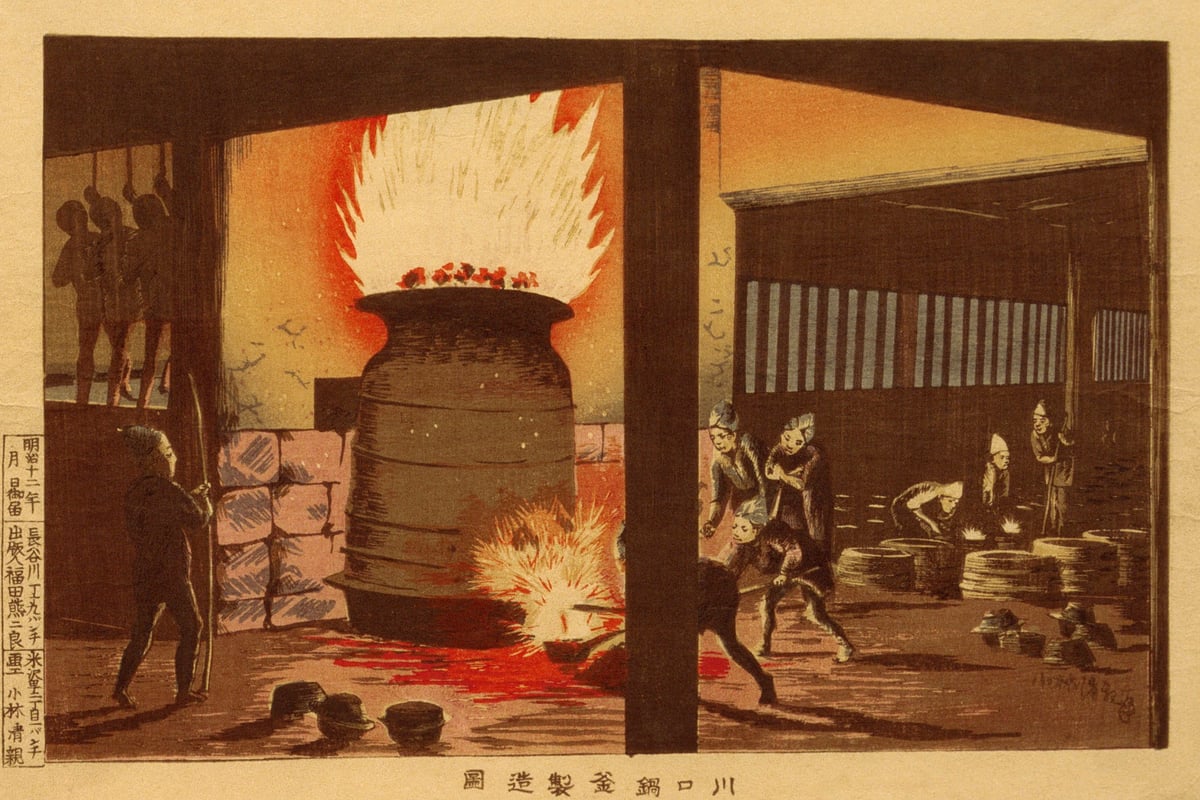
Kawaguchi Imono is the general term for the casting industry that developed in Kawaguchi City, situated between the Arakawa and Shiba rivers, an area known as 'Kawaguchi, the Town of Casting.' Its origins remain uncertain, with several competing theories placing its beginnings in the Heian, Kamakura, Nanboku-cho, or Sengoku periods, but it is thought that casters had settled in the area by at least the medieval period. Good-quality sand and clay suited to mold-making could be obtained along the Arakawa and Shiba river basins, and the area's proximity to the major consumer center of Edo (Tokyo), together with its convenient water transport, allowed it to develop from the Edo period onward into a major production center for pots, kettles, farm tools, temple bells, and more. From the Meiji era, factory production and technological innovation advanced, and in 1942 Kawaguchi achieved the highest production volume in Japan among single cities; it is also known as the setting of the film 'Kyupora no Aru Machi' (The Town with the Cupola Furnace). In recent years, production has continued across a wide range of fields, from household goods to industrial products, pursuing lighter weight and refined design.
Origin
Several theories surround the origin of Kawaguchi Imono: that casters who served in Taira no Masakado's rebellion (around 940) settled in the area; that casters who came from the Southern Song dynasty introduced the craft during the Kamakura period; that casters migrated from Kawachi Province during the Nanboku-cho period; or that a caster in service to the lord of Iwatsuki Castle was involved during the Sengoku period. Documentary evidence is scarce, so none of these theories has been confirmed. In every account, however, the ready availability of good-quality sand and clay suited to mold-making along the Arakawa and Shiba river basins is cited as the common factor behind the establishment of the casting industry in this area.
History
During the Edo period, Kawaguchi's proximity to the major consumer center of Edo, combined with convenient water transport, allowed it to develop into a major production center for everyday cast-iron goods. Toward the end of the Edo period, the town is also said to have cast cannons and cannonballs, drawing on techniques developed for casting temple bells. In 1905, casting businesses organized a trade association, and technological innovation and diversification of products progressed through the Meiji and Taisho eras. In 1942, Kawaguchi achieved the highest casting production volume in Japan among single cities, and in 1973 production peaked at 407,000 tons per year. After the war, the industry's focus shifted from everyday goods to machine castings, and Kawaguchi became known nationwide as the 'Town of Casting,' famously serving as the setting for the film 'Kyupora no Aru Machi' (1962).
Features
A defining feature of Kawaguchi Imono is the way its range of products has expanded over time to meet demand — from everyday items like pots, kettles, and farm tools, to manhole covers, machine parts, and, more recently, cookware designed for lighter weight and refined appearance. Building on the traditional sand-casting techniques that use the fine sand and clay of the Arakawa and Shiba river basins, producers now combine these methods with modern technology such as computer simulation to manufacture a wide variety of cast products. The cupola furnace monument installed at 'Cupola Square' by the east exit of Kawaguchi Station is cherished as a symbol of the Town of Casting.
Materials Used
| Main Production Areas |
|
|---|
Artisans & Workshops
伊藤鉄工株式会社
A Kawaguchi casting manufacturer founded in 1931. It develops the 'Ferramica' brand of pots and frying pans made from ductile cast iron, achieving products roughly 40% lighter than conventional cast-iron cookware.
Official site →How to Buy
- Ferramica(伊藤鉄工)
- A brand of lightweight ductile cast-iron pots and frying pans that draws on the skills of Kawaguchi casting craftsmen. Available for purchase through its online shop.Where to buy →PR
Hands-on Experiences
川口市立文化財センター 郷土資料館
埼玉県川口市鳩ヶ谷本町2-1-22
The casting exhibit room displays materials and tools related to the casting industry from the late Edo period through around 1975. Admission is free.
View details →