Image: Wikimedia Commons
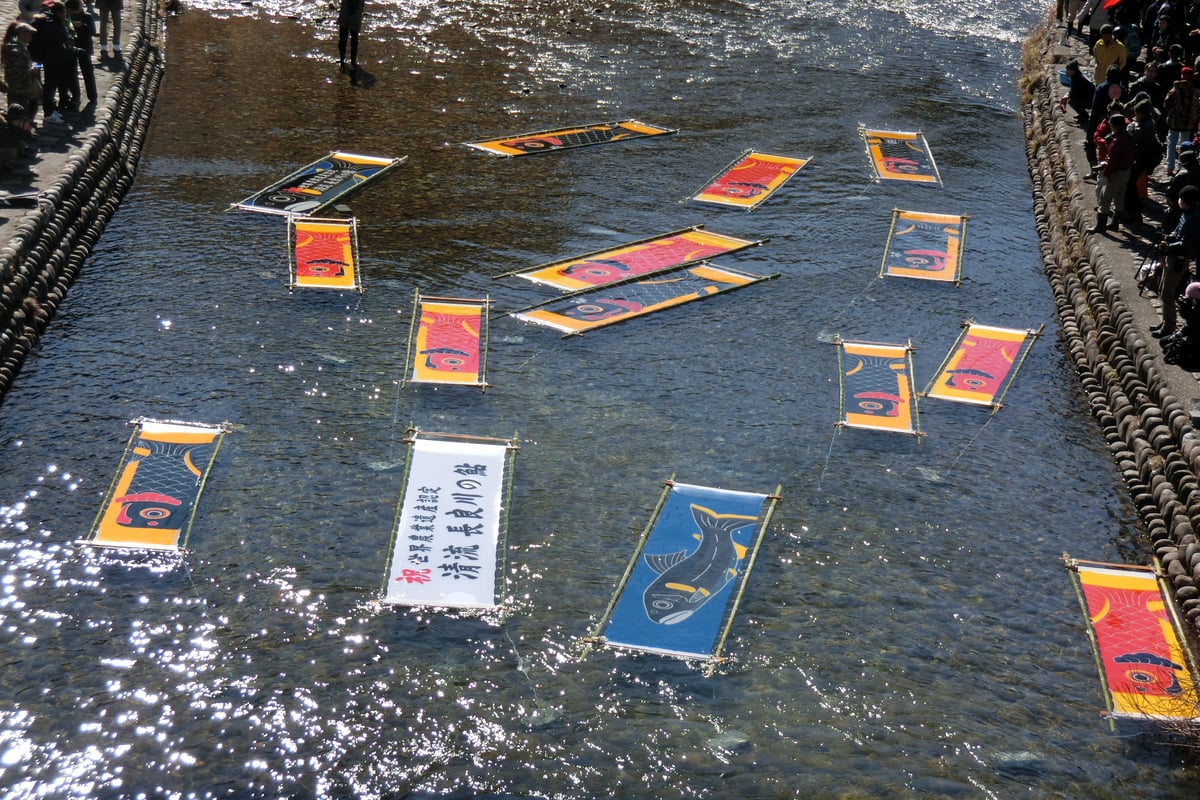
Gujo Honzome is an indigo-dyeing tradition from the town of Hachiman in Gujo City, Gifu Prefecture, known for its tsutsugaki (tube-drawing) technique used to dye carp-shaped koinobori streamers and other banners. Its origins are said to date back to the Tensho era (1573-1592) of the Azuchi-Momoyama period, and the craft has been handed down for more than 400 years in Hachiman, a town blessed with the abundant, clear waters of the Yoshida River, a tributary of the Nagara River. Craftspeople use a resist paste called managori, made from glutinous rice, squeezed from a cloth cone directly onto the fabric (tsutsugaki), or apply the paste through a stencil (katazome) to outline the pattern, before dyeing the cloth more than a dozen times in natural indigo to achieve a deep, vivid blue. Designated an Important Intangible Cultural Property of Gifu Prefecture in 1977 (Showa 52), the tradition is still carried on today by the Watanabe Dyeworks in Hachiman, now in its 15th generation. The annual kanzarashi (cold rinsing) of koinobori in the Yoshida River, held around the coldest time of the year, is a beloved winter tradition of Gujo Hachiman.
Origin
Gujo Honzome, an indigo-dyeing tradition of Hachiman in Gujo City, Gifu Prefecture, is said to trace its history back to the Tensho era (1573-1592) of the Azuchi-Momoyama period. In Hachiman, blessed with the abundant waters of the Yoshida River, a tributary of the Nagara River, the technique of tsutsugaki indigo dyeing for koinobori and other banners took root and has been handed down for more than 400 years.
History
The techniques passed down since the Edo period are still preserved today, with the Watanabe Dyeworks in Hachiman, Gujo City, carrying on the tradition of Honzome dyeing into its 15th generation. It was designated an Important Intangible Cultural Property of Gifu Prefecture in 1977 (Showa 52). Every year around the coldest time of the season, dyed koinobori are soaked in the Yoshida River to rinse away excess paste and indigo, a practice known as the kanzarashi of the koinobori, cherished as a winter tradition of Gujo Hachiman.
Features
A resist paste called managori, made from glutinous rice, is squeezed from a cloth cone (tsutsu) directly onto the fabric to outline patterns in the tsutsugaki technique, or applied through a stencil in the katazome technique, before the cloth is dyed with natural indigo. A single piece of cloth may be dipped in the indigo vat more than a dozen times, producing a deep, vivid blue that changes character with use, a quality celebrated abroad as Japan blue.
Techniques
Tsutsugaki (Tube Drawing)
A technique in which resist paste is squeezed directly onto the fabric through a cloth cone (tsutsu) filled with managori paste to outline the pattern. It is well suited to depicting the bold designs of large banners such as koinobori.
Katazome (Stencil Dyeing)
A technique in which a stencil is placed on the fabric and resist paste is applied with a spatula. It allows fine, repeating patterns to be reproduced evenly.
Materials Used
Production Process
- 1
Sketching and paste application
A preliminary sketch of the design is drawn, and managori paste is applied to the areas to be resisted.
- 2
Covering the paste
Ash or sawdust is sprinkled over the paste and left to dry, preventing dye from seeping into the resisted areas.
- 3
Indigo dyeing
The fabric is dipped in a vat of prepared natural indigo and exposed to air to develop its color, a process repeated more than a dozen times.
- 4
Rinsing
The paste is washed away in a river or basin, revealing the indigo-dyed pattern.
| Main Production Areas |
|
|---|
Artisans & Workshops
渡辺染物店
A dyeworks said to have been founded during the Tensho era, carrying on Gujo Honzome across 15 generations. It produces hand-drawn honzome koinobori and other indigo-dyed items.
Official site →How to Buy
- Gujo Honzome Watanabe Dyeworks (Online Shop)
- Sells indigo-dyed stoles, tablecloths, and other items. Stoles start at around 4,730 yen and tablecloths at around 7,150 yen.Where to buy →PR
Hands-on Experiences
郡上本染 渡辺染物店
岐阜県郡上市八幡町島谷737
Offers an indigo-dyeing workshop program (reservation required), where visitors can experience making indigo-dyed items such as stoles.
View details →