Image: Wikimedia Commons
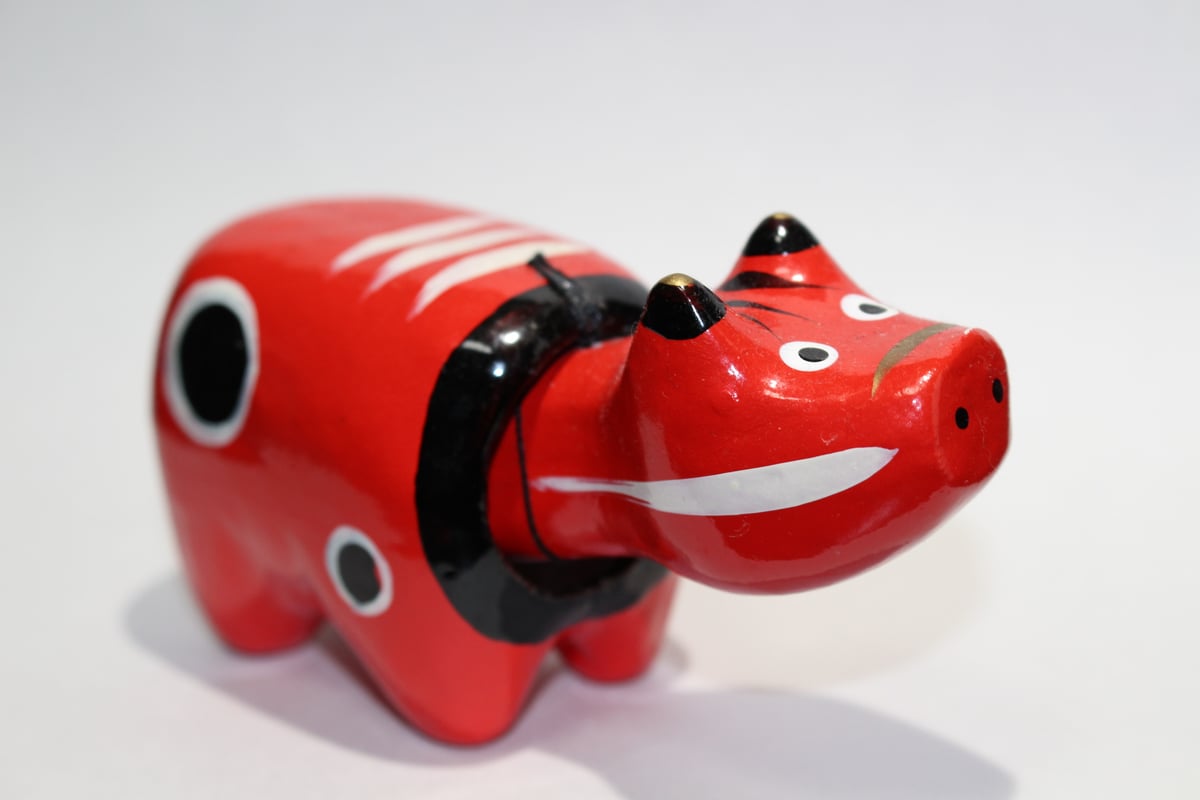
Akabeko is a papier-mâché (hariko) folk toy representing the Aizu region of Fukushima Prefecture, shaped like a red-painted cow. 'Beko' is a Tohoku dialect word for cow, and the toy's origin is said to date back roughly 1,200 years, to a legend of a red-haired ox that, when many other oxen collapsed from exhaustion during the construction of the main hall of Enzō-ji Temple (Fukuman Kokuzōson) in Aizu-Yanaizu, alone carried timber to the very end. The hariko technique itself is said to have been introduced to Aizu during the Tenshō era (1573-1592) by craftsmen invited by Gamō Ujisato, who became lord of Aizu and sought to promote local industry. In 1713, when smallpox spread through the Aizu region, a tale spread that children who owned an Akabeko were spared from the disease, and ever since, Akabeko has been treasured as a lucky charm to ward off evil and disease. The red of its body is said to represent protection from evil, while the spots painted on it represent the marks of smallpox, and its head, which sways gently when touched, still makes it a signature souvenir of Aizu today.
Origin
There are several accounts of Akabeko's origin, but the best known traces back roughly 1,200 years, to a legend of a red-haired ox that, when many other oxen collapsed from exhaustion while hauling timber for the construction of the main hall of Enzō-ji Temple (Fukuman Kokuzōson) in Aizu-Yanaizu, alone carried the timber to the very end. In gratitude for the ox's effort, people are said to have begun making and passing down papier-mâché toys in its likeness. The hariko technique itself is said to have been brought to Aizu during the Tenshō era (1573-1592) by craftsmen invited from other regions by Gamō Ujisato, who became lord of Aizu and sought to promote local industry.
History
In 1713, when smallpox spread through the Aizu region, a tale spread that children who owned an Akabeko were spared from the disease. From then on, Akabeko came to be displayed in homes as a charm to ward off evil and pray for freedom from illness. Since then it has been handed down through generations as a folk toy of the Aizu region, and today several workshops continue to make it using the hariko technique.
Features
The red of Akabeko's body is said to represent protection from evil, while the black spots painted on it represent the marks of smallpox, embodying a wish to ward off disease. The head and body are joined with a paper cord, so that a light touch sets the head gently swaying — an endearing gesture that is part of its charm. In recent years, keychain-sized Akabeko have also been made, broadening its appeal from a lucky charm displayed at home to a talisman people carry with them.
Techniques
Hariko (papier-mâché technique)
A technique in which washi paper is pasted in many layers over a wooden mold to form the shape of a cow, dried, and then removed from the mold to create the body. It produces a light, sturdy finish and forms the base for the toy's distinctive swaying-head structure.
Materials Used
| Main Production Areas |
|
|---|
Artisans & Workshops
野沢民芸
A folk-craft manufacturing cooperative based in Nozawa, Nishiaizu Town. It operates a directly run shop on Nanukamachi Street in Aizuwakamatsu City, producing and selling traditional Akabeko and other Aizu papier-mâché folk crafts.
Official site →荒井工芸所(笑美)
A workshop in Aizuwakamatsu City that offers Akabeko painting experiences and sales. Known for its hands-on classes where visitors paint an unpainted papier-mâché piece, it is popular with tourists.
Official site →How to Buy
- 野沢民芸商店(七日町通り)
- The directly run shop of Nozawa Mingei on Nanukamachi Street in Aizuwakamatsu City. It carries a wide range of items, from classic Akabeko to zodiac-animal and other papier-mâché figures.Where to buy →PR
Hands-on Experiences
笑美(荒井工芸所)
福島県会津若松市(JR会津若松駅よりバス約5分)
Reservation required. The Akabeko painting experience costs from around 1,300 yen and takes about 60 minutes. Visitors paint an unpainted Akabeko in the colors of their choice, and staff then join the head and body to complete the piece.
View details →FAQ
Q. Why is Akabeko red?
A. The red color is believed to ward off evil, and the spots painted on its body are said to represent the marks of smallpox. Following a tale that children who owned an Akabeko were spared from smallpox during an Edo-period outbreak, it came to be cherished as a lucky charm against disease.
Q. Where can I try painting an Akabeko?
A. At places such as Arai Kogeisho (Warabi) in Aizuwakamatsu City, visitors can try painting an unpainted papier-mâché Akabeko (reservation required).