Image: Wikimedia Commons
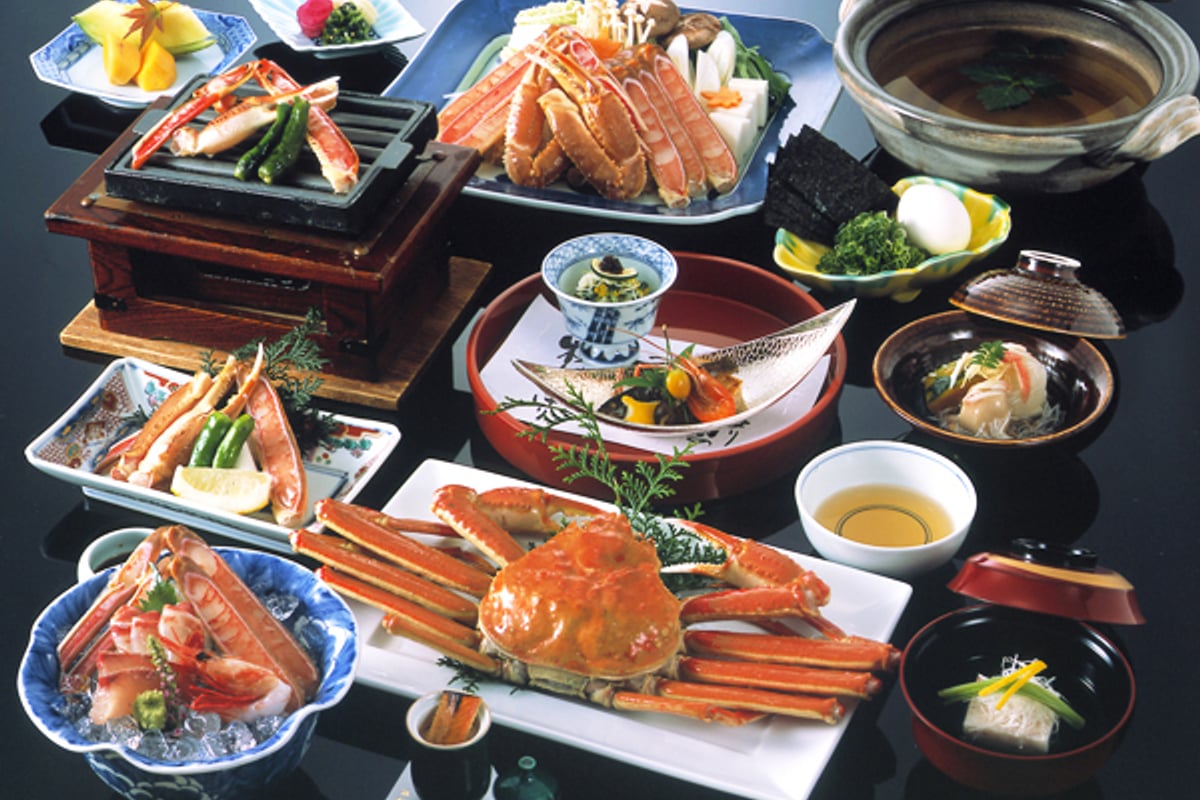
Matsuba crab (matsubagani) is the name used in the San'in region for male snow crab (zuwaigani). In the Tajima area of northern Hyogo Prefecture, it is landed at fishing ports in Shin'onsen Town, Kami Town, and Toyooka City, and it has become a signature winter delicacy. It is landed at five fishing ports, including Hamasaka Fishing Port at the prefecture's northwestern tip, and the catch is among the largest in Japan. Each port has its own brand, and the crabs are shipped with tags attached to their legs as 'Tsuiyama Kani,' 'Shibayama Gani,' 'Kasumi-ko Matsuba Gani,' and 'Hamasaka-san Matsuba Gani.' The season opens every year on November 6; male Matsuba crabs can be caught until March 20 of the following year, while female seko-gani can be caught only until the end of December in order to protect the stock. Besides being boiled in salted water and eaten with nihaizu (vinegar-soy dressing), the crab is also used in takikomi gohan (rice cooked with ingredients), zosui (rice porridge), miso soup, and more. Kasumi Fishing Port is also the only place in the prefecture where red snow crab (benizuwaigani) is landed; these are called 'Kasumi crab' and are a different crab from Matsuba crab.
Origin
According to the Ministry of Agriculture, Forestry and Fisheries, snow crab is called 'Matsuba crab' in San'in and 'Echizen crab' in Hokuriku. There are two theories about the origin of the name 'Matsuba crab': one is that pine needles (matsuba) were used as fuel when boiling the crabs, and the other is that the meat spreads out like pine needles when soaked in water. In Tajima, the main producing areas are the coasts of Shin'onsen Town, Kami Town, and Toyooka City. There are good fishing grounds offshore from the ports, and from Tsuiyama Port in Toyooka City it takes about two and a half hours by fishing boat to reach the grounds.
History
The catch of Tajima Matsuba crab peaked around 1965 (Showa 40). After that, larger fishing boats and advances in fishing methods led to overfishing, and the catch dropped sharply from the latter half of the Showa 40s (the early 1970s). Today fishing continues while protecting the stock, for example by limiting the fishing season. While each port develops its own brand, the Tajima Matsuba Crab Promotion Council (但馬産松葉ガニ普及推進協議会), made up of 20 organizations, has created a unified logo and promotes the crab in Kobe and Osaka.
Features
As proof of the brand, tags specific to each fishing port are attached to the crabs' legs. Tsuiyama Kani uses blue tags and Shibayama Gani uses pink tags. At Shibayama Port in Kami Town, crabs are finely sorted into more than 100 grades. There are also special brands such as the top-grade 'Shibayama Gold' and Hamasaka's '光輝' (meaning 'brilliance'). At the first auction of 2022, a single Shibayama Gold crab sold for a record 3,158,000 yen.
Main Ingredients
Food Culture
During the Matsuba crab season, tour trains that include crab meals run from the Kansai area and elsewhere, and hot spring resorts and port inns in Tajima are crowded with visitors coming for crab. At Tsuiyama Port in Toyooka City, the 'Toyooka Tsuiyama Port Crab Festival' is held in November, during the fishing season.
Famous Shops
おけしょう鮮魚の海中苑
兵庫県豊岡市城崎町湯島132
A shop run directly by a seafood broker at Tsuiyama Port. Crab and fresh fish are sold on the first floor, and at the restaurant on the second floor you can enjoy everything from casual crab dishes to full-course crab meals. Full-course crab meals start at about 13,500 yen per person, with a minimum order of two servings. It is located in the Kinosaki Onsen hot spring town.
遊魚館
兵庫県美方郡香美町香住区若松748
A seafood market adjacent to Kasumi Fishing Port, run directly by the Tajima Fisheries Cooperative. Fresh fish such as Kasumi crab and processed products are on sale. There are also unusual sweets such as soft-serve ice cream containing fish sauce made with Kasumi crab, and crab gelato. It is about a 15-minute walk from JR Kasumi Station.
旅館 割烹 荒岩
兵庫県美方郡新温泉町浜坂263
A kappo ryokan (an inn known for its Japanese cuisine) about a five-minute walk from Hamasaka Station on the JR San'in Main Line. Its specialty is tagged Matsuba crab landed at Hamasaka Port, and in winter guests come for its crab dishes. Hamasaka is a port town with one of the largest Matsuba crab catches in Japan.
FAQ
Q. Are Matsuba crab and Echizen crab different crabs?
A. Both are male snow crab; only the name differs by region. In the San'in region it is called Matsuba crab, and in Fukui Prefecture in Hokuriku it is called Echizen crab. In addition, tags are attached at each fishing port where the crabs are landed, and they are branded under names such as Tsuiyama Kani and Shibayama Gani.
Q. What is the difference between Kasumi crab and Matsuba crab?
A. Kasumi crab is the brand name for red snow crab landed at Kasumi Fishing Port, a different species from Matsuba crab, which is snow crab. It is caught with basket traps in the deep sea at depths of about 800 to 1,500 m, and it is known for its sweet, juicy meat. The season runs from September to around May of the following year, so it can be enjoyed for longer than Matsuba crab.