Image: Wikimedia Commons
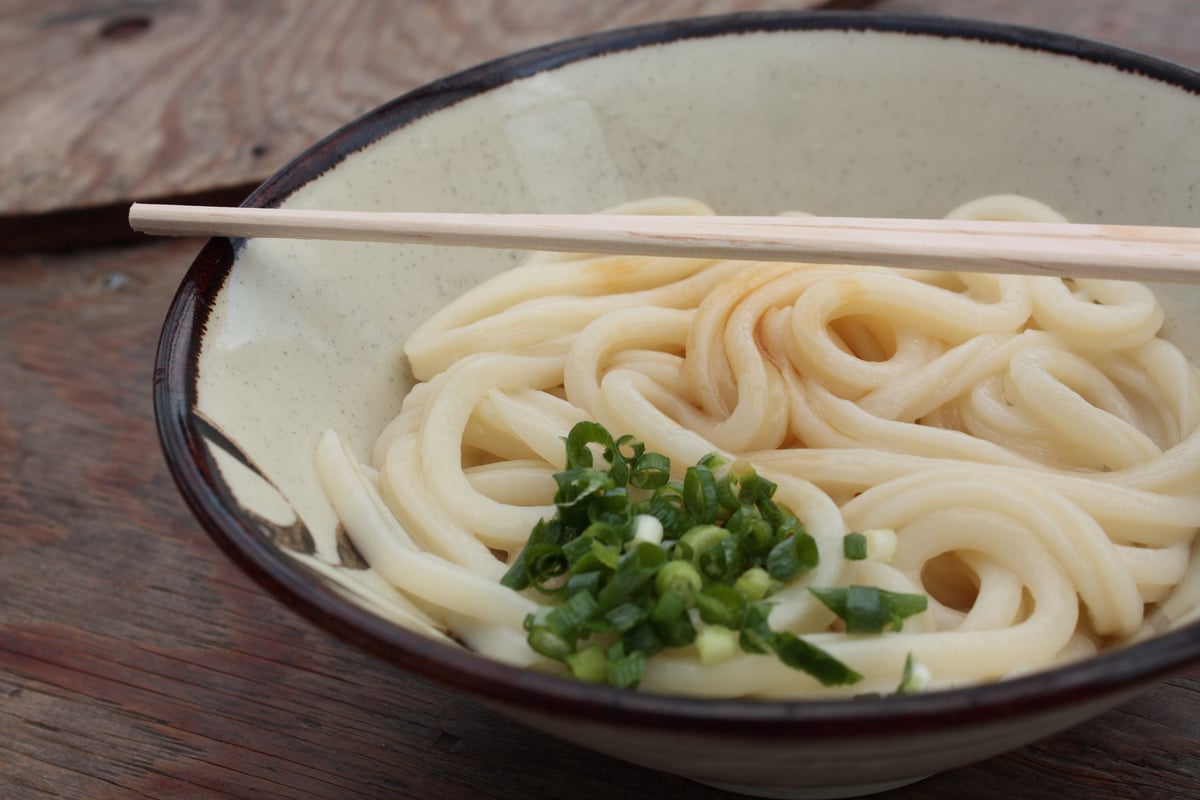
Sanuki Udon is udon that has long been eaten in Kagawa Prefecture. It is characterized by its strong, springy texture (koshi) and the smooth way it goes down. Because Kagawa has little rainfall and mild winters, wheat has long been widely grown as a second crop after rice. Another reason udon culture took root is said to be that all the ingredients needed for udon could be found within the prefecture: salt from Sakaide and other places, iriko (dried anchovies) from Ibukijima Island, and soy sauce from Shodoshima Island. There are many ways to eat it, such as 'kake,' topped with hot dashi broth; 'bukkake,' topped with a stronger tsuyu sauce; 'kamaage,' freshly boiled noodles served in their cooking water; and 'zaru,' noodles chilled in cold water and dipped in tsuyu. Udon is a familiar part of everyday meals for people in the prefecture. According to a 2009 survey by the Ministry of Agriculture, Forestry and Fisheries, Kagawa Prefecture ranked first in Japan in consumption of flour for udon. Since 2011, Kagawa Prefecture has run a tourism campaign calling itself 'Udon Prefecture,' which made it known throughout Japan. In fiscal 2025 (Reiwa 7), it was also recognized as a '100-Year Food' by the Agency for Cultural Affairs.
Origin
In Kagawa there is a legend that Kukai (Kobo Daishi), who is said to have been born in Sanuki Province (present-day Kagawa Prefecture), brought the method of making udon back from Tang China. At Takinomiya Tenmangu Shrine in Ayagawa Town, a tradition holds that Kukai's disciple Chisen passed on the method, and every year on April 24 a ritual is held in which udon and other foods are offered. However, these accounts have not been confirmed as historical fact and are told as legends. The most common theory is that the prototype of udon was a food introduced from Tang China in the Nara period.
History
The 'Konpira Festival Screen' (Konpira Sairei-zu Byobu), painted around 1702–1703 in the Edo period, depicts an udon shop in front of the gates of Kotohira-gu Shrine where dough is being kneaded, rolled out and cut. In the Meiji period, udon was sold at night from food stalls. The name 'Sanuki Udon' is said to appear already in a magazine article from 1960. Self-service shops, where customers warm their own noodles, are said to have emerged in the mid-1960s. Successive booms followed, triggered by events such as the opening of the Great Seto Bridge in 1988, and from around 2002 chains of self-service shops also spread outside the prefecture.
Features
The noodles are made from wheat flour, salt and water; they are thick and have a firm, springy texture. The dashi broth is said to often use iriko (boiled and dried Japanese anchovies) from places such as Ibukijima Island. Shops come in various styles: 'regular shops,' where staff take your order; 'self-service shops,' where customers warm their own noodles and help themselves to toppings; and 'noodle-factory style' shops, where you eat in a corner of a noodle-making factory. Under the Fair Competition Code, only products made within the prefecture that meet standards for the amount of water added, the amount of salt, the aging time and so on may be labeled with terms such as 'honba' (authentic). Under these standards, the boiling time is set at about 15 minutes.
Main Ingredients
Food Culture
In Kagawa, there was a custom of serving udon to the people who had helped with rice planting on Hangesho (around July 2), when rice planting is finished. In connection with this custom, July 2 is said to have been designated 'Udon Day' in 1980. In the past, udon was also a food for 'hare no hi' (special days), served at the turn of the seasons and at celebrations.
How It Differs from Home Cooking
At home, 'shippoku udon,' in which a broth of simmered seasonal vegetables is poured over udon in winter, is said to have been made as a representative local dish. There are also products that make it easy to eat at home, such as frozen Sanuki Udon first released in 1974. At shops, besides enjoying freshly boiled noodles, you can have fun choosing your own toppings, such as tempura, at self-service shops.
Famous Shops
日の出製麺所
香川県坂出市富士見町1-8-5
A noodle factory in Sakaide City and a noodle-factory style shop where you can eat udon on the premises only during a short period around midday. The eating hours are reported to be about one hour a day. A small udon is reported to start at around 130 yen, but hours and prices may change.
山越うどん
香川県綾歌郡綾川町羽床上602-2
A popular shop in Ayagawa Town known for 'kamatama,' freshly boiled noodles coated with raw egg. Tourist guides list one serving of kamatama at around 350 yen and one serving of kake at around 300 yen. It is said to be open from the morning until early afternoon.
中野うどん学校 琴平校
香川県仲多度郡琴平町796
A facility in Kotohira Town, home of Kotohira-gu Shrine, where you can try making hand-made udon. You knead the dough, tread on it with your feet and cut it yourself. Reservations are required, and for groups of two or more it is reported to cost from around 1,760 yen per person.
FAQ
Q. Can udon made outside Kagawa Prefecture also be called 'Sanuki Udon'?
A. The name 'Sanuki Udon' (さぬきうどん) itself is widely used even for products made outside Kagawa Prefecture. On the other hand, under the Fair Competition Code, there are conditions for labels such as 'honba' (authentic), 'meisan' (famous product) and 'tokusan' (local specialty). The udon is said to need to be made within Kagawa Prefecture and meet standards such as a water content of 40% or more, salt of 3% or more and aging of 2 hours or more.
Q. Is it true that Kukai introduced udon?
A. In Kagawa, the story that Kukai (Kobo Daishi) brought the method of making udon back from Tang China is widely known. However, no reliable historical sources supporting it have been found, and researchers have not confirmed it as historical fact. It is best understood as a well-loved legend unique to Sanuki, Kukai's home province.