Mehari Zushi (Rice Balls Wrapped in Pickled Takana Leaves)
Mehari Zushi (Rice Balls Wrapped in Pickled Takana Leaves)
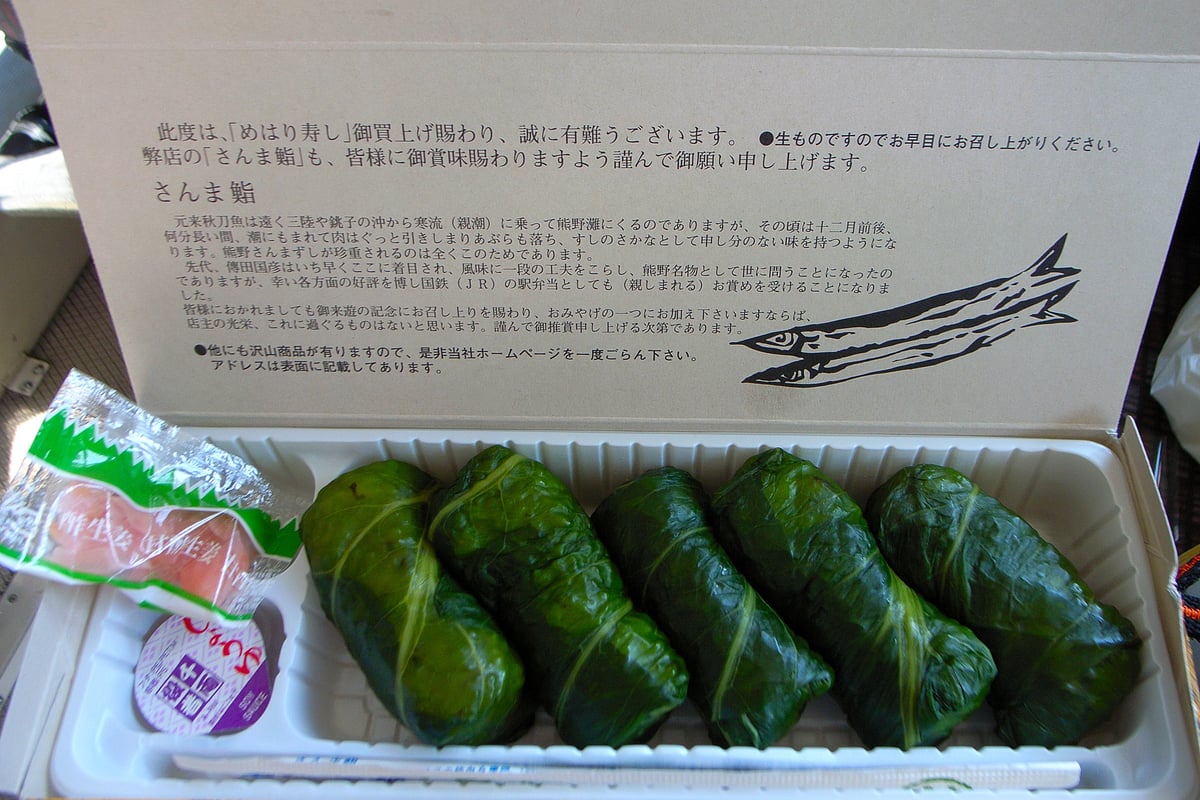
Image: Wikimedia Commons
Mehari zushi is a local dish of southern Wakayama Prefecture in which a large rice ball is wrapped in salt-pickled takana (leaf mustard) leaves. It is popular mainly in the Kumano region, including Shingu City, and also in the neighboring Kumano area of Mie Prefecture. In this area, where forestry and fishing thrive, it spread as a packed lunch that could be eaten quickly between work in the mountains or during busy fishing. The name is said to come from 'opening your mouth wide, as wide as your eyes open in amazement (me wo miharu), to eat it' or from 'so delicious it makes your eyes open wide.' According to the Ministry of Agriculture, Forestry and Fisheries, it also appears in the mid-Edo-period kabuki play 'Ise Ondo Koi no Netaba.' It used to be made large, but today smaller, easier-to-eat versions are the norm. Chopped takana stems, umeboshi (pickled ume plums), katsuobushi (dried bonito flakes), and the like are sometimes added to the rice, and each household and shop has its own variations. Shingu City has specialty shops, and it is also enjoyed as a specialty of Kumano tourism.
Origin
Southern Wakayama Prefecture is an area where forestry and fishing thrive. Mehari zushi is said to have begun as a packed lunch that woodcutters and ikadashi (raftsmen who assembled felled timber into rafts and floated them down rivers) made so they could eat right away between tasks. The takana used for wrapping is easy to grow even in places with little sunlight and was widely cultivated in mountainous areas. There are several theories about the origin of the name, including 'opening your mouth as wide as your eyes open in amazement to eat it,' 'so delicious it makes your eyes open wide,' and 'wrapping the rice ball up completely, as if sealing it (mehari).'
History
According to the Ministry of Agriculture, Forestry and Fisheries, mehari zushi also appears in the mid-Edo-period kabuki play 'Ise Ondo Koi no Netaba' and was a food known since long ago. In the past, it was made large so that it could be eaten quickly between tasks. In 1962 (Showa 37), 総本家めはりや was founded in Shingu City and is known for being one of the first to commercialize mehari zushi. Today, small rice balls are the norm, and the fillings mixed into the rice have become more varied.
Features
Takana is harvested from winter to early spring and salt-pickled in barrels around January and February. This takana is soaked in vinegar, and then the leaves are spread out and used to wrap the shaped rice. Besides plain white rice, sushi rice is sometimes used. Some shops mix chopped takana stems into the rice or season it with soy sauce, and grilled fish, umeboshi, or shirasu (whitebait) may also be added as fillings. Shingu City is said to produce takana with particularly large, tender leaves.
Main Ingredients
Food Culture
Born as a packed lunch for work in the mountains and for fishing, mehari zushi is still made today as a taste of home in the Kumano region. Some products are registered under 'Premier Wakayama,' Wakayama Prefecture's certification for excellent local products, and it is also sold as an ekiben (station boxed lunch) and as a souvenir. With changing fillings, it is being passed down to younger generations as well.
How It Differs from Home Cooking
At home, the basic method is the simple one of wrapping plain white rice in lightly pickled takana. At specialty shops, each shop has its own touches, such as using rice mixed with chopped takana stems and seasoned with a soy sauce-based sauce, or shaping each rice ball with warm rice as it is ordered.
Famous Shops
総本家めはりや 新宮本店
和歌山県新宮市薬師町5-6
Founded in 1962 (Showa 37), this shop is known for being one of the first to commercialize mehari zushi. Rice mixed with chopped takana stems and seasoned with a soy sauce-based sauce is shaped one piece at a time as each order comes in. A pack of four mehari zushi is about 560 yen. It also has a branch in Wakayama City.
| 和歌山水了軒 'Mehari Zushi' | An ekiben sold at JR Wakayama Station. It contains five bale-shaped mehari zushi made of soy sauce-based seasoned rice mixed with chopped takana and wrapped in pickled takana. It comes with sweet vinegared ginger. The price at the time it was featured in 2022 was 600 yen. |
|---|
FAQ
Q. What does 'mehari' mean?
A. There are several theories. Well-known explanations are that when eating a large rice ball you 'open your mouth as wide as your eyes open in amazement,' or that it is 'so delicious it makes your eyes open wide.' Another theory is that the rice ball is wrapped up completely in takana, as if sealing it (mehari).