Koyasan Goma Dofu (Sesame Tofu of Mount Koya)
Koyasan Goma Dofu (Sesame Tofu of Mount Koya)
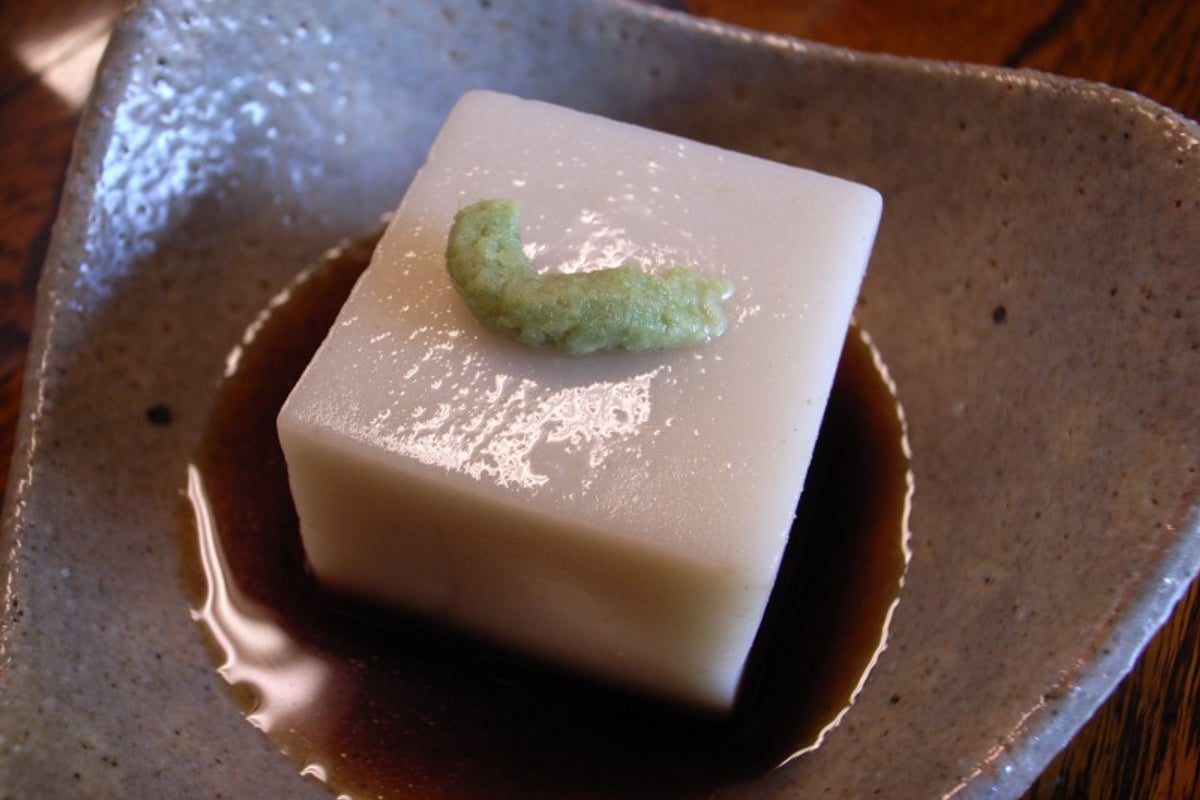
Image: Wikimedia Commons
Koyasan goma dofu is a dish of shojin cuisine (Buddhist vegetarian cuisine) made by kneading ground white sesame with Yoshino kuzu (kudzu starch) and water, then chilling it until it sets. Although it is called tofu, it contains no soybeans, and it is characterized by the aroma of sesame and a smooth, springy mouthfeel. According to the Ministry of Agriculture, Forestry and Fisheries, it is said to have originated as one of the shojin dishes eaten during rigorous ascetic training on Mount Koya (Koyasan), which Kobo Daishi (Kukai) founded about 1,200 years ago. In shojin cuisine, which uses no meat or fish, protein tends to be lacking. Goma dofu is said to have been created as a way to efficiently consume sesame, which contains high-quality protein. On Mount Koya, white goma dofu made with hulled white sesame is the mainstream, and it is generally eaten with wasabi and soy sauce. Even today it is an indispensable part of the shojin meals served at shukubo (temple lodging), and on the mountain there are long-established goma dofu shops dating back to the Meiji era and the early Showa era. It is also widely enjoyed as a souvenir of a pilgrimage.
Origin
According to the Ministry of Agriculture, Forestry and Fisheries' 'Uchi no Kyodo Ryori' (Our Local Cuisine), goma dofu is said to have originated on Mount Koya, founded by Kobo Daishi, as shojin cuisine for monks in training. There is also a legend that Kukai brought sesame back from Tang China, but sesame is thought to have been cultivated in Japan before Kukai's time. Another theory traces its origin to the '麻豆腐' described in the Wakan Shojin Ryori Sho, published in 1697 (Genroku 10), so there are various theories about where it came from.
History
Goma dofu was an indispensable part of the meals of monks training on Mount Koya. Even today it is a standard shojin dish served at meals on Mount Koya and at Zen temples. On the mountain, 濱田屋 is said to have been founded in the Meiji era, and 角濱総本舗 began producing goma dofu in the early Showa era. In 1965 (Showa 40), 角濱 developed goma dofu sterilized by high-temperature heating and obtained a patent for it; this gave the goma dofu a longer shelf life, and it spread nationwide as a souvenir.
Features
Koyasan goma dofu is made by grinding hulled white sesame, adding pure Yoshino kuzu and water, kneading the mixture over heat, and then chilling it until it sets. Unlike the brown goma dofu of Eihei-ji temple in Fukui Prefecture, which uses roasted unhulled sesame, it is white in color and has a refined sesame flavor. It is generally eaten with wasabi and soy sauce or with vinegared miso, and it is also sometimes enjoyed like a sweet, topped with brown sugar or kuromitsu (brown sugar syrup).
Main Ingredients
Food Culture
Goma dofu is a standard shojin dish served at the shukubo on Mount Koya. Today it has also become a souvenir of pilgrimages and an everyday food that can be bought at supermarkets. Locally, there are also programs in which children learn everything from growing sesame to making goma dofu.
How It Differs from Home Cooking
At home, using sesame paste saves the trouble of grinding the sesame and makes goma dofu easy to prepare. The long-established shops on Mount Koya use only hulled white sesame, pure Yoshino kuzu, and the mountain's spring water, kneading the mixture carefully to bring out a smooth texture and a refined sesame aroma.
Famous Shops
濱田屋
和歌山県伊都郡高野町高野山444
A long-established goma dofu shop said to have been founded in the Meiji era. It makes its goma dofu using only natural spring water from Mount Koya, hulled white sesame, and pure kuzu. You can enjoy it in the shop for about 400 yen per piece, and takeout starts from about 1,600 yen for a box of four. Because sales end once everything is sold out, reservations are recommended.
角濱ごまとうふ総本舗 大門店
和歌山県伊都郡高野町高野山230
A long-established eatery that has supplied goma dofu to Kongobu-ji, the head temple, and other temples since its founding in 1927. It stands near the Daimon gate at the entrance to Mount Koya. A kaiseki meal centered on goma dofu is about 2,300 yen, and goma dofu to take home as a souvenir can also be purchased.
| 大覚総本舗 'Koyasan Goma Dofu' | A souvenir product from 大覚総本舗, which makes and sells goma dofu on Mount Koya. It is said to have received recommendations such as Wakayama Prefecture's excellent souvenir designation. You can choose from a box of four 120 g pieces of goma dofu for about 1,579 yen (tax included) or a box of six for about 2,249 yen (tax included). |
|---|
FAQ
Q. Are goma dofu and koya-dofu the same thing?
A. They are different foods. Goma dofu is a dish made from sesame and kuzu and uses no soybeans. Koya-dofu is a preserved food made by freezing and drying soybean tofu. Because both are known as shojin dishes associated with Mount Koya, their names are easily confused.