Image: Wikimedia Commons
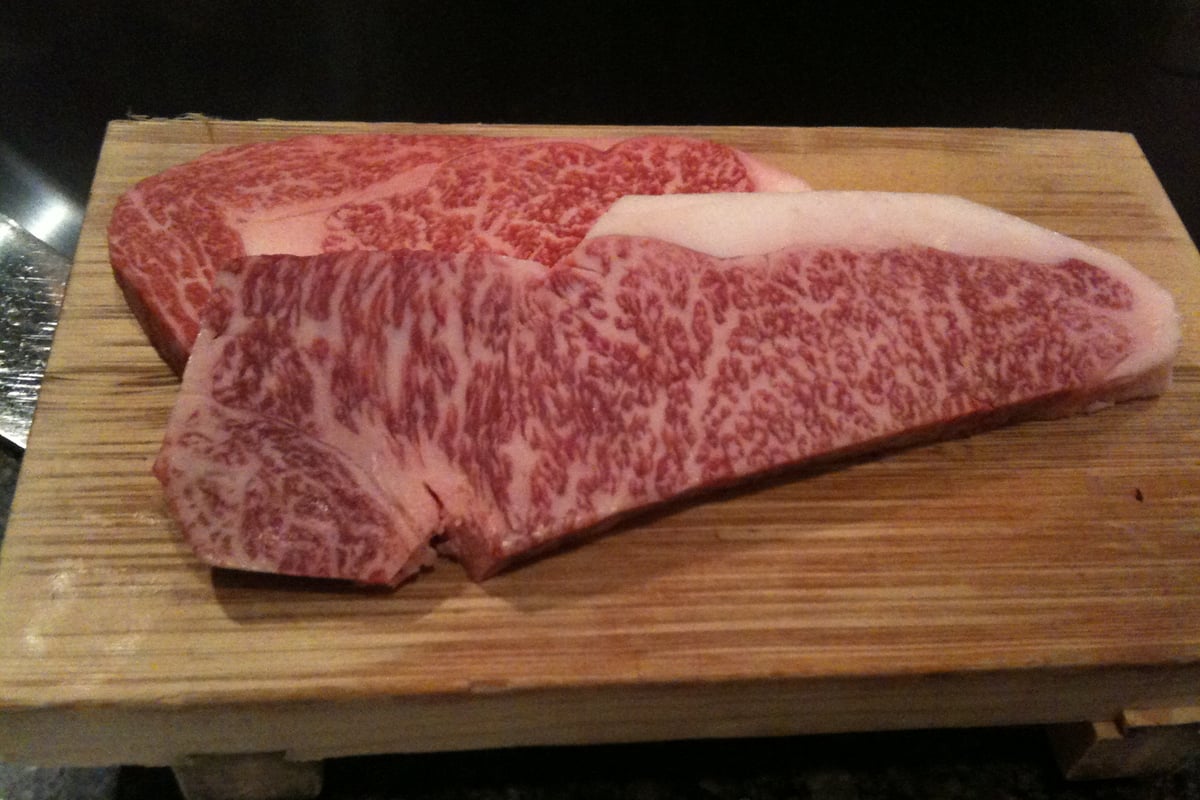
Kobe Beef is a brand name given only to beef from Hyogo-raised Tajima cattle (Tajima-ushi / Tajima-gyu) that meets strict standards. Also called 'Kobe Meat' (Kobe Niku) and 'Kobe-gyu', it was registered as a national Geographical Indication (GI) in 2015 (Heisei 27). The standards are set by the Kobe Beef Marketing and Distribution Promotion Association, established in 1983 (Showa 58). The Tajima cattle that serve as the source cattle (motoushi) originate from cattle used for farm work for about 1,200 years in the Tajima region of northern Hyogo Prefecture. After the Port of Kobe opened in 1868 (Meiji 1), foreigners praised its flavor highly, and the name 'Kobe Beef' spread around the world. It is characterized by fine marbling and the sweetness of fat that seems to melt in the mouth. Certified meat is stamped with the 'Nojigiku stamp', shaped like the nojigiku, Hyogo's prefectural flower. Besides being enjoyed as steak and sukiyaki, it is known overseas as a byword for premium wagyu.
Origin
Tajima cattle, the source cattle of Kobe Beef, have long been kept in the mountain valleys of the Tajima region in northern Hyogo Prefecture as working cattle for farming and hauling. According to the Geographical Indication registration documents, their history is said to date back about 1,200 years. According to the Kobe Beef Marketing and Distribution Promotion Association, Tajima cattle have kept their bloodline pure from the Edo period to the present day, without crossing with other lineages. This long accumulation of breeding improvement forms the foundation for their fine marbling.
History
When the Port of Kobe opened in 1868 (Meiji 1), many foreigners came to live in Kobe. The Association relates that the first to eat Tajima cattle obtained from farmers were the British, and that the flavor became widely known under the name 'Kobe Beef'. There is also an anecdote that Ito Hirobumi, who became the first governor of Hyogo Prefecture that same year, was fond of eating it. In 1983 (Showa 58), the Kobe Beef Marketing and Distribution Promotion Association was launched and set out the definition, and in 2012 (Heisei 24), exports to Macau began.
Features
Only heifers that have never calved or steers (castrated males) among Hyogo-raised Tajima cattle can be certified as Kobe Beef. The conditions are a BMS (Beef Marbling Standard), which shows the degree of marbling, of No. 6 or higher; a yield grade, which shows the proportion of edible meat, of A or B; and a meat quality grade of 4 or higher. There are also upper limits on carcass weight, such as 499.9 kg or less. Fattening takes about two years, and the cattle are shipped at around 30 to 32 months of age. Fat with a melting point so low that it melts at the temperature of human skin is finely interspersed through the lean meat, creating a melt-in-the-mouth texture.
Main Ingredients
Food Culture
In Kobe, shops dealing in beef opened from the Meiji period onward, and long-established steakhouses and butcher shops still stand in Sannomiya and Motomachi. Besides teppanyaki-style steak, the beef has been enjoyed in many forms, such as sukiyaki and miso-marinated beef. Certifications are limited to about 7,000 head per year, said to be less than 0.2% of Japan's domestic beef consumption.
Famous Shops
モーリヤ本店
兵庫県神戸市中央区下山手通2-1-17
Founded in 1885 (Meiji 18), this is a long-established steakhouse representative of Kobe. It serves Kobe Beef and carefully selected beef that carries on the Tajima cattle bloodline. Each floor has counter seats with an iron griddle, where diners can enjoy steak grilled right in front of them. It is a short walk from Sannomiya Station.
大井肉店
兵庫県神戸市中央区元町通7-2-5
A long-established shop that opened in 1871 (Meiji 4) as Kobe's first beef specialty shop. The founder, 岸田伊之助, is said to have had a keen eye for cattle and a talent for business. In addition to selling meat, the main store also serves dishes such as steak and hamburg steak.
| 大井肉店 'Gyuniku Misozuke' (miso-marinated beef) | A product of beef marinated in miso, which 大井肉店 began making and selling in 1902 (Meiji 35). It is said to have spread nationwide along with 'Gyuniku Tsukudani' (beef tsukudani). Because it only needs to be grilled, it is popular as a gift that lets people easily enjoy the taste of a long-established Kobe shop. |
|---|
FAQ
Q. What is the difference between Kobe Beef and Tajima cattle?
A. Tajima cattle is the name of the cattle themselves, raised in Hyogo Prefecture with managed bloodlines. Kobe Beef is a name permitted only for meat from Tajima cattle that meets standards such as marbling and weight. In other words, all Kobe Beef comes from Tajima cattle, but not all Tajima cattle become Kobe Beef.
Q. Is there a cattle breed called 'Kobe-gyu'?
A. No. 'Kobe-gyu' is a meat brand name, not the name of a cattle breed. The official names are 'Kobe Niku' (Kobe Meat) and 'Kobe Beef', and 'Kobe-gyu' is also included among the names under the Geographical Indication. The Kobe Beef Marketing and Distribution Promotion Association recommends the name 'Kobe Beef'.