Image: Wikimedia Commons
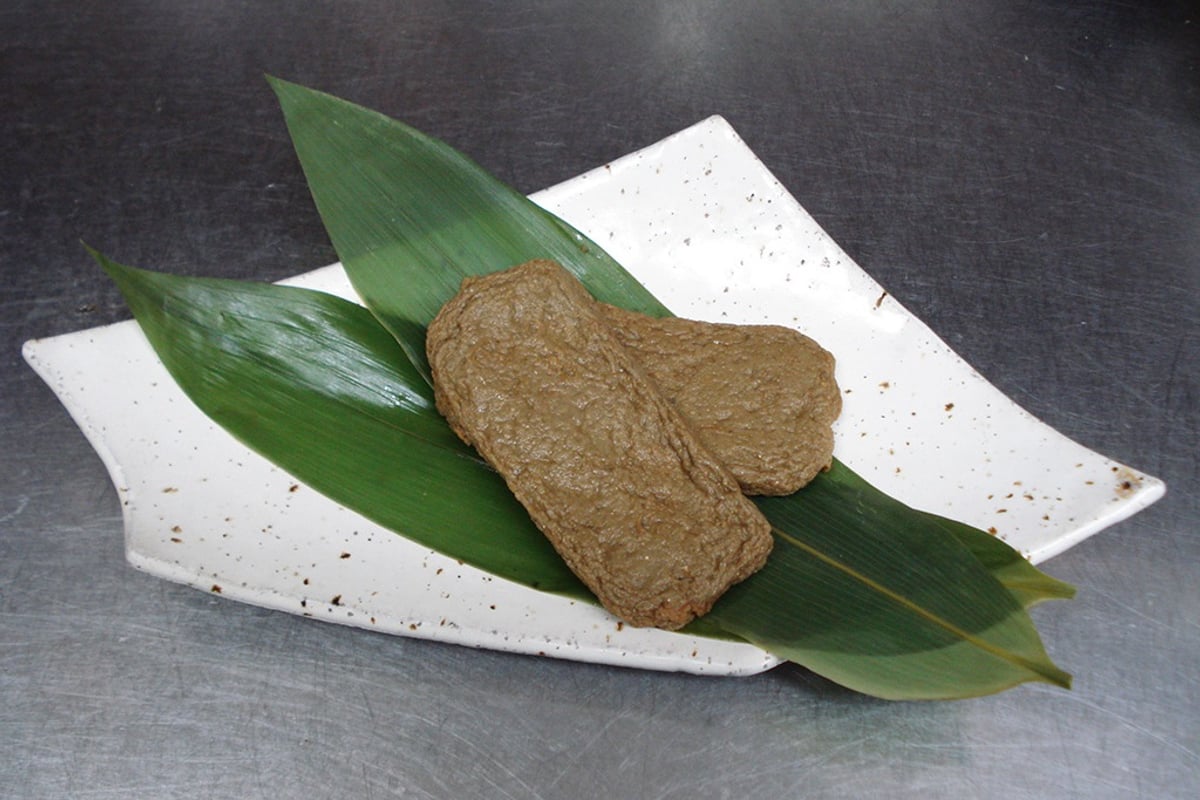
Jakoten is a fish paste product made mainly in Uwajima City and Yawatahama City in the Nanyo (southern Ehime) region of Ehime Prefecture. The heads and innards of small fish such as hotaru-jako (glowbelly, known locally as 'haranbo') are removed, and the fish are ground up bones, skin and all, shaped into oval patties, and deep-fried in oil. Because even the bones and skin are used, it is packed with the savory flavor of the fish and is said to be rich in calcium. In Uwajima, fried fish paste has been called 'tenpura,' and versions made with the skin and bones have been distinguished as 'kawa-tenpura' (skin tenpura). A well-known theory holds that it originated when Date Hidemune, the first lord of the Uwajima domain, brought kamaboko (fish cake) makers from Sendai. Besides being eaten freshly fried as is, it is lightly grilled and served with grated daikon or ginger, or used as an ingredient in oden, udon and curry, making it an indispensable part of everyday meals in Nanyo. In Uwajima City and Yawatahama City, there are also kamaboko shops where you can try making jakoten.
Origin
According to materials from the Ministry of Agriculture, Forestry and Fisheries, its beginnings are said to be recorded in the history of the Uwajima domain. The account says that in 1615 (Genna 1), Date Hidemune, the first lord of the Uwajima domain, longing for his home, brought kamaboko makers from Sendai and had them make it. Hidemune was the eldest son of Date Masamune. On the other hand, there is also a theory that kamaboko was already being made in Uwajima, where fish were plentiful, before Hidemune entered the castle.
History
Jakoten was originally a home-cooked dish along the Uwa Sea, called 'tenpura' as a way to enjoy small mixed fish deliciously. Eventually it came to be made by fishmongers and kamaboko shops as well, and the version using the bones and skin was distinguished as 'kawa-tenpura' and the version using only the flesh as 'mi-tenpura.' The name 'jakoten' is said to have been given when it was marketed outside the prefecture. The kamaboko cooperative in Uwajima City works to promote it, for example by publishing a map of shops where jakoten can be bought.
Features
The main ingredient is hotaru-jako (glowbelly), a fish about 10 cm long caught in the Uwa Sea. It is a white-fleshed fish with a black inner throat, and its name comes from the way it glows bluish-white from the belly to the tail. At 安岡蒲鉾 (Yasuoka Kamaboko) in Uwajima, hotaru-jako is combined with other small fish from nearby waters, such as horse mackerel and croaker; each fish is cleaned by hand, then the paste is kneaded in a stone mortar and fried in rapeseed oil. There are also recipes that use lizardfish skin or horse mackerel flesh, and the flavor changes depending on the blend of fish.
Main Ingredients
Food Culture
In Nanyo, jakoten is eaten year-round as a side dish and as a snack with drinks. It is said that oden in Uwajima City almost always includes jakoten. 'Tenpura curry,' which uses jakoten instead of meat, is a familiar home-cooked dish in the production area, and 'jako katsu,' coated in breadcrumbs and fried, is also made.
Famous Shops
安岡蒲鉾 本社・工場
愛媛県宇和島市三間町中野中293
A kamaboko maker founded in 1952 (Showa 27), whose factory production line can be toured for free. A hands-on jakoten-making experience is also available by reservation; the official website states that it costs 1,500 yen for adults and 1,000 yen for elementary school children and younger, and is accepted for groups of two or more. Its products are also sold at the shop in Michi-no-Eki Mima (roadside station), at JR Matsuyama Station and at Matsuyama Airport.
View details →谷本蒲鉾店
愛媛県八幡浜市駅前1
A long-established kamaboko shop in Yawatahama said to have been founded in 1916 (Taisho 5). At its production factory 'できるん' near JR Yawatahama Station, there is an experience in which you make two pieces of jakoten and one chikuwa on a bamboo stick; it is described as costing 1,100 yen for adults and 880 yen for junior high school students and younger, and is accepted for groups of five or more. There is also a Dogo branch in front of the Dogo Onsen Honkan in Matsuyama City.
View details →道の駅 みなとオアシスうわじま きさいや広場
愛媛県宇和島市弁天町1-318-16
A roadside station near Uwajima Port that is described as selling freshly fried jakoten. It also has a food court where you can enjoy dishes such as Uwajima Taimeshi, and the Uwajima local cuisine restaurant かどや (Kadoya) has had an outlet here since 2009. It is about a 15-minute walk from JR Uwajima Station.
| Assortment of jakoten and kamaboko | 安岡蒲鉾 (Yasuoka Kamaboko) also sells assortments of jakoten, kamaboko and chikuwa at 'だんだん通り' inside JR Matsuyama Station and at the shop on the second floor of Matsuyama Airport. Even just before leaving Matsuyama, you can buy Uwajima jakoten as a souvenir. |
|---|
FAQ
Q. Where does the name 'jakoten' come from?
A. One theory is that because it was made from various small mixed fish (zako) caught in bottom trawl nets, it was called 'zakoten,' which later changed to 'jakoten.' Another theory links it to its main ingredient, hotaru-jako (haranbo), and the origin is not clear.
Q. How is hotaru-jako, the main ingredient, caught?
A. According to 安岡蒲鉾 (Yasuoka Kamaboko), in Uwajima fishermen who specialize in hotaru-jako catch it using a fishing method called 'buri-ami.' Here 'buri' refers to the floats attached to the net, not the fish called buri (yellowtail). Outside Uwajima, it is said to be landed mainly by bottom trawl nets. It is a fish that is rarely seen at fish shops.