Image: Wikimedia Commons
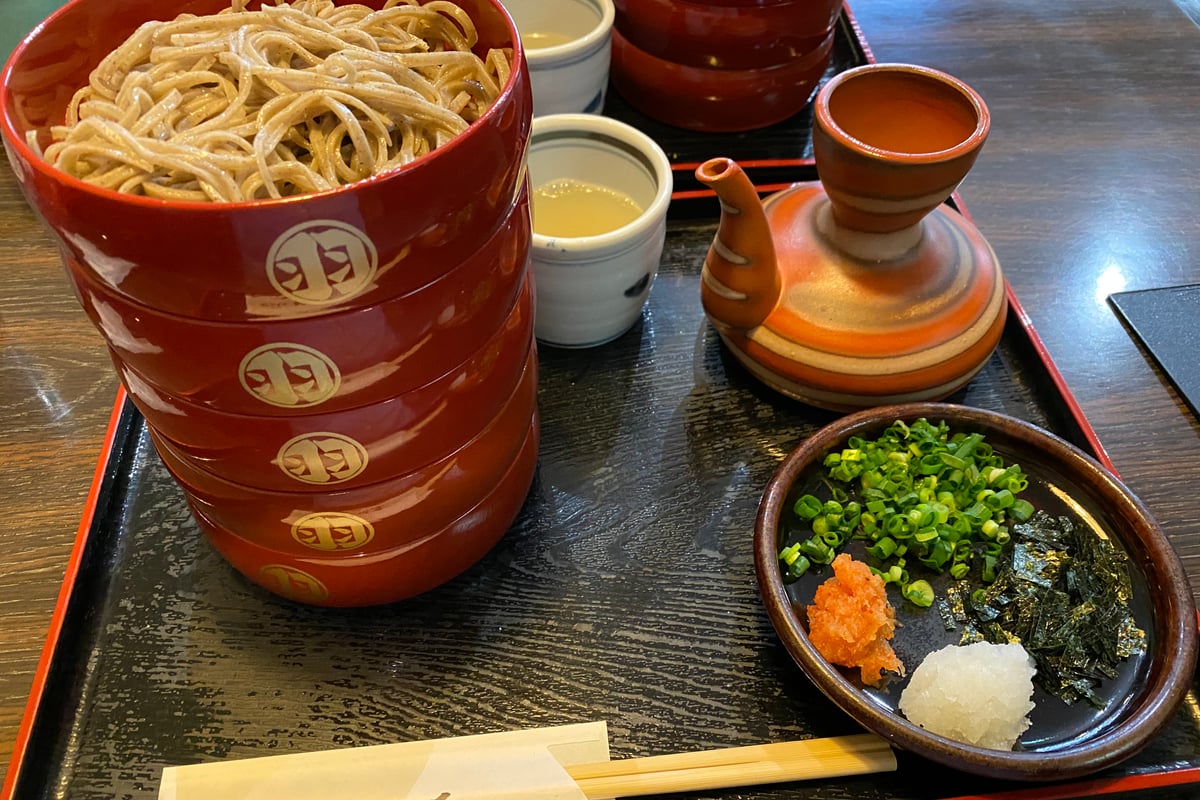
Izumo soba is the soba (buckwheat noodles) traditionally eaten in the Izumo region in eastern Shimane Prefecture. Along with Iwate's wanko soba and Nagano's Togakushi soba, it is counted as one of Japan's three great soba styles. Because the noodles are made by hikigurumi (whole-grain milling), in which buckwheat seeds are ground on a millstone together with their inner husk, they are dark in color and have a strong aroma and flavor. There are two typical ways of eating it. One is warigo soba, in which cold soba is served in stacked round lacquerware dishes called warigo and eaten with the broth poured directly over it. The other is kamaage soba, a hot dish in which boiled soba is placed in a bowl together with its cooking water and eaten with broth and condiments added. A widely known theory holds that it began in the early Edo period, when Matsudaira Naomasa brought soba makers along on moving from the Matsumoto domain in Shinano Province to the Matsue domain. In front of Izumo Taisha and in the castle town of Matsue, there are many soba shops, including long-established ones that have continued since the Edo period.
Origin
In the Izumo region, soba, which grows even in poor mountain fields, has been cultivated since ancient times, and it is also said that in Okuizumo it has been eaten since the Heian period. Soba in noodle form (soba-kiri), the forerunner of today's Izumo soba, is said to have been introduced in the early Edo period. A widely known theory holds that in Kan'ei 15 (1638), when Matsudaira Naomasa, lord of the Matsumoto domain in Shinano Province, moved to the Matsue domain in Izumo Province on the orders of Tokugawa Iemitsu, Naomasa brought soba makers from Matsumoto.
History
In the Edo period, the Matsue domain is said to have encouraged eating soba, and soba culture spread in Izumo. Warigo soba is said to have been born in the castle town of Matsue in the Edo period, and kamaage soba in the area around Izumo Taisha. Kamaage soba is said to have begun when food stalls served new-crop soba hot around the time of the Kamiari-sai festival in the tenth month of the old lunar calendar. This was because the soba could not be rinsed in water at the stalls. In March 2022, Izumo soba was recognized by the Agency for Cultural Affairs as a 100-Year Food (in the Traditional 100-Year Food category).
Features
Because it is made by hikigurumi, grinding the buckwheat together with its inner husk, it is dark in color, with a strong aroma and a firm, chewy texture (koshi). According to materials from the Ministry of Agriculture, Forestry and Fisheries, the wheat flour used as a binder is relatively little, at about 20 percent. For warigo soba, the noodles are served in round vermilion-lacquered warigo stacked about three high, topped with condiments, and eaten with the broth poured directly over them. Because the noodles are rinsed in cold water after boiling, it is also called arai ('washed'). For kamaage soba, the noodles are served unrinsed in a bowl together with the thick soba cooking water (soba-yu), and the flavor is adjusted to taste with broth and condiments.
Main Ingredients
Food Culture
The Izumo way of eating warigo soba is to work through it one tier at a time, adding condiments and broth to each tier. The soba shop associations of Izumo City and Matsue City have designated February 11, the day Matsudaira Naomasa received the order to move to the Matsue domain, as 'Izumo Soba Day,' and in 2022 it was certified and registered by 日本記念日協会 (Japan Anniversary Association).
Famous Shops
出雲そば 荒木屋
島根県出雲市大社町杵築東409-2
A long-established shop near Izumo Taisha, described as founded in the Tenmei era (1780s). It uses domestic buckwheat, mainly from Izumo. Its warigo soba, served in vermilion-lacquered warigo, is listed at 1,080 yen on the official website. Besides kamaage soba and kamo nanban (soba with duck), it also offers a special soba zenzai.
View details →献上そば 羽根屋 本店
島根県出雲市今市町549
A handmade soba shop founded in the late Edo period, about a 10-minute walk from JR Izumoshi Station. The shop name, which includes the word kenjo ('presented'), is said to come from the shop having presented soba during Emperor Taisho's imperial visit to the San'in region. Travel information sites describe the three-tier warigo soba at about 900 yen and the three-color warigo at about 1,050 yen.
八雲庵
島根県松江市北堀町308
An Izumo soba shop on a street lined with samurai residences along the moat of Matsue Castle. Diners can eat while looking out over the garden, and besides warigo soba, its hot kamo nanban is also known as a specialty. The shop is said to close once the soba runs out.
| 献上そば 羽根屋の半生そば・干しそば | Izumo soba sold by mail order by 羽根屋, including semi-fresh (han-nama) soba and dried soba for home use, packaged together with soba broth. On its Rakuten Ichiba store, a trial set for sampling both semi-fresh and dried soba is listed at 1,850 yen.Where to buy →PR |
|---|
FAQ
Q. What does 'warigo' mean?
A. Warigo originally meant a lunch box, and in Izumo soba it refers to round lacquerware dishes. In Matsue in the Edo period, people carried soba around in square boxes. Because the corners of square boxes were hard to wash, the boxes are said to have gradually become round.