Image: Wikimedia Commons
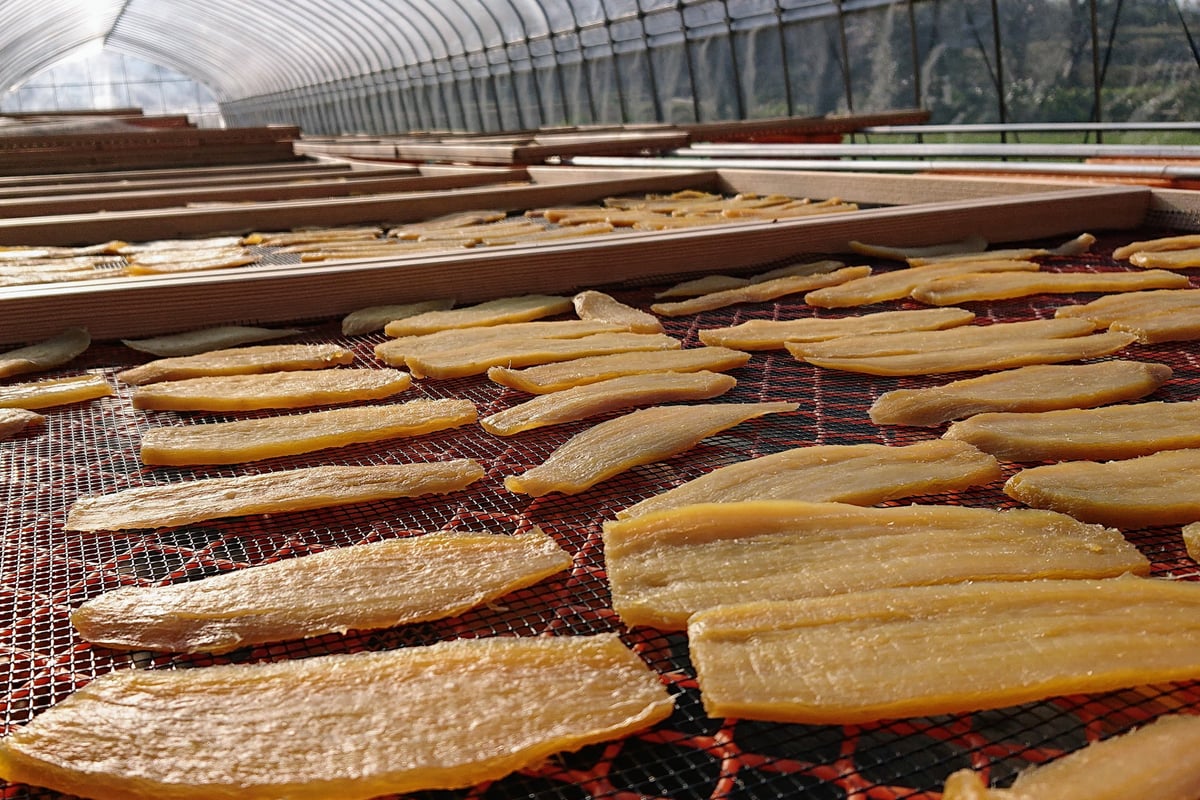
Hoshi imo is a preserved food made by steaming sweet potatoes, slicing them thin, and drying them in the sun; the coastal area of Ibaraki Prefecture centered on Hitachinaka City and Tokai Village accounts for the great majority of Japan's national production. Ibaraki's production is said to originate around 1908, when Terunuma Kantaro brought back a method he had seen in Shizuoka, prompting Yuasa Toshichi, a cracker maker in Minato (present-day Hitachinaka City), and others to begin making hoshi imo. The number of producers grew steadily from the Taisho era into the early Showa era, and after the war, production expanded rapidly with prefectural encouragement; by around 1955, Ibaraki had overtaken Shizuoka Prefecture, the birthplace of the product, to become Japan's top producing region. Taking advantage of the coastal area's winter sea breezes and ample sunshine, the region offers a range of flavors and textures across varieties, from the long-established Tamayutaka to the popular newer Beniharuka, and hoshi imo remains a beloved souvenir representative of Ibaraki today.
Origin
Ibaraki's hoshi imo is said to have originated around 1908, when Terunuma Kantaro observed the 'mushi-kiriboshi' method of steaming and thinly slicing sweet potatoes before drying them, which had been devised in Shizuoka Prefecture, and brought it back home, prompting Yuasa Toshichi, a cracker maker in Minato (present-day Hitachinaka City), and others to begin producing hoshi imo. In neighboring Ajigaura, Koike Kichibei and others also took up production, and the technique spread throughout the coastal area.
History
The number of producers grew steadily from the Taisho era into the early Showa era, reaching 2,350 producing households and about 3,260 tons of output within the prefecture by 1933. Production declined during the war as sweet potatoes were diverted to staple food use, but recovered afterward with prefectural encouragement, and by around 1955 Ibaraki had overtaken Shizuoka Prefecture, the birthplace of the product, to become Japan's top producing region, a position it continues to hold, accounting for the great majority of the national market today.
Features
Taking advantage of the winter sea breezes and ample sunshine of coastal areas such as Hitachinaka City and Tokai Village, hoshi imo is made using the 'mushi-kiriboshi' method of steaming sweet potatoes, slicing them thin, and drying them in the sun. Part of the appeal is being able to compare varieties, from the long-established Tamayutaka, known for its moist, refined sweetness, to Beniharuka, prized for its vivid orange color and rich sweetness, each with its own distinctive texture and flavor.
Food Culture
Around Hitachinaka City, fields covered entirely in drying hoshi imo during the winter farming off-season have become a seasonal local sight, and the area is home to numerous direct-sale stands and hoshi imo specialty shops. Producers also engage in outreach and tasting events, working together as a region to build the brand's reputation.
Famous Shops
マルヒ
茨城県ひたちなか市阿字ヶ浦町385-1
A specialty shop in Ajigaura that produces and sells hoshi imo. Flat dried sweet potato (Tamayutaka and Beniharuka varieties) starts at around 340 yen.
View details →| 干しいも(照沼) | Hoshi imo made by a Hitachinaka City producer committed to organically grown sweet potatoes, offered in a variety of forms through the online store.Where to buy →PR |
|---|