Okonomiyaki (Hiroshima Style)
Hiroshima-Style Okonomiyaki (Layered Savory Pancake)
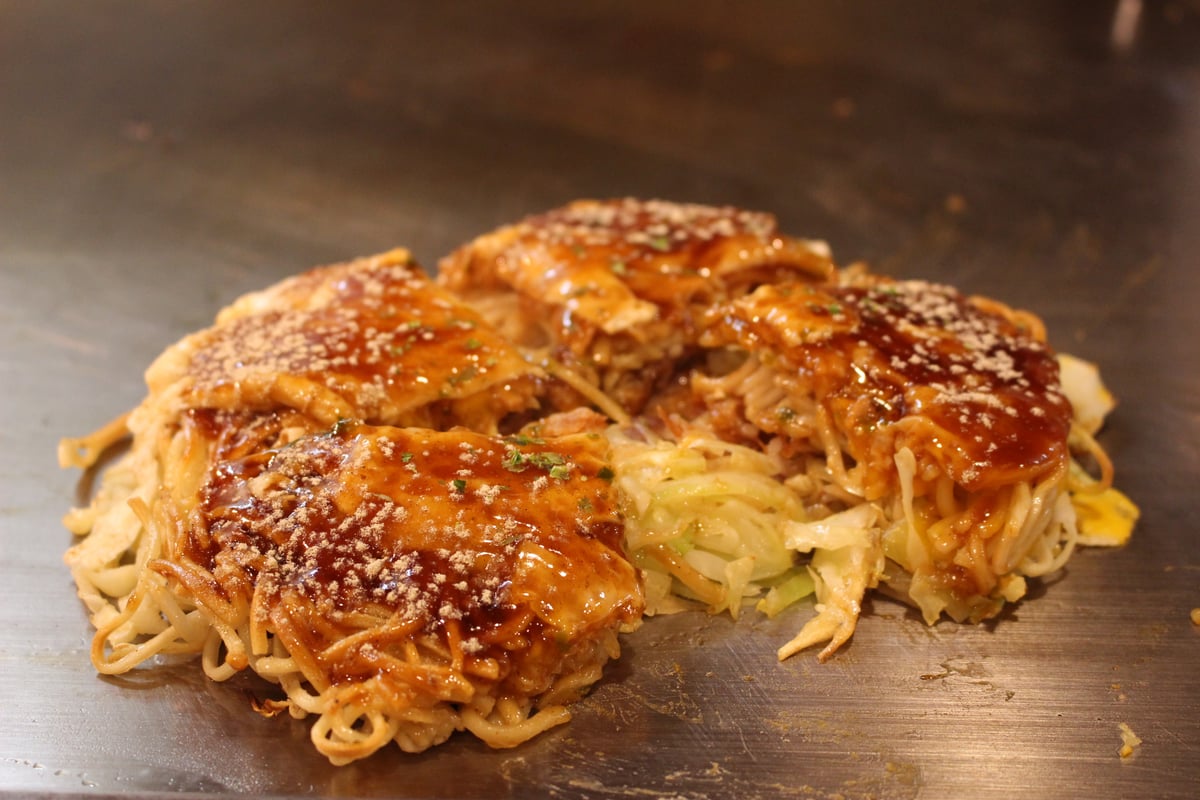
Image: Wikimedia Commons
Okonomiyaki (Hiroshima Style) is a flour-based dish (konamon) eaten as everyday food in Hiroshima Prefecture. Its hallmark is kasane-yaki (layered grilling): a batter of wheat flour mixed with water is spread thinly into a circle on an iron griddle, and cabbage, bean sprouts, pork belly and other ingredients are layered on top in order and cooked. This makes it very different in preparation from Okonomiyaki (Osaka Style), in which the ingredients are mixed into the batter before cooking. Another feature unique to Hiroshima is adding grilled Chinese-style noodles (called 'soba' locally) or udon and finishing it together with a thin layer of cooked egg. Finally, a thick, sweetish okonomi sauce is spread on top, and it is sprinkled with aonori (green laver) and other toppings. Locally, the standard order with pork, egg and noodles is called 'niku-tama soba.' According to お好み焼アカデミー (Okonomiyaki Academy), there are said to be more than 1,600 okonomiyaki shops in the prefecture and about 800 in Hiroshima City alone. As a food that sustained people through the postwar reconstruction period, it is still loved today as the soul food of the people of Hiroshima.
Origin
The forerunner of Hiroshima okonomiyaki is said to be issen yoshoku (a prewar flour-batter snack), which was popular as a treat for children before the war. It was a simple light meal of wheat flour mixed with water, cooked thin and spread with Worcestershire sauce. In postwar Hiroshima, which the atomic bombing had reduced to burnt ruins, stalls selling issen yoshoku made with rationed wheat flour appeared and filled empty stomachs in a time of food shortages. It is said that at first it contained no meat or eggs, and was made by placing vegetables on the batter and folding it in half as it cooked.
History
According to Hiroshima Prefecture, by around 1950 the name 'okonomiyaki,' meaning 'cooked with whatever you like,' had spread. With the addition of cabbage and Chinese noodles (chuka soba), the basic Hiroshima form took shape. In 1952, a Hiroshima condiment maker (today's Otafuku Sauce) responded to the problems faced by stall owners and launched a thick 'okonomi sauce.' The stalls that gathered in Shintenchi Square in central Hiroshima City after the war later moved into a building and became Okonomimura (お好み村).
Features
Its greatest feature is that the batter and ingredients are layered rather than mixed. Plenty of cabbage, bean sprouts, tenkasu (tempura bits), pork belly and so on are placed on the thinly spread batter, which is then flipped so that the batter acts as a lid and the vegetables are steam-grilled. This is stacked on top of soba or udon stir-fried separately, then placed on a thinly cooked egg and flipped over. The traditional style is to eat it directly from the griddle with a small spatula, cutting it into a grid as you go.
Main Ingredients
Food Culture
Within the prefecture there are also local variations by area, known as 'gotochi-yaki.' Bingo Fuchu-yaki from Fuchu City uses minced meat instead of pork belly, and Mihara-yaki from Mihara City includes chicken offal. In 'Inoko' from Innoshima in Onomichi City, versions with udon are the mainstream. All of these have been recognized as the Agency for Cultural Affairs' '100-Year Food.'
Famous Shops
お好み焼 みっちゃん総本店 八丁堀本店
広島県広島市中区八丁堀6-7 チュリス八丁堀1F
A long-established shop described as founded in 1950 (Showa 25), which started as a postwar food stall. It is known as the shop of Iune Mitsuo, nicknamed 'Micchan,' and is also said to be one of the originators of okonomiyaki with noodles. Its signature menu item is 'soba niku tamago' (noodles, pork and egg), and there are other branches in the city, such as the Orizuru Tower shop.
薬研堀 八昌
広島県広島市中区薬研堀10-6
A shop also called 'Ao-Hassho' (Blue Hassho) because of its blue noren curtain and eaves. It is regarded as the starting point of the 'Hassho lineage,' in which many shops in the city are connected by master-apprentice relationships. Its most popular item is 'soba niku tama,' and because each one takes time to cook, there is often a wait. Gourmet sites state that it is closed on Mondays and on the first and third Tuesdays.
お好み村
広島県広島市中区新天地5-13
A building housing a collection of okonomiyaki shops, originating from the food stalls that gathered in Shintenchi Square after the war. It was rebuilt as the current building in 1992, and according to a 2021 news report, 23 shops occupied the second to fourth floors. At counters surrounding the griddles, you can enjoy freshly cooked okonomiyaki while chatting with the owners.
| みっちゃん総本店 Frozen Hiroshima-Style Okonomiyaki | A product in which 'soba niku tamago,' a popular menu item at みっちゃん総本店 (Micchan Sohonten), is handmade one at a time and frozen. It can be heated in a microwave and comes with a special sauce. It is certified as Hiroshima City's 'The Hiroshima Brand' (ザ・広島ブランド), and can be bought at places such as Omiyage Kaido in ekie at Hiroshima Station and at Hiroshima Airport. The price is given as 1,188 yen (tax included).Where to buy →PR |
|---|---|
| Otafuku Okonomi Sauce | A thick, sweetish sauce that grew up together with Hiroshima's okonomiyaki shops. Its distinguishing feature is a viscosity that keeps it from running off the okonomiyaki, and it is also certified as Hiroshima City's 'The Hiroshima Brand' (ザ・広島ブランド). Widely sold in supermarkets and elsewhere in the prefecture, it is indispensable when making Hiroshima-style okonomiyaki at home. |
FAQ
Q. Is it okay to call it 'Hiroshima-yaki'?
A. Outside the prefecture it is sometimes called 'Hiroshima-yaki,' but people in Hiroshima generally just call it 'okonomiyaki.' Hiroshima Prefecture's official website also introduces it as 'okonomiyaki,' neither 'Hiroshima-style' nor 'Hiroshima-yaki.' At local shops, saying 'okonomiyaki' is enough to be understood.
Q. Why do so many shop names end in '-chan'?
A. It is said that this is because many women who had lost their husbands to the war or the atomic bombing opened shops to make a living. Another reason is said to have been to make the shops easy to find for family members returning from the battlefront. Even today, many shop names look like women's names, such as 'Micchan' and 'Rei-chan.'