Botchan Dango (Three-Color Dumplings)
Botchan Dango (Three-Color Skewered Dumplings of Dogo)
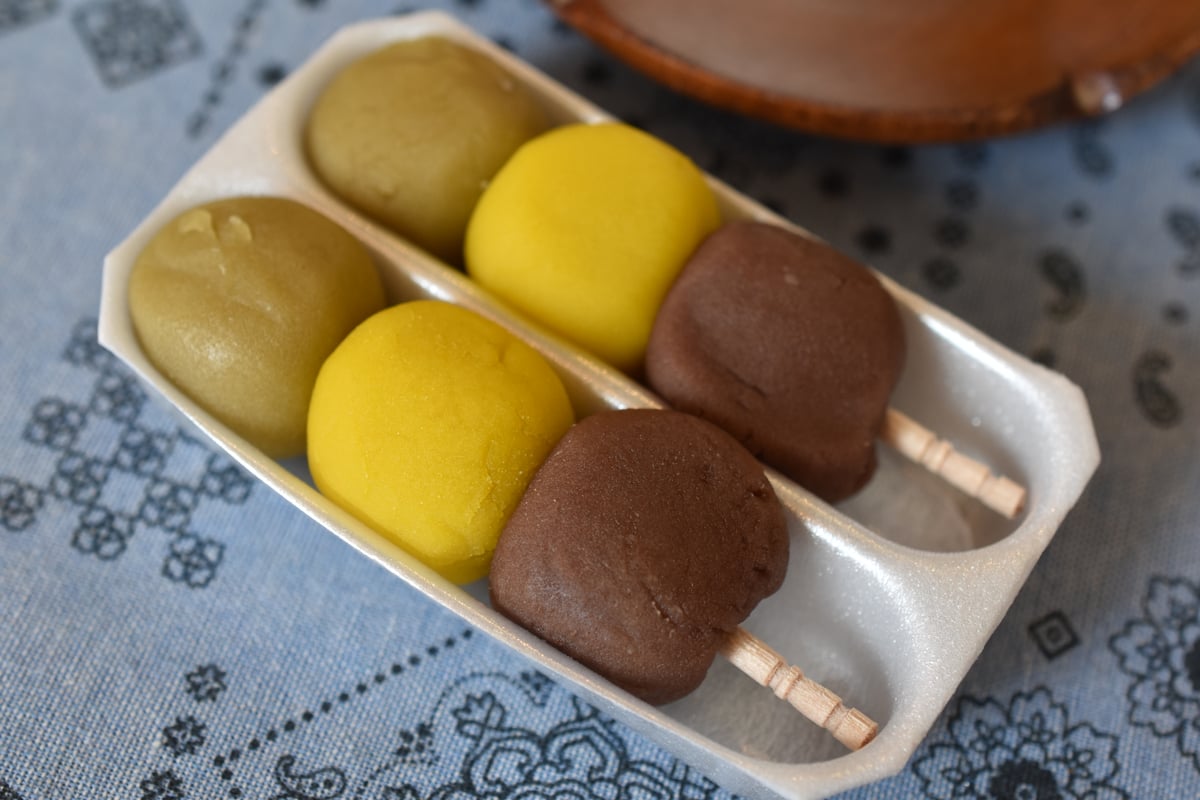
Image: Wikimedia Commons
Botchan Dango are skewered dumplings, a famous confection of Matsuyama City, Ehime Prefecture, known as a specialty of Dogo Onsen. Soft mochi is wrapped in bean paste of three colors, matcha, yellow and azuki, and the pieces are put on a single skewer. They were named after a scene in Natsume Soseki's novel 'Botchan' in which the protagonist stops at a dumpling shop on his way back from the hot spring and eats dumplings. Soseki's experiences while teaching in Matsuyama are said to have provided material for the novel. However, the dumplings in the novel were a different kind called 'yuzarashi dango,' and today's three-color dumplings are said to have been devised after the novel was published, in 1921 (Taisho 10), by つぼや菓子舗 in Dogo. Today they are made by several confectionery companies in Matsuyama City and can be bought in the Dogo Onsen shopping arcade, at stations, ports and airports, and elsewhere. About the size of a palm, they are enjoyed as a not-too-sweet treat to go with tea.
Origin
Soseki was posted to Ehime Prefectural Ordinary Middle School as an English teacher in 1895 (Meiji 28) and spent about a year in Matsuyama. 'Botchan,' published in 1906 (Meiji 39), contains a scene in which the protagonist eats dumplings in a town with a hot spring, and the next day finds 'Two plates of dumplings, 7 sen' written on the classroom blackboard. This dumpling shop is said to have been modeled on '茶屋又,' which sold yuzarashi dango at the entrance to the pleasure quarter that stood behind Dogo Onsen Honkan.
History
茶屋又 was founded in 1883 (Meiji 16) and corresponds to today's つぼや菓子舗. After the novel was published, in 1921 the second-generation owner is said to have reworked the two-color yuzarashi dango into three colors and begun selling them as 'Botchan Dango.' Before long other confectioners in Matsuyama City also began making them, and they became a representative souvenir of Dogo Onsen and Matsuyama. つぼや菓子舗 still makes by hand the yuzarashi dango that Soseki is said to have eaten, serving them only in the shop.
Features
Soft mochi such as gyuhi is wrapped in bean paste of three colors and put on a skewer. Generally, from top to bottom, they are arranged as matcha bean paste, yellow bean paste and azuki bean paste. The yellow bean paste is known as kimi-an, made with egg yolk, but there are also products that use no egg. The ingredients of the bean paste and the shelf life vary from shop to shop, and many products are individually wrapped one skewer at a time.
Main Ingredients
Food Culture
They are widely sold in the Dogo Onsen shopping arcade, souvenir shops in Matsuyama City, hotels and ryokan, and shops at stations, ports and airports, and have become a standard souvenir for visitors to Matsuyama. At shops in Dogo Onsen, you can also enjoy the dumplings with tea on the premises.
Famous Shops
つぼや菓子舗
愛媛県松山市道後湯之町14-23
Founded in 1883, this shop is said to be the model for the dumpling shop that appears in 'Botchan.' It is in the shopping arcade about a 3-minute walk from Dogo Onsen Station, and inside you can enjoy Botchan Dango and the two-color yuzarashi dango. Botchan Dango are reported to cost 864 yen for a pack of eight skewers.
うつぼ屋 本店
愛媛県松山市平田町230
A Matsuyama confectioner founded in 1954 that makes and sells Botchan Dango as an official supplier to Dogo Onsen Honkan. It is said to be the maker of the Botchan Dango often seen at souvenir shops and kiosks, and it also has a shop in いよてつ高島屋 in Minato-machi, Matsuyama City.
一六本舗 道後本館前店
愛媛県松山市道後湯之町20-17
The branch in front of Dogo Onsen Honkan of the confectioner founded in 1883 and known for Ichiroku Taruto. It also sells Botchan Dango, reported to start at 108 yen per skewer. On the second floor is 一六茶寮, a café serving Japanese sweets.
FAQ
Q. Are the dumplings in the novel the same as today's Botchan Dango?
A. They are said not to be the same. The dumplings in the novel were modeled on the two-color yuzarashi dango sold by 茶屋又, and in the novel two plates cost 7 sen. Today's three-color Botchan Dango are said to have been devised by the shop's second-generation owner in 1921, after the novel was published.