Image: Wikimedia Commons
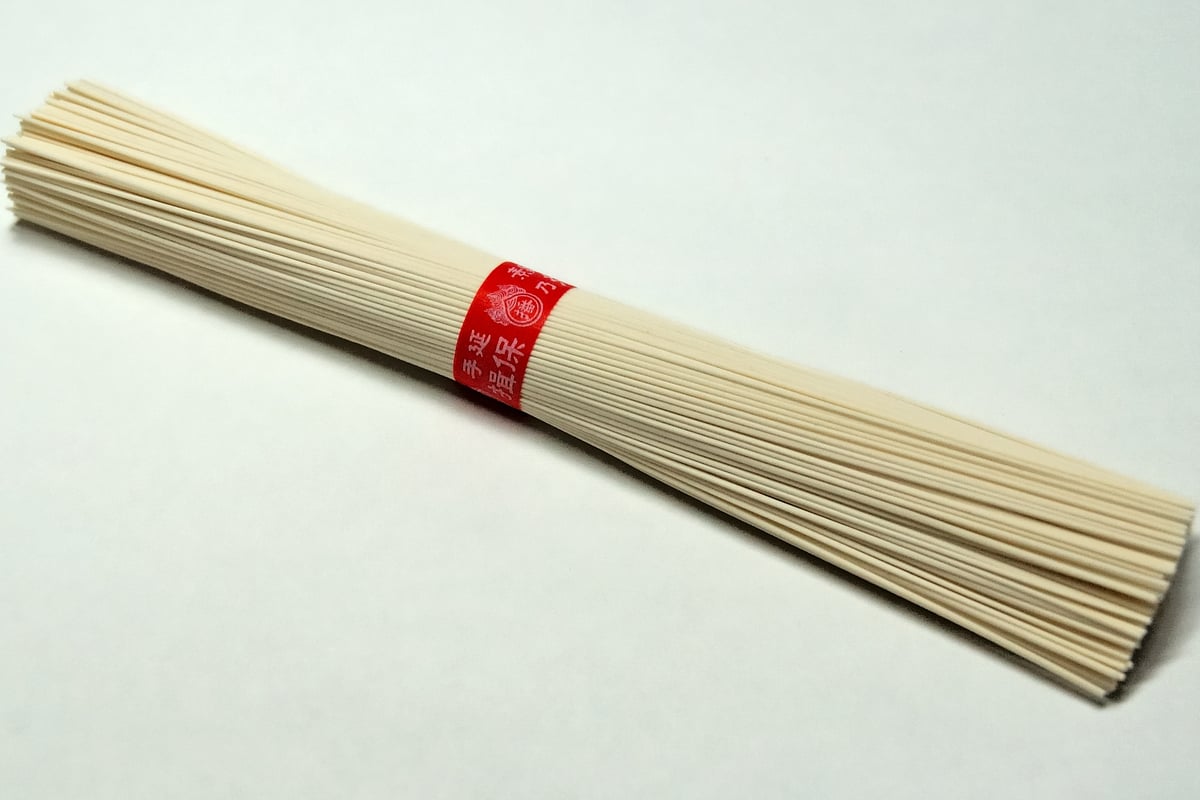
Banshu somen is hand-pulled somen made in the Harima region of southwestern Hyogo Prefecture. The main production areas lie in the basin of the Ibo River (Ibo-gawa), including Tatsuno City, Shiso City, Taishi Town, Sayo Town, and Himeji City. It is made from wheat flour, salt, and water using the 'tenobe' (hand-pulled) method, in which the dough is twisted while being stretched thinner little by little. It does not easily turn soft when boiled and is characterized by a smooth texture and a firm, clean bite. Its representative brand is 'Ibo no Ito' from the Hyogo Prefecture Tenobe Somen Cooperative. Ibo no Ito boasts the largest production volume of any hand-pulled somen in Japan, and in 2024 (Reiwa 6) it was registered as a national Geographical Indication (GI). Somen-making in Banshu has a history of about 600 years, and the word 'saumen' appears in a temple record from the Muromachi period. Blessed with wheat from the Banshu Plain, the clear waters of the Ibo River, and salt from Ako, it has been handed down as work for the winter agricultural off-season. It is eaten year-round: as chilled somen in summer and as warm nyumen in winter.
Origin
The oldest record of somen in Banshu is the old document 鵤荘引付, preserved at Ikarugadera Temple, the base of Ikaruga-no-sho, a manor estate (shoen) that belonged to Horyuji Temple. An entry for 1418 (Oei 25) mentions 'saumen'. In Harima, wheat was grown on the Banshu Plain, and the clear water of the Ibo River and salt from Ako were also available. There was also the technology of milling flour with waterwheels, and the fact that the land was well suited to somen-making is considered the reason it took root as an industry.
History
In the An'ei era (1771–1780) of the Edo period, the Tatsuno Domain encouraged somen-making as a 'licensed trade'. In the Bunka era (1804–1818), the domain began protecting and fostering local products. In 1887 (Meiji 20), 播磨国揖東西両郡素麺営業組合, a somen business association that was the predecessor of the Hyogo Prefecture Tenobe Somen Cooperative, was established. In 1894 (Meiji 27), unified standards and grades were introduced, and the name 'Ibo no Ito' was born. It was registered as a trademark in 1906 (Meiji 39), and in 1997 (Heisei 9), the museum 'Somen no Sato' opened.
Features
Production takes place from October to April of the following year, when temperature and humidity are stable. Salt water is added to the wheat flour and kneaded, the dough is rolled out into bands, and then it is stretched thinner in stages while being twisted. The noodles are hung on poles and pulled longer, dried, and then cut to uniform lengths. The finished somen are laid to rest and aged in a dedicated storehouse in a process called 'yaku'. Noodles aged for one year are called 'hine' (old), and those aged even longer 'ohine' (very old); passing through the rainy season makes their texture firmer.
Main Ingredients
Food Culture
It is eaten regardless of season, as chilled somen in summer and as warm nyumen in winter. Offcuts produced during manufacturing, shaped like the plectrum (bachi) of a shamisen, are called 'bachi' and enjoyed in a soup called 'bachi-jiru'. The Tatsuno City Board of Education also holds somen-making experience sessions for children.
Famous Shops
揖保乃糸資料館 そうめんの里
兵庫県たつの市神岡町奥村56
A museum opened in 1997 (Heisei 9) by the Hyogo Prefecture Tenobe Somen Cooperative. It exhibits the history and production process of hand-pulled somen and also has a hands-on corner and a shop. At the restaurant on the first floor, visitors can enjoy somen dishes made with Ibo no Ito. Admission to the second-floor exhibition room is about 300 yen for adults.
| 揖保乃糸 'Superior Grade (Red Band)' | The standard product of the Hyogo Prefecture Tenobe Somen Cooperative, this red-banded somen accounts for about 80% of production. It is made from October to April of the following year. It does not easily turn soft when boiled and offers a smooth, firm texture. It is widely sold at supermarkets and department stores across Japan, and is also a classic summer gift. |
|---|---|
| 揖保乃糸 'Special Grade (Black Band)' | A black-banded grade made only by skilled craftspeople during the coldest period, from December to February. It uses higher-quality wheat flour than the Superior Grade. 'Hine' (old), aged for one year, and 'ohine' (very old), aged even longer, have a distinctive aroma and a strong, firm texture. It is often chosen as a gift. |
FAQ
Q. Is 'Ibo no Ito' a place name?
A. It is a brand name derived from the Ibo River, which flows through the production area, and not a place name itself. It was one of the names created when grades were established in 1894 (Meiji 27). It was later unified as the cooperative's trademark, and hand-pulled somen that meet the cooperative's standards are shipped under this name.
Q. Is there a connection between Tatsuno's usukuchi soy sauce and somen?
A. Both are industries that grew up in the same Ibo River basin under the protection of the Tatsuno Domain. In Tatsuno, 円尾孫右衛門 is said to have created usukuchi (light-colored) soy sauce in 1666 (Kanbun 6). Shared blessings, namely the soft water of the Ibo River, wheat grown in Banshu, and salt from Ako, have supported both somen and soy sauce.