Image: Wikimedia Commons
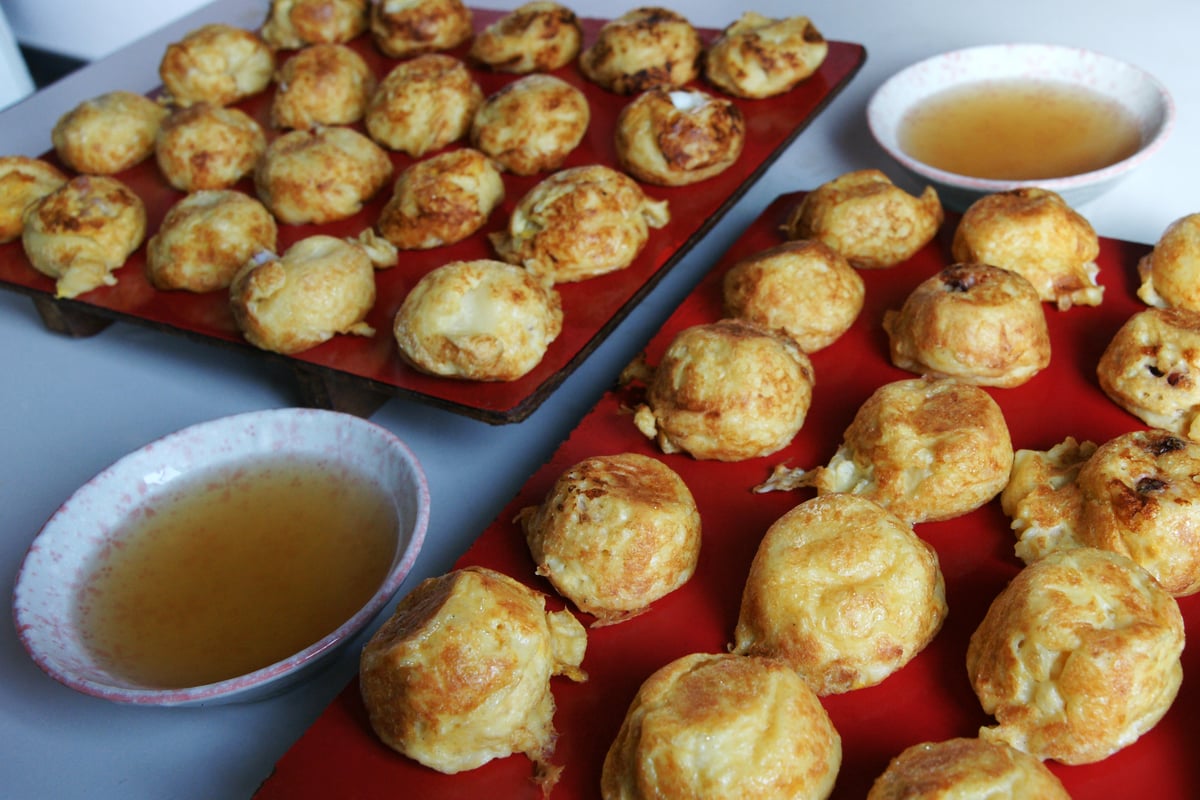
Akashiyaki is a local dish of Akashi City, Hyogo Prefecture: an egg-rich batter filled with octopus is cooked into rounds, which are dipped in warm dashi broth to eat. Locally it has long been called 'tamagoyaki'. The batter is made by mixing wheat flour with jinko (starch obtained by removing the gluten from wheat flour; also called ukiko), giving it a soft, fluffy texture. It looks similar to takoyaki, but the big difference is that it is enjoyed with dashi rather than sauce. It is cooked in a copper pan and served on a slightly tilted wooden board called an ageita. It is said to have originated when egg yolks left over from making 'Akashi-dama', imitation coral made from egg whites, were combined with octopus, which is plentiful in Akashi, and cooked. There are about 70 shops in Akashi City (as of 2021), and it is enjoyed by children and adults alike as an everyday lunch or snack.
Origin
From the end of the Edo period through the Taisho era, Akashi thrived on the production of 'Akashi-dama', ornaments used in necklaces and hair accessories. Akashi-dama were imitation coral made from egg whites. It is said that the dish may have begun when the large quantities of egg yolks left over from their production were mixed with octopus caught in the sea right in front of the town and cooked. This theory is said to have been introduced by the manga artist 広瀬安美 in the magazine Tabi ('Travel') in 1964 (Showa 39), and 向井屋, a shop on 川端通 in the city, is cited as the shop where the dish originated.
History
井上喜平治, known as 'Dr. Octopus' at the Hyogo Prefectural Fisheries Experimental Station, estimated in the book Tako no Kuni ('Land of Octopus', 1965) that the dish was born around 1889–1890 (Meiji 22–23). In the Taisho era, sales from street stalls spread, and some shops that started as stalls continue today, such as Honke Kimuraya, founded in 1924 (Taisho 13). There are two theories about the origin of the name 'Akashiyaki', which spread outside the city. One holds that it was the name of a product sold nationwide by an Osaka food company in 1973 (Showa 48); the other holds that a city employee coined the name for promotional purposes around 1988 (Showa 63).
Features
The batter combines eggs, wheat flour, jinko, and dashi; with its high proportion of egg, it has a yellowish tint. Adding jinko gives it a melt-in-the-mouth softness. The batter is poured into a copper pan, which conducts heat well, chunks of octopus are added, and the pieces are turned with long cooking chopsticks and shaped into rounds. The finished pieces are about 5 cm in diameter. They are served lined up on an ageita board and eaten by dipping them into a bonito and kombu dashi with mitsuba (Japanese wild parsley) floating in it. Some shops pair them with cold dashi, and others have customers eat them with salt.
Main Ingredients
Food Culture
In Akashi, it is eaten regardless of season as an everyday lunch or snack. Specialty shops cluster around Akashi Station and the Uontana shopping street, and each shop has its own character in the batter recipe and the flavor of its dashi. It is a soul food known affectionately to locals as 'tamagoyaki'.
How It Differs from Home Cooking
At home, people often make it easily in a takoyaki maker, but specialty shops use copper pans and quickly turn the soft batter to shape it. The amount of egg, the proportion of jinko, and the way the dashi is made reflect each shop's own approach, and some shops do not use jinko at all.
Famous Shops
本家きむらや
兵庫県明石市鍛治屋町5-23
A tamagoyaki specialty shop founded in 1924 (Taisho 13). It began as a street stall, and the current owner is the fourth generation. Two eggs go into each 20-piece serving, and the seasoning is simple, using only kombu dashi and soy sauce. The dipping dashi, made with kombu from the Donan area (southern Hokkaido) and katsuobushi, has a rich flavor, and one serving costs about 900 yen.
玉子焼専門店 松竹
兵庫県明石市大明石町1-6-1 パピオスあかし1階
Founded in 1958 (Showa 33), this shop has been run for three generations. Its hallmark is a nicely browned surface, giving a fragrant exterior and a soft, molten interior. Refills of mitsuba are free. Tamagoyaki starts at about 900 yen, and takeout is available.
ふなまち
兵庫県明石市材木町5-12
A popular local shop that has been in business for about 50 years. Its batter, a blend of wheat flour and jinko, is fluffy and is enjoyed with a rich bonito and kombu dashi. Tamagoyaki costs about 900 yen. It is known as a soul-food shop long loved by local customers.
FAQ
Q. Why is Akashiyaki called 'tamagoyaki' locally?
A. Because the batter uses plenty of egg (tamago), it has long been called 'tamagoyaki' in Akashi. 'Akashiyaki' is a name that spread mainly outside the city. For this reason, signs and menus at shops in the city still often read 'tamagoyaki' (玉子焼).
Q. How is Akashiyaki different from takoyaki?
A. For Akashiyaki, jinko is mixed into an egg-rich batter, which is cooked until soft and fluffy. It is eaten by dipping in warm dashi rather than with sauce, and is served on an ageita board. Takoyaki is generally made by cooking a wheat-flour batter on an iron griddle and topping it with sauce and aonori (green laver). Akashiyaki is also said to be one of the roots of takoyaki.