Image: Wikimedia Commons
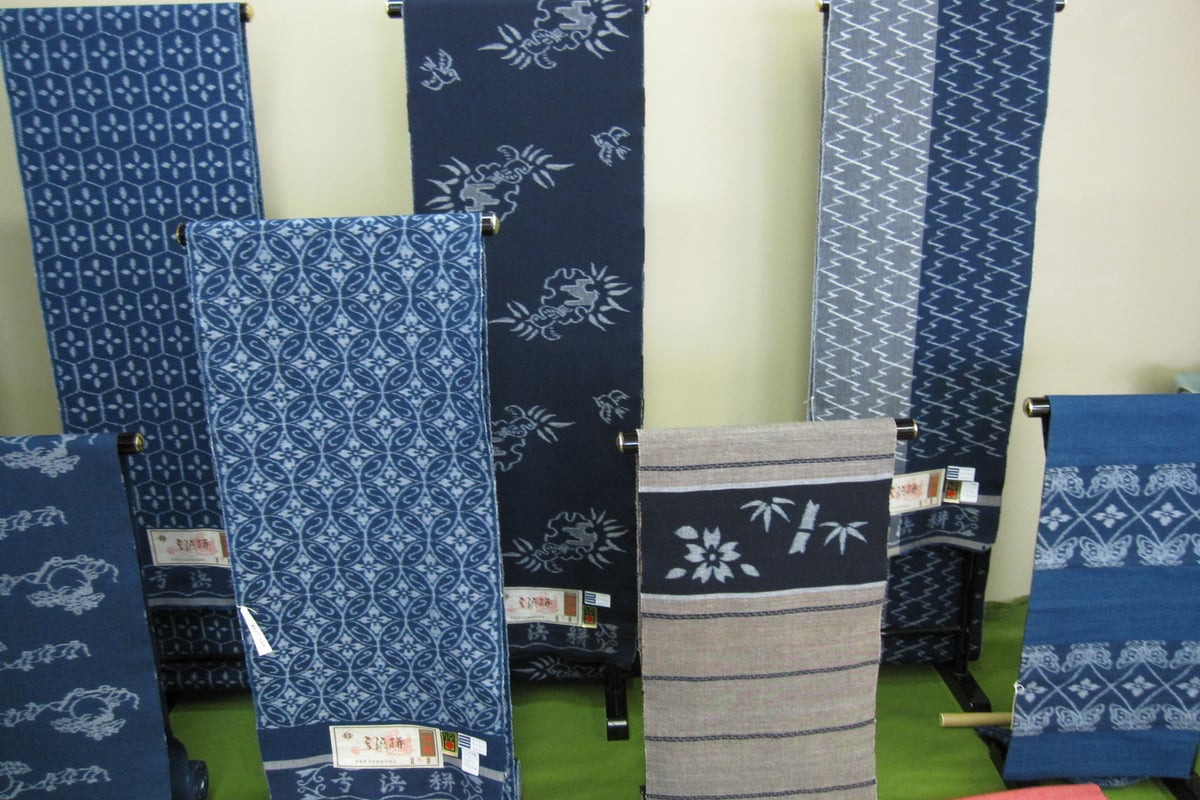
Yumihama Gasuri is a cotton kasuri (ikat) that has been woven on the Yumigahama Peninsula (Yonago City and Sakaiminato City) in western Tottori Prefecture. Kasuri is a textile in which patterns are created during weaving by using threads that have been partially dyed in advance. In the late 17th century, cotton growing for household use began on the sandy soil of Yumigahama, and in the mid-18th century wholesalers of aidama (indigo balls) were established and cotton production increased. In the early 19th century, women in farming households began weaving e-gasuri (pictorial kasuri) with pictures woven in for their families. Its appeal lies in its simple, rough texture, with auspicious motifs such as cranes and tortoises or pine, bamboo and plum appearing in white against a deep indigo ground. In the Meiji era, Tottori Prefecture's kasuri output ranked third in Japan, but it declined with the development of the spinning industry and the spread of synthetic fibers. In 1975 (Showa 50), it was designated a Traditional Craft by the Minister of Economy, Trade and Industry (national Traditional Craft). In 1978 it also became an Intangible Cultural Property of Tottori Prefecture.
Origin
The beginnings of Yumihama Gasuri are closely tied to cotton growing on the Yumigahama Peninsula. According to Japan Traditional Crafts Aoyama Square, cotton growing for household use began on the peninsula's sandy soil in the late 17th century. Materials from Tottori Prefecture say it originated in the early Edo period, when housewives in farming households began weaving work clothes, everyday wear, futons and other items for their families. The cotton of this area, which spread as a crop that could grow even in sandy soil, was called Hakushu cotton.
History
In the mid-18th century, wholesalers of aidama were established and cotton production increased. In the early 19th century, women in farming households in Yonago and Yumigahama began weaving e-gasuri known as '浜の目絣'. In the Meiji era, Tottori Prefecture's kasuri output ranked third in Japan, but many producers went out of business due to the development of the Western-style spinning industry and other factors. After the war, the dyeing and weaving artist 嶋田悦子 from Sakaiminato City and others worked hard to revive it, and in 1975 it was designated a national Traditional Craft. In recent years, weavers who became independent after completing successor-training programs have also emerged.
Features
Yumihama Gasuri is a yarn-dyed, plain-woven cotton textile in which white kasuri patterns are woven against a deep indigo ground. Because it was woven with wishes for the health and prosperity of the family, auspicious motifs such as cranes and tortoises or pine, bamboo and plum are still its representative patterns. The kasuri thread is used only for the weft, and the patterns are aligned by hand. It absorbs moisture well and retains warmth, which also made it suitable for farm work clothes. Today, besides kimono fabric, small items such as noren curtains, table runners and bags are also made.
Techniques
Tekukuri (hand-binding of kasuri threads)
A technique in which parts of the threads are tightly bound with other thread according to the design so that dye cannot penetrate, and the threads are then dyed with indigo. The bound parts remain white and become the pattern when woven. For Yumihama Gasuri, it is specified that the dyeing of kasuri threads must be done by hand-binding.
E-gasuri (pictorial kasuri)
A technique in which kasuri thread is used only for the weft and the white parts are aligned by hand row by row during weaving to create picture-like patterns. The design is drawn full-size on washi, and a tanegami (pattern paper), made by carving the pattern into paper treated with persimmon tannin, is used to mark the places on the weft threads to be bound.
Materials Used
Production Process
- 1
Design and tanegami making
A full-size design is drawn on washi. Based on it, a tanegami is made by carving the pattern into paper treated with persimmon tannin.
- 2
Stretching the threads and marking
The weft threads are aligned and hung on a frame (edai), and the tanegami is placed against them to mark the places to be bound with ink.
- 3
Binding the weft
The marked parts are bound tightly with thread to resist the dye so that it cannot get in.
- 4
Indigo dyeing
The bound threads are dyed with indigo. Only the bound parts remain white.
- 5
Unbinding and preparing the threads
The bindings are removed, and the threads go through aku-dashi (removing impurities), washing and drying. The kasuri weft threads are sorted in the order of the pattern and wound onto bobbins in preparation for weaving.
- 6
Weaving
On a hand-operated takabata (high loom), the cloth is woven while the white parts of the weft are aligned row by row, making the pictorial pattern emerge.
| Main Production Areas |
|
|---|
Artisans & Workshops
村上絣織物
A Yumihama Gasuri workshop in 和田町, Yonago City. Its representative, 村上一枝, is a certified traditional craftsperson for Yumihama Gasuri. Besides kimono fabric with patterns such as 'puffed-up sparrows', 'pine, bamboo and plum with fan motifs' and 'pine-bark lozenges', the workshop also weaves small items such as placemats and drawstring pouches.
工房ゆみはま
A Yumihama Gasuri workshop in 竹内町, Sakaiminato City. It carries on the long-standing work of hand-binding, dyeing with shoai (pure indigo) and weaving on a takabata. It makes kimono, kimono fabric, noren curtains, tote bags, wallets, coin purses and more.
鳥取弓浜 中村括り
A Yumihama Gasuri workshop run by 中村武志. 中村武志 studied in a government-supported Yumihama Gasuri successor-training program in 2007 and became independent in 2010 after three years of training. Under the motto 'giving today's Yumihama Gasuri a value for today', the workshop also makes products such as work caps.
Official site →織房 絲の文(しょくぼう いとのあや)
A Yumihama Gasuri workshop in Sakaiminato City. The weaver studied in a Yumihama Gasuri successor-training program in 2010 and became independent in 2013. Using traditional techniques, the workshop weaves mainly traditional pictorial patterns and makes small items such as pouches, coasters and handbags, as well as kasuri thread.
Official site →How to Buy
- Contacting each workshop directly
- Tottori Prefecture's 'とっとりの手仕事' (Tottori handcrafts) website advises contacting each workshop directly to purchase Yumihama Gasuri. The site introduces Yumihama Gasuri workshops in the prefecture, such as 村上絣織物 and 工房ゆみはま, along with photos of their work.Where to buy →PR
- 鳥取県弓浜絣協同組合
- The production-area cooperative of Yumihama Gasuri, with its office in 上福原, Yonago City. It is listed as the Yumihama Gasuri production-area cooperative by Japan Traditional Crafts Aoyama Square and in Tottori Prefecture materials, and its contact number is 090-5695-9384. It serves as a point of contact for questions about producers and products.
Hands-on Experiences
工房ゆみはま 弓浜絣体験
鳥取県境港市竹内町899
A Yumihama Gasuri experience plan for weaving cloth from Japanese-grown cotton is listed on the booking site 'Jalan'. The fee is from about 8,000 yen per person, and reservations are required. You can hear explanations of the processes from collecting Hakushu cotton seeds to spinning thread and drafting designs.
View details →FAQ
Q. Where is 'Yumihama'?
A. It refers to the Yumigahama Peninsula, which extends in an arc like a bow (yumi) from Yonago City to Sakaiminato City. The name Yumihama Gasuri comes from this 'Yumihama', and it is also simply called 'Hama Gasuri'.
Q. How does it differ from Kurayoshi Gasuri?
A. Both are e-gasuri of Tottori Prefecture and, together with Hirose Gasuri of Shimane Prefecture, are counted among the representative kasuri of the San'in region. Yumihama Gasuri has been woven on the Yumigahama Peninsula in the western part of the prefecture, and Kurayoshi Gasuri in Kurayoshi City in the central part. Yumihama Gasuri is designated a national Traditional Craft, and Kurayoshi Gasuri is designated a Tottori Prefecture Local Craft.
Q. What kind of cotton is Hakushu cotton?
A. It is a cotton that began to be cultivated in the Edo period in Hoki Province, in western Tottori Prefecture, as a crop that could grow even in sandy soil. Its fibers are short and difficult to process, but it is springy, light and warm. Today Sakaiminato City grows it together with its citizens, and it is also used for Yumihama Gasuri.