Image: Wikimedia Commons
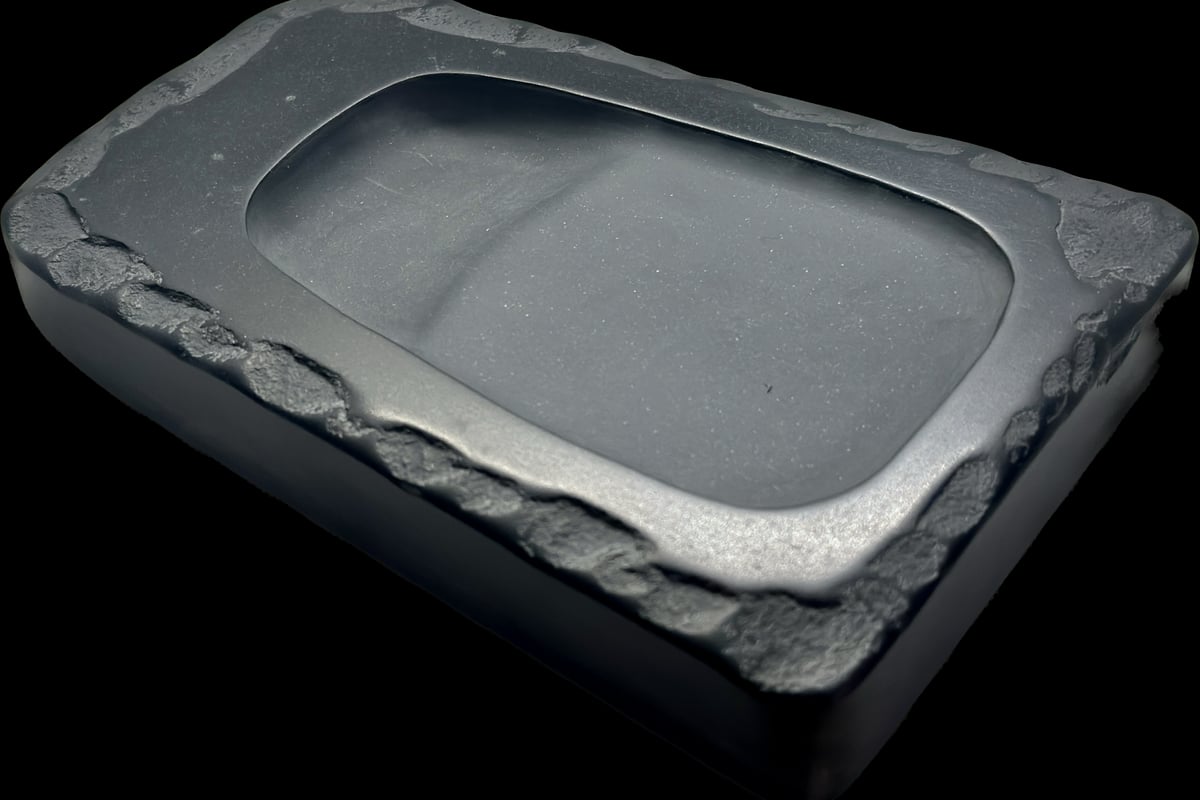
Wakata stone inkstones (Wakata-ishi suzuri) are inkstones made in Tsushima City, Nagasaki Prefecture. They use shale (a mudstone that splits into plates) taken from the upper reaches of the Sasu River in the Wakata district of Izuhara Town. The stone is a jet black with a bluish tinge, and many inkstones are said to be made in a natural style with restrained carving that makes the most of the mottling and streaks on the surface. The grinding surface has a good balance of smoothness and hardness, and the inkstones are valued for how well the ink grinds and the color of the ink. There is a legend that Murasaki Shikibu of the Heian period used one with fondness when writing 'The Tale of Genji.' It is also said that Hayashi Razan, a Confucian scholar of the early Edo period, praised them as rivaling China's Duanxi (Tankei) inkstones. In 1991 (Heisei 3), they were designated a Nagasaki Prefecture Traditional Craft. Today, craftsmen of 芳秀堂 (Hoshudo) and 若田石硯匠会 (Wakata Stone Inkstone Craftsmen's Association) carve each one by hand.
Origin
Inkstone making on Tsushima is said to have begun in the early Edo period, and it is described as having been from around this time that inkstones began to be made as merchandise. Shale can be found across the whole of Tsushima, but the stone from Wakata has long been considered the best for inkstones. Both Murasaki Shikibu's fondness for the inkstones and Hayashi Razan's praise are told as legends.
History
According to a local magazine, in the late Edo period 満山俊三 of Izuhara carved inkstones alongside making fishhooks, laying the foundation of today's Wakata stone inkstones. Later, the first 岩坂芳秀, who had studied under the 満山 family, opened 芳秀堂 in 1924 (Taisho 13) and left many inkstones until his death in 1975. 芳秀堂 is said to have been revived in 2004, after a gap of 29 years, by his son, the second-generation 芳秀.
Features
The stone is jet black with a bluish tinge and is formed from many layers of hardened clay. It is said to combine smoothness when grinding ink with just the right hardness, and to excel in bringing out and holding the color of the ink. Because these are natural inkstones that make use of the stone's patterns, they are also described as enjoyable as decorative objects. Because each is carved by hand, every piece differs in color, shape and size.
Materials Used
Production Process
- 1
Deciding the shape
Looking at the shape of the stone, the craftsman decides the position and shape of the 'bokudo' (the surface where ink is ground) and the 'bokuchi' (the well where ink collects). A paper pattern is traced onto the stone, and the rim of the inkstone is carved out while making the most of the stone's character.
- 2
Carving
Switching between chisels with different tips to suit each purpose, the craftsman carves and polishes the bokudo and bokuchi. The back of the inkstone is also made flat. The second-generation head of 芳秀堂 is described as carving by pushing the chisel with his right shoulder.
- 3
Polishing the bokudo
The surface is polished in three stages, with coarse, medium and finishing whetstones. For finishing, Tsushima whetstone taken from Aso Bay on Tsushima is used, and the craftsman checks how well the hobo (the fine irregularities that grind the ink) have formed.
- 4
Finishing
The corners of the rim are rounded off and polished with cloth-backed sandpaper. Finally, lacquer is applied with the fingers, coated differently for each part, to finish the inkstone.
| Main Production Areas |
|
|---|
Artisans & Workshops
芳秀堂(岩坂芳秀堂)
An inkstone workshop opened in 1924 by the first 岩坂芳秀. In 2004 his son, 岩坂治人, revived it as the second-generation 芳秀. He is said to be researching techniques that bring out the character of the stone, such as 'wood-grain patterns' and 'iron-rust patterns.'
Official site →若田石硯匠会
An association of craftsmen in the Wakata lineage, also called '硯匠会' (Kenshokai). Nagasaki Prefecture's materials list it as a maker alongside 芳秀堂. Wakata stone inkstones are said to be made by about five craftsmen, three of whom belong to this association.
How to Buy
- Tsushima City hometown tax donations (furusato nozei)
- Wakata stone inkstones by 「匠」運営協議会 and 岩坂芳秀堂 are listed as gifts for hometown tax donations to Tsushima City. Because they are made to order, shipping is said to take about a month. Donation amounts and availability change over time.Where to buy →PR
Hands-on Experiences
体験であい塾 匠
長崎県対馬市厳原町下原82-12
Visitors are said to be able to try making their own original inkstone under the guidance of 若田石硯匠会. Reservations are required, and the contact number is 0920-56-0118. The fee for the inkstone-making experience could not be confirmed, so please inquire in advance, including whether it is currently offered.
View details →FAQ
Q. Is it true that Murasaki Shikibu used one?
A. The story that Murasaki Shikibu used one with fondness when writing 'The Tale of Genji' is presented strictly as a legend. It is not a fact confirmed by historical records, but it is a tradition that shows the stone has long been known for fine inkstones.