 1 / 2
Image: Wikimedia Commons
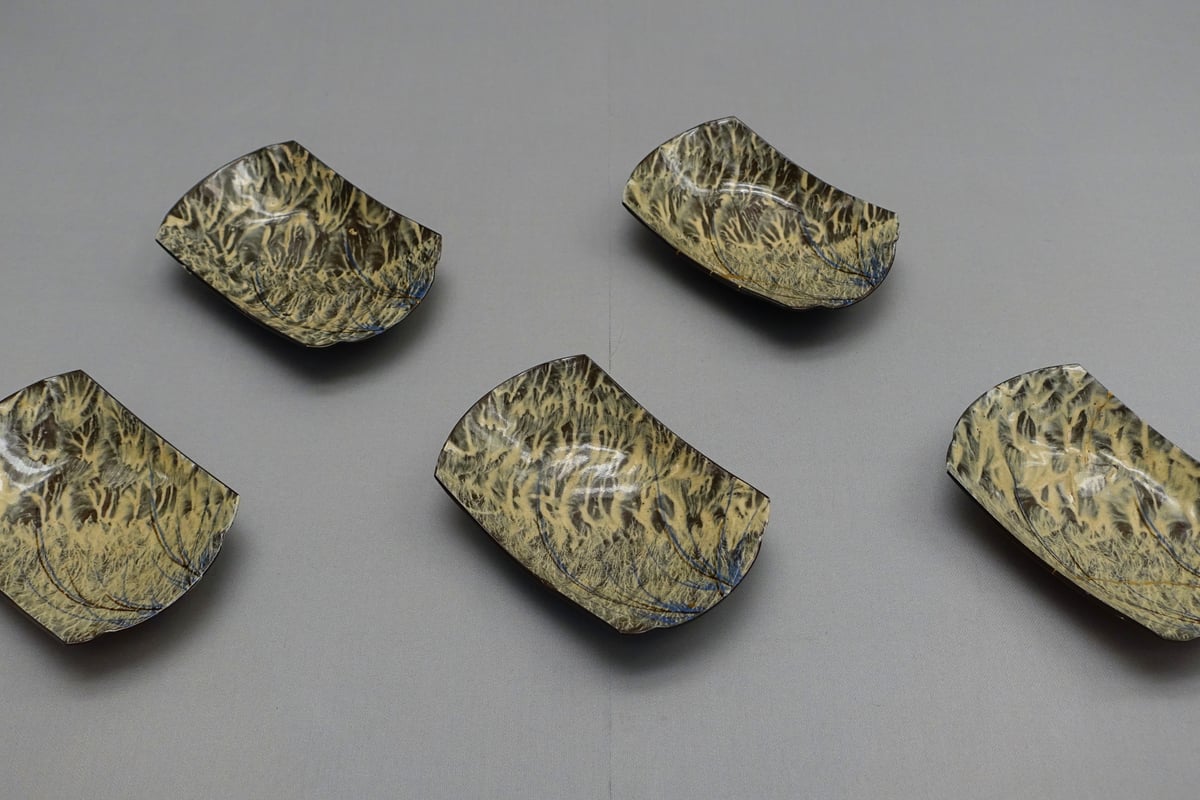
Utsutsugawa ware (Utsutsugawa-yaki) is pottery that was fired in Utsutsugawa-machi, Nagasaki City, during the Edo period. It is said that in 1691 (Genroku 4), Tanaka Gyobuzaemon, a retainer of the Isahaya family, left his post and opened a kiln together with his second son, Jinnai. The iron-rich clay turns a chocolate color when fired, and its greatest feature is hakeme (brushed slip), in which white slip is applied over it with a brush. Its bold shapes, such as boat-shaped and corner-cut forms, and its seasonal motifs were also highly regarded, and it was praised as the 'Ninsei of the West' (after Ninsei, a celebrated Kyoto potter). However, the kiln ceased after only about 60 years, and because few works survive, it is called a 'phantom ware.' Since the Meiji era there have been continued attempts at revival, and kilns such as 臥牛窯 (Gagyu-gama) in Sasebo City have reproduced the techniques. The kiln site that remains where the kiln was first opened is designated a Historic Site of Nagasaki Prefecture.
Origin
According to the Isahaya family's records, the 'Nisshinki,' Tanaka Gyobuzaemon, a hikan (retainer) of the Isahaya family, left his post in 1691 and opened a kiln with his second son, Jinnai. The founders are also described as having come from Arita. Above the kiln stands a kiln Kannon erected in 1704 (Hoei 1), inscribed with names including Tanaka Soetsu (Gyobuzaemon), Jinnai and Shigetomi Mohei.
History
Utsutsugawa ware was fired for about 60 years, until around 1748 (Kan'en 1). The reason it ceased is said to have been the domain's financial circumstances. In the Meiji era, Baba Todayu and Danno Katsuji attempted to revive it, but their efforts did not last long. Later, Yokoishi Gagyu, the 12th generation of 臥牛窯 in Sasebo City, succeeded in reproducing the techniques, and the 13th generation is described as having further refined them.
Features
The iron-rich clay of Utsutsugawa turns a chocolate-like color when fired. Its hallmark is applying white slip over it with a brush or writing brush to create patterns with varying shades. The vessel shapes are bold, such as boat-shaped and corner-cut forms, and are accompanied by seasonal motifs such as wisteria flowers and butterflies. According to tradition, it was spoken of in the same breath as Ninsei in the phrase 'Ninsei in Kyoto, Utsutsugawa in the West,' and it is also described as the pinnacle of hakeme patterning.
Techniques
Uchi-hakeme (struck brush marks)
A technique in which white slip is applied by striking it on with a brush, leaving the brush marks as a pattern. A Nagasaki City article describes the pattern as recalling thinly sliced fugu (pufferfish) sashimi. It is one of the representative techniques of Utsutsugawa ware.
Fuki-hakeme (blown brush marks)
A technique in which breath is blown onto the white slip to spread it, creating a mysterious, misty pattern. Together with uchi-hakeme, it is said to be the greatest feature of Utsutsugawa ware. 臥牛窯 also introduces 'mizore-hake' (sleet brushing) as a traditional technique.
Finishing while half-dry
臥牛窯 explains that the core of its secret method is to carry a wheel-thrown vessel, while still soft and half-dry, all the way through trimming, attaching handles, applying slip and painting.
Materials Used
Production Process
- 1
Wheel throwing
Iron-rich clay is thrown on the wheel to form the vessel. At 臥牛窯, the work proceeds from here to the next steps while the piece is still half-dry.
- 2
Trimming and attaching handles
The soft, half-dry body is trimmed to refine its shape, and handles and other parts are attached as needed.
- 3
Slip, hakeme and painting
A base coat of slip is applied and colored, and then hakeme brushwork is added to the inside of the vessel. Next, it is painted.
- 4
Bisque firing, glazing and main firing
After drying thoroughly, the piece is bisque-fired, glazed and given its main firing. When fired, the clay turns a chocolate color and the white hakeme stands out.
| Main Production Areas |
|
|---|
Artisans & Workshops
臥牛窯
A kiln said by tradition to have been opened in 1602 at Kihara Sarayama (present-day Kihara-cho, Sasebo City). The 12th generation is said to have reproduced the techniques of Utsutsugawa ware, and the brothers of the 13th-generation Yokoishi Gagyu to have perfected them. The 12th and 13th generations are said to have been designated as Intangible Cultural Properties of Nagasaki Prefecture, and the 15th generation succeeded as head of the kiln in 2020.
Official site →How to Buy
- 臥牛窯 online shop
- 臥牛窯 sells its vessels through its own online shop. A crowdfunding campaign listed beer cups made with Utsutsugawa ware techniques at 23,760 to 27,000 yen including tax. Prices are subject to change.Where to buy →PR
Hands-on Experiences
長崎歴史文化博物館 伝統工芸体験工房(長崎陶芸復興塾)
長崎県長崎市立山1-1-1
In the workshop on the museum's second floor, the Nagasaki Ceramics Revival School (長崎陶芸復興塾), which aims to reproduce and develop the techniques of Utsutsugawa ware, is active. It is described as offering wheel-throwing and painting experiences. Please check the schedule and fees with the museum in advance.
View details →現川焼陶窯跡
長崎県長崎市現川町
The kiln site that remains where Utsutsugawa ware was first made, designated a Historic Site of Nagasaki Prefecture in 1963. The kiln Kannon erected in 1704 also remains. It is a 7-minute walk from the 'Utsutsugawa' bus stop.
View details →FAQ
Q. Why is Utsutsugawa ware called a 'phantom ware'?
A. Because it was fired for only a short time in the Edo period, about 60 years, and very few works survive. It is also said that the fact that no one was able to reproduce the techniques for about 200 years after it ceased contributed to the name.