Image: Wikimedia Commons
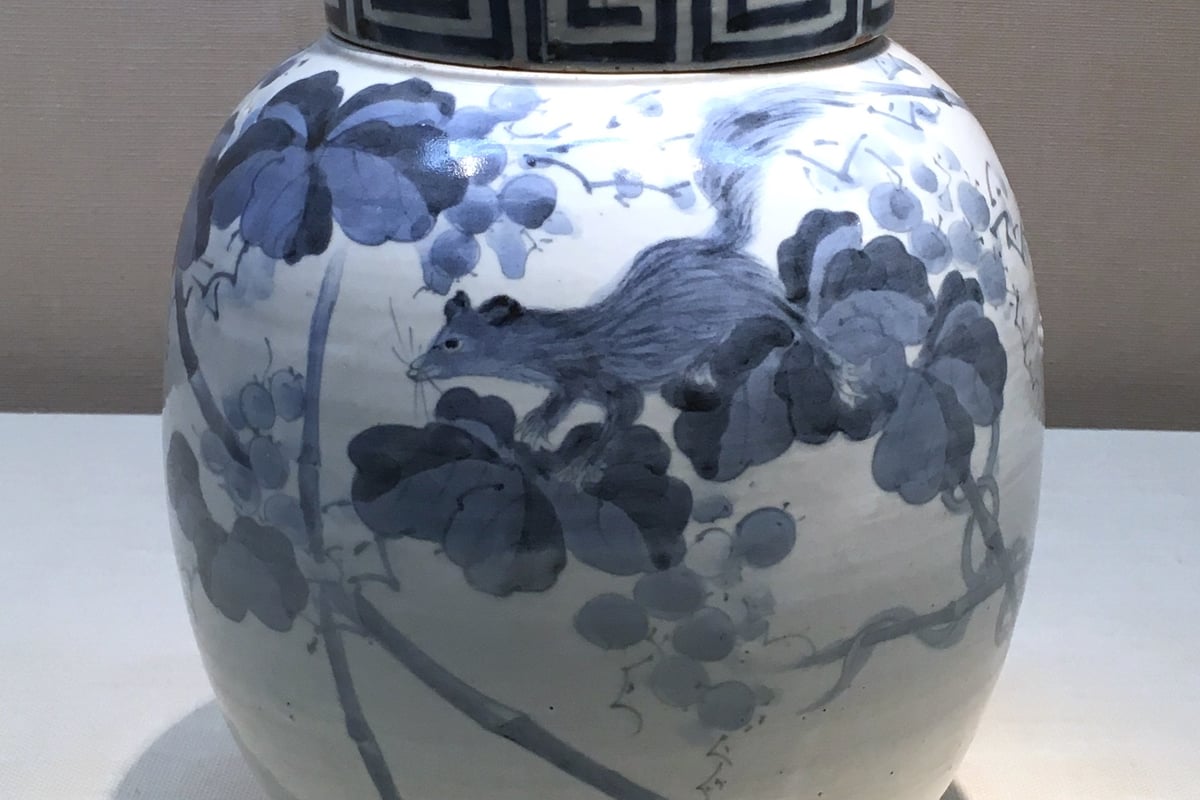
Tobe-yaki is porcelain made mainly in Tobe Town, Iyo District, Ehime Prefecture. Its defining feature is patterns such as karakusa (arabesque scrolls) painted by brush onto milky-white porcelain with an indigo pigment called gosu (cobalt underglaze pigment). Its plump, thick-walled vessels are hard to break and easy to hold even when filled with something hot, so they have long been loved as everyday tableware. It is sometimes called 'kenka-jawan' (quarrel bowls), because it is said to be sturdy enough not to break even if a married couple threw it at each other during a quarrel. In the mid-Edo period, porcelain making using whetstone scraps began in Tobe, then a production area of whetstones (toishi), on the orders of the Ozu domain. Sugino Josuke is said to have succeeded in firing white porcelain in 1777 (An'ei 6). In 1976 (Showa 51), it was designated a national Traditional Craft. Many kilns are scattered around the town, and visitors can see exhibits at 砥部焼伝統産業会館 (Tobe-yaki Traditional Industry Hall) and try pottery making. Every spring, the Tobe-yaki Festival is held, bringing the kilns together.
Origin
Tobe has long been a production area of whetstones, and in the Edo period they were used under the name 'Iyo-to' (Iyo whetstones) for purposes such as polishing swords. It is said that Kato Yasutoki, the 9th lord of the Ozu domain, ordered that the whetstone scraps produced in quarrying be put to use for porcelain, and that the potter Sugino Josuke built a kiln at Gohonmatsu. The kiln is said to have been built in 1775 (An'ei 4), and after much hardship, he is said to have succeeded in firing white porcelain in 1777. There are various theories about how it began.
History
In 1818 (Bunsei 1), Mukai Genji is said to have found high-quality porcelain stone at Kawanobori, greatly improving quality. In the Meiji period, Mukai Wahei created tan'oji (pale yellow porcelain), which was highly praised at the 1893 Chicago World's Fair. In 1966 (Showa 41), a crafts course was established at a local high school, advancing the training of potters. In 1976, it was designated a national Traditional Craft, and in 1989 (Heisei 1), 砥部焼伝統産業会館 (Tobe-yaki Traditional Industry Hall) opened.
Features
It uses porcelain stone quarried around Tobe, such as at Kamio Pass, and is finished as thick, sturdy porcelain. It is easy to hold even when filled with something hot and keeps food warm, which is another reason it is favored as everyday tableware. Craftspeople paint each piece by hand with a brush, and the blue of the gosu stands out against the white porcelain. The representative pattern is karakusa, and patterns such as the sun, nazuna (shepherd's purse) and tokusa (horsetail) are also well known.
Techniques
Hand-Painting with Gosu
Patterns are painted by brush onto bisque-fired vessels using an indigo pigment called gosu. Because craftspeople paint each piece by hand, slight differences in brushwork appear even within the same design. After firing, a deep blue emerges on the milky-white ground.
Karakusa Pattern
The pattern most representative of Tobe-yaki, it depicts twining vines stretching out, drawn in bold lines. 梅山窯 (Baizan-gama), founded in 1882 (Meiji 15), is known for creating the karakusa pattern distinctive to Tobe.
Materials Used
Production Process
- 1
Forming
Clay made from porcelain stone is thrown on a potter's wheel and shaped into vessels. Parts made by slip casting (ikomi), such as mug handles, are sometimes attached. Tobe-yaki is described as basically made to order, with almost every step done by hand.
- 2
Bisque Firing and Underglaze Painting
The dried vessels are bisque-fired at about 900°C. Patterns such as karakusa are then painted with gosu by brush onto the bisque-fired vessels. This painting beneath the glaze is called underglaze painting (shitaetsuke), and craftspeople paint each piece by hand.
- 3
Glazing and Main Firing
Once painting is finished, the whole vessel is coated with glaze and given its main firing at a high temperature of about 1,300°C. Firing at high temperature makes the porcelain hard and sturdy, and the gosu patterns beneath the glaze develop their indigo color.
| Main Production Areas |
|
|---|
Artisans & Workshops
梅山窯(株式会社梅野精陶所)
Opened in 1882, it is the oldest of the kilns still operating in Tobe. Under the motto 'utility and beauty,' it has continued to make practical tableware and is known for creating the karakusa pattern that represents Tobe-yaki. It is located at 1441 Ominami, Tobe Town.
Official site →How to Buy
- 梅山窯 Shop (Ominami, Tobe Town)
- At 梅山窯 in Ominami, Tobe Town, tableware can be purchased at the shop on the premises, and visiting is free. A travel guide lists an 8-sun (about 24 cm) flat plate at 3,300 yen and soba choko (small cups for soba dipping sauce) from 1,210 yen. Prices are subject to change.Where to buy →PR
- Tobe-yaki Festival
- A sales event held every spring at 陶街道ゆとり公園 park, where many kilns set up stalls and about 100,000 pieces of Tobe-yaki are said to be on display. In 2026, the 41st festival was held on April 18 and 19. Admission is free.
Hands-on Experiences
砥部町陶芸創作館
愛媛県伊予郡砥部町五本松82
Visitors can choose from about 80 kinds of bisque-fired vessels and paint them with gosu. The painting experience starts from 300 yen and takes about 30 minutes to 1 hour. A forming experience making vessels from 1 kg of clay is listed from 1,500 yen (reservation required, shipping extra).
View details →砥部焼陶芸館
愛媛県伊予郡砥部町宮内83
A facility that sells everyday Tobe-yaki tableware and also offers pottery-making experiences. Hand-building is listed at 1,800 yen, painting from 600 yen, and wheel-throwing at 3,500 yen (reservations required for hand-building and wheel-throwing, shipping extra).
View details →砥部焼伝統産業会館
愛媛県伊予郡砥部町大南335
A facility that exhibits materials and works conveying the history of Tobe-yaki; it opened in 1989. Admission is listed as 300 yen for adults, with opening hours from 9:00 to 17:00, closed on Mondays (or the following weekday if Monday is a national holiday). A map of the surrounding kilns is also available.
View details →FAQ
Q. Why is Tobe-yaki called 'kenka-jawan' (quarrel bowls)?
A. The name means that it is sturdy enough not to break even if a married couple threw their bowls at each other during a quarrel. It is said to have spread as a humorous way of describing how hard to break this thick porcelain is.
Q. Where is Tobe-yaki made?
A. It is made mainly in Tobe Town, Iyo District, Ehime Prefecture. The town lies just south of Matsuyama City, about 45 minutes by bus from Iyotetsu's Matsuyama-shi Station. Kilns are scattered around the town, and some have their own shops.