Image: Wikimedia Commons
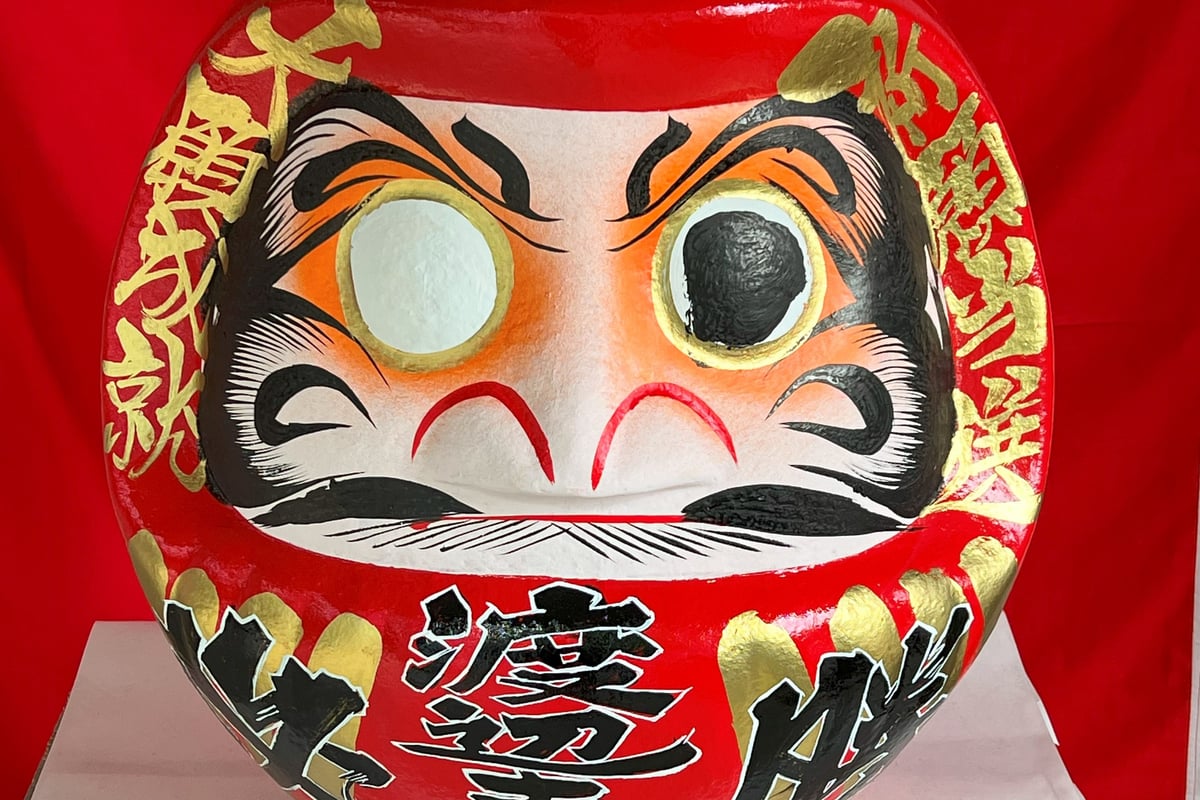
Takasaki Daruma are lucky daruma dolls made in Takasaki, Gunma Prefecture. About 900,000 are produced each year, making the area Japan's leading production center, accounting for roughly 80% of the nation's papier-mache daruma output. Tradition holds that they originated in the late Edo period, during the Kansei era, when Yamagata Tomogoro, who lived near Shorinzan Darumaji Temple, had the temple's ninth head priest, Togaku, carve him a wooden mold, over which he layered washi paper to make a daruma. The earliest dolls resembled a seated Zen meditation figure, but as sericulture farmers came to associate the 'rising' of silkworms with the daruma 'righting itself' after falling, they began enshrining daruma as lucky charms on their household altars, and the shape gradually rounded into the familiar form seen today. A defining feature unique to Takasaki Daruma, not found in daruma from other regions, is that the eyebrows are painted to resemble a crane, the mustache a turtle, and auspicious characters such as 'business prosperity' and 'household safety' are written on the shoulders. Every year on January 6 and 7, the Nanakusa Grand Festival Daruma Market held at Shorinzan Darumaji Temple draws large crowds and is a beloved feature of Takasaki's winter season.
Origin
The origin of Takasaki Daruma traces back to the Kansei era (1789-1801) in the late Edo period. Tradition holds that Yamagata Tomogoro, who lived in the village of Kami-Toyooka near Shorinzan Darumaji Temple, had the temple's ninth head priest, Togaku, carve a wooden mold, over which he layered washi paper to make a daruma. Shorinzan Darumaji Temple traces its history to 1680, when the lay Buddhist Ichiryo enshrined a seated statue of the Zen patriarch Bodhidharma there, and the temple has long been associated with daruma worship. Daruma making, nurtured before the temple gate, later developed into a local industry in Takasaki.
History
The earliest daruma resembled a seated Zen meditation figure, but because Joshu (the old name for the Gunma region) was a major sericulture area, farmers came to associate the 'rising' of silkworms with the daruma righting itself after falling, and began enshrining daruma on their household altars as lucky charms to pray for a good silkworm harvest and business prosperity. This connection drove growing demand, and the shape gradually rounded into the endearing form seen today. In 1993, Takasaki Daruma was designated a Gunma Prefecture Furusato Traditional Craft, and the area now produces about 900,000 dolls a year, accounting for roughly 80% of Japan's total production of papier-mache daruma.
Features
The defining feature of Takasaki Daruma, not found in daruma from other production areas, is that the eyebrows are painted to resemble a crane, the mustache a turtle, and auspicious characters such as 'business prosperity' and 'household safety' are written on the shoulders. The traditional method uses hariko, in which many layers of washi paper are pasted onto a wooden mold, dried, and then removed from the mold to form the body, though vacuum-molding is now also widely used to make the base shape. Many of the finishing steps, including painting the face and writing the characters, are still done entirely by hand, and alongside the classic red daruma, dolls in a variety of colors and designs are now also produced.
Techniques
Hariko (papier-mache technique)
A technique in which many layers of washi paper are pasted onto a wooden mold, dried, and then removed from the mold to form the body. This traditional method of Takasaki Daruma produces the doll's distinctive rounded shape as well as a finish that is light yet sturdy.
Materials Used
Production Process
- 1
Forming the body
Waste paper dissolved in water is broken into fibers and vacuum-molded using a perforated metal mold. It is dried with warm air and then in the sun for two to three days, resulting in a sturdy body about 5mm thick.
- 2
Undercoating
Gofun made from baked shells is mixed into paint to create an undercoat. A weight called a 'hetta' is attached to the base of the body, the whole surface is coated, and it is then dried in the sun for two to three days.
- 3
Coloring
The entire body is colored using a dedicated tank. Red daruma, popular as lucky charms, are mass-produced this way, while white and other colored daruma are hand-painted by artisans.
- 4
Face base painting
The face is given a white base color, and the area around the eyes is shaded with an orange gradient. This delicate handwork forms the foundation of the doll's expression.
- 5
Face painting and lettering
The eyebrows are painted to resemble a crane and the mustache a turtle, and auspicious characters such as 'business prosperity' and 'success in exams' are written on the belly, shoulders, and back to complete the doll.
| Main Production Areas |
|
|---|
Artisans & Workshops
大門屋(だるまのふるさと大門屋)
The largest daruma workshop in Takasaki, founded more than 100 years ago. Fourth-generation artisan Junichi Nakata, a certified Gunma Prefecture Furusato Traditional Craftsperson, produces a wide range of daruma, from traditional red lucky daruma to contemporary designs.
Official site →三代目だるま屋ましも
A workshop run by daruma artisan Teruei Mashimo, who handles every step by hand, from carving the wooden mold to painting the face. Known as a specialist shop carrying on the traditional techniques of the birthplace of Takasaki Daruma.
Official site →How to Buy
- 群馬県達磨製造協同組合
- A cooperative association of Takasaki Daruma manufacturers. Its official website lists member manufacturers and retailers, allowing daruma to be purchased directly from the production area.Where to buy →PR
- 少林山七草大祭だるま市
- A daruma market held through the night at Shorinzan Darumaji Temple every January 6 and 7. Stalls selling daruma line the temple grounds, drawing crowds seeking lucky daruma for the new year.Where to buy →PR
Hands-on Experiences
だるまのふるさと大門屋
群馬県高崎市藤塚町124-2
Reservation required; face-painting experience from about 1,500 yen, roughly 45 minutes. Under the guidance of a certified traditional craftsperson, visitors can easily try painting a Takasaki Daruma face.
View details →