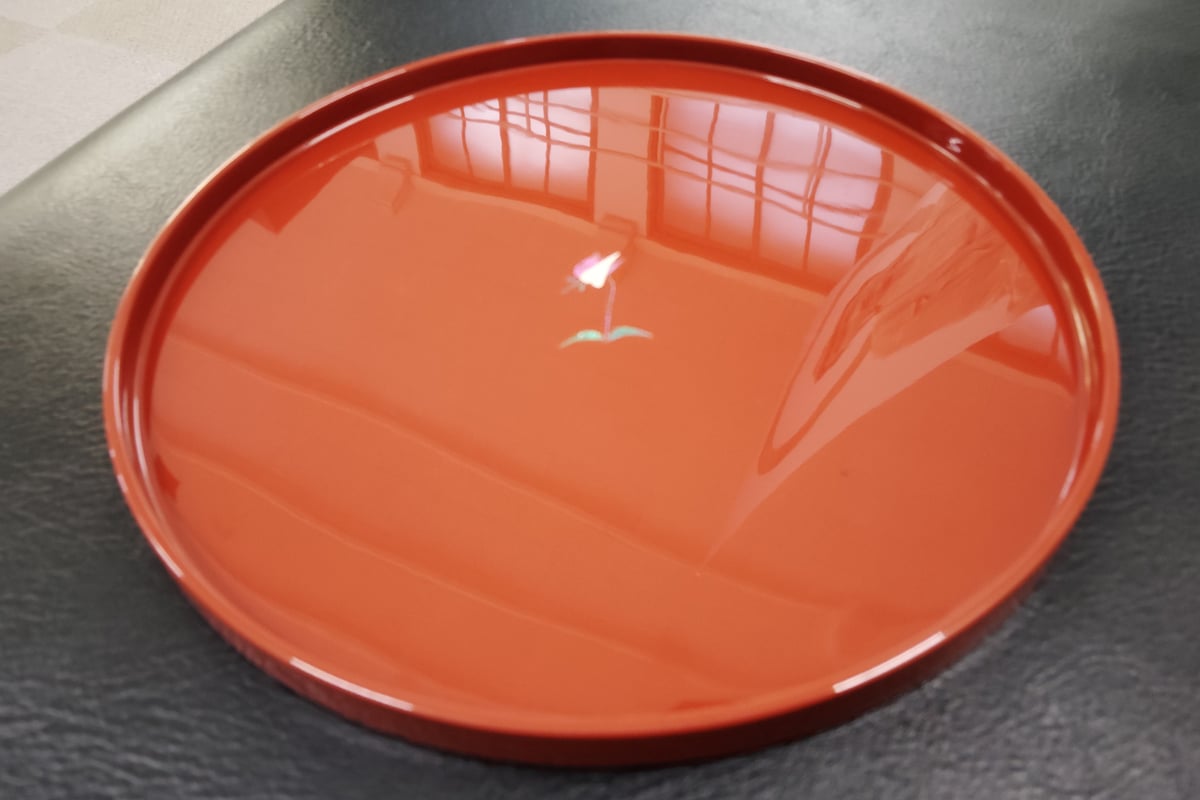
Image: Wikimedia Commons
Takaoka-shikki is lacquerware produced in Takaoka City, Toyama Prefecture. It is said to have begun in the early Edo period, during the Keicho era, when Maeda Toshinaga, the second lord of the Kaga Domain, had lacquer applied to everyday items such as armor, chests, and trays while building Takaoka Castle. Later, in the Meiwa era, Tsujiya Tanpo established the tsuishu and zonsei techniques modeled on Chinese lacquerware, and 'aogai-nuri' (mother-of-pearl inlay) developed based on the skill of the master craftsman Somada Seisuke, who had been invited from Kyoto by Toyama Domain lord Maeda Masatoshi; in the late Edo period, the first Ishii Yusuke studied Ming-dynasty Chinese lacquerware to create the original 'Yusuke-nuri' technique. Its greatest feature is that this single production area possesses a wider variety of decorative techniques than most others. With the establishment of the Toyama Prefectural Craft School in 1891 helping to advance technical instruction, the craft has been applied to a wide range of items, from everyday goods such as trays, tiered boxes, and tea utensils to art and craft pieces. Designated a METI-designated Traditional Craft in 1975, its traditional techniques continue to be passed down in workshops throughout Takaoka City today.
Origin
Takaoka-shikki is said to have begun in the early Edo period, during the Keicho era (1596-1615), when Maeda Toshinaga, the second lord of the Kaga Domain, had lacquer applied to everyday items such as armor, chests, and trays while building Takaoka Castle. Craftsmen were gathered as an industry of the castle town, and the skills of woodworking and lacquering took root in the region.
History
In the Meiwa era, Tsujiya Tanpo turned the tsuishu and zonsei techniques modeled on Chinese lacquerware into products, and in the early Edo period aogai-nuri (mother-of-pearl inlay) developed under the influence of the master craftsman Somada Seisuke, invited from Kyoto by Toyama Domain lord Maeda Masatoshi. In the late Edo period, the first Ishii Yusuke studied Ming-dynasty Chinese lacquerware and established his original Yusuke-nuri technique, adding to the accumulation of varied decorative techniques. Techniques were systematized following the establishment of the Toyama Prefectural Craft School in 1891, and the craft was designated a METI-designated Traditional Craft on September 4, 1975.
Features
Takaoka-shikki's greatest feature is that a single production area possesses several distinct decorative techniques—aogai-nuri, Yusuke-nuri, and chokoku-nuri (zonsei). The three-dimensional, colorful decoration using shell, metal powder, and colored lacquer gives it a wider range of designs than lacquerware from other regions, and it is cherished as everyday items such as trays, tea utensils, and writing boxes.
Techniques
Aogai-nuri (mother-of-pearl inlay)
A technique in which thinly processed abalone or great green turban shell is cut with a knife or needle into small triangular or diamond-shaped pieces, which are combined to depict landscapes or birds and flowers. It developed under the influence of the master craftsman Somada Seisuke, invited from Kyoto.
Yusuke-nuri
A technique created in the late Edo period by the first Ishii Yusuke after studying Ming-dynasty Chinese lacquerware. Chinese-style designs of flowers, birds, landscapes, and figures are drawn using sabi-e and gold-leaf pictures, with mother-of-pearl or semi-precious stones placed at key points, combining several methods.
Chokoku-nuri (zonsei)
A technique in which multiple layers of colored lacquer are carved to create a pattern, developed from the Chinese tsuishu and tsuikoku techniques. It is characterized by three-dimensional shading.
Materials Used
Production Process
- 1
Making the wood base
Wood such as zelkova or alder is shaped into trays or vessels using techniques such as lathe-turning and joinery.
- 2
Undercoating
Cloth is applied and a paste of clay powder is layered on to strengthen the wood base.
- 3
Mid-coating
Lacquer is applied in layers to even out the surface and prepare a base for decoration.
- 4
Decoration
Patterns of shell or colored lacquer are applied using techniques such as aogai-nuri, Yusuke-nuri, and chokoku-nuri.
- 5
Top-coating and polishing
Top-coat lacquer is applied and then carefully polished to bring out luster and texture.
| Main Production Areas |
|
|---|
Artisans & Workshops
株式会社柴田漆器店
A Takaoka-shikki retailer founded in 1926 (Showa 1). It manufactures and sells trays, tea utensils, sake sets, and other items using traditional Takaoka-shikki techniques such as aogai-nuri.
Official site →螺鈿工房おりはし
A workshop located east of Shin-Takaoka Station at the foot of Mt. Futagami, producing works using the aogai-nuri (mother-of-pearl inlay) technique of Takaoka-shikki.
Official site →武蔵川工房
A workshop specializing in the raden (mother-of-pearl) inlay work of Takaoka-shikki, producing and showcasing products decorated with shell.
Official site →How to Buy
- 株式会社柴田漆器店
- A long-established retailer founded in 1926, where trays, tea utensils, sake sets, and other Takaoka-shikki items featuring aogai-nuri can be purchased.Where to buy →PR
- 高岡地域地場産業センターZIBAオンラインショップ
- An online shop run by ZIBA, a facility handling Takaoka's traditional crafts including Takaoka-shikki, where products from multiple workshops can be purchased together.Where to buy →PR
Hands-on Experiences
高岡地域地場産業センター(ZIBA)漆器体験
富山県高岡市御旅屋セリオ2階
A lacquerware decoration experience using mother-of-pearl inlay and maki-e. Accommodates groups of about 4 to 20 people, taking about 120 minutes.
View details →伝統工芸高岡漆器協同組合 体験教室
富山県高岡市
A lacquerware experience run by the cooperative, where visitors can try techniques such as aogai-nuri and maki-e.
View details →FAQ
Q. What are the representative techniques of Takaoka-shikki?
A. The three representative techniques are aogai-nuri (mother-of-pearl inlay), which combines small pieces of shell to form patterns; Yusuke-nuri, born from studying Ming-dynasty Chinese lacquerware; and chokoku-nuri (zonsei), in which colored lacquer is carved.
Q. When was Takaoka-shikki designated a traditional craft?
A. It was designated a METI-designated Traditional Craft on September 4, 1975 (Showa 50).