Image: Wikimedia Commons
Sugiharagami is handmade washi paper made in Kami-ku, Taka Town (Takacho), Hyogo Prefecture. Only kozo (paper mulberry; a shrub of the mulberry family and a representative raw material of washi) is used as its raw material, and it is characterized by a gentle whiteness and a soft texture. It is thought to descend from the 'Harima paper' of the Nara period, and in the Heian period paper was made at Sugihara-no-sho (椙原庄), a manor of the Fujiwara clan. In the Kamakura period it became the official paper of the shogunate, and in the Muromachi period it was so highly valued that it was recorded that 'samurai will not write letters on anything but Sugihara.' From the Meiji era onward it declined under pressure from Western-style paper, and production ceased for a time in 1925 (Taisho 14). Papermaking was recreated in 1970, and it was revived when the town-run Sugiharagami Research Institute was established in 1972. It was designated a Hyogo Prefecture Important Intangible Cultural Property in 1983 and a Hyogo Prefecture Designated Traditional Craft in 1993.
Origin
Harima has long been known as a papermaking area, and Sugiharagami is presumed to descend from the Harima paper of the Nara period. In the Heian period, paper was made at Sugihara-no-sho, a Fujiwara clan manor located in the Sugihara Valley (杉原谷) of Harima Province. In the Denryaku, the diary of the regent (kampaku) Fujiwara no Tadazane, the name 'Sugihara-no-sho paper' (椙原庄紙) appears in an entry for 1116. This is considered the origin of the name Sugiharagami. In 1940, research by two scholars, Dr. Shinmura Izuru and Dr. Jugaku Bunsho, showed that the Sugihara Valley was the birthplace of Sugiharagami.
History
In the Kamakura period it was used as paper for official shogunate documents, and the Hojo Kudaiki records that in 1219 'Sugiharagami first came into wide circulation.' In the Muromachi period it was regarded as indispensable for samurai letters, and '十帖一本,' ten jo (bundles) of Sugiharagami presented together with one suehiro (folding fan), became a standard gift to superiors. Similar papers called '○○ Sugihara' also appeared in various regions. In the Edo period it was also used for ukiyo-e and spread among ordinary people. From the Meiji era onward it declined due to the spread of Western-style paper and other factors, and production ceased in 1925. Papermaking was recreated in 1970, and the Sugiharagami Research Institute began operating in 1972.
Features
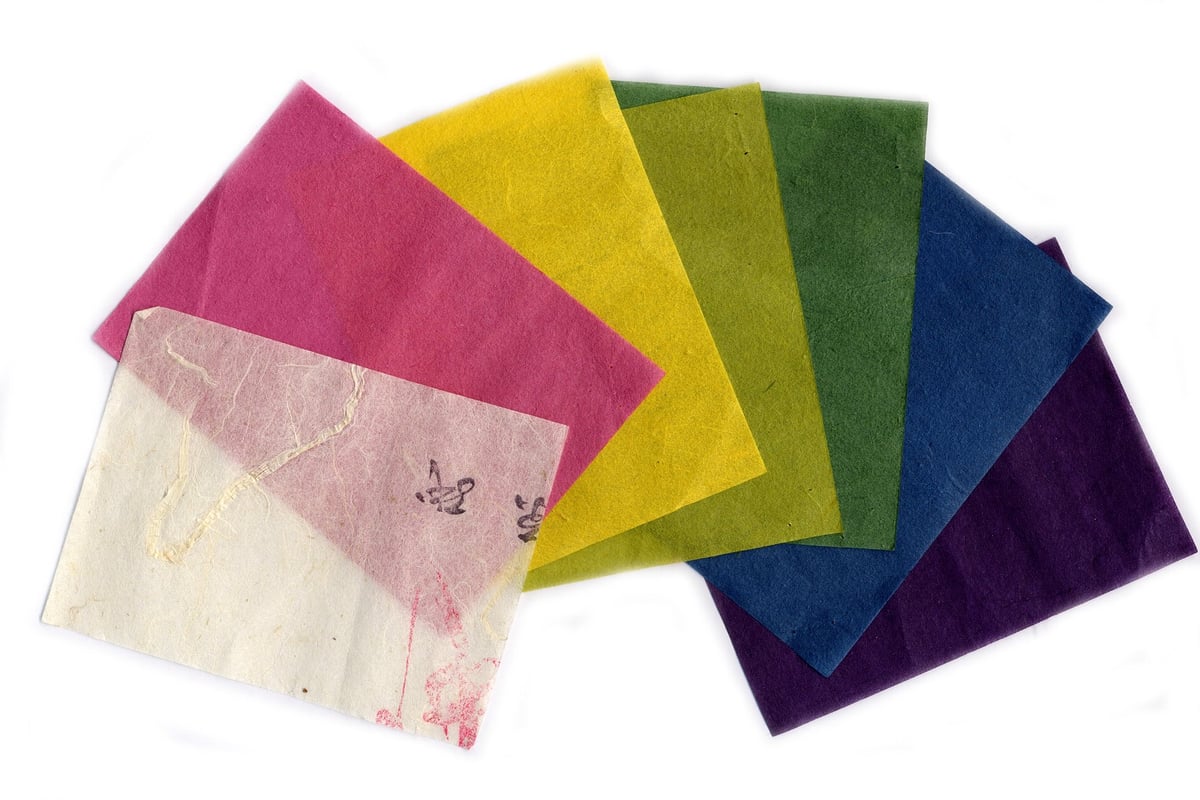
Sugiharagami uses only kozo as its raw material, and its appeal lies in its gentle whiteness and soft feel. In winter, 'kawa-sarashi' (river bleaching), in which the white inner bark of kozo is exposed to cold river water, is carried out to bring out its natural whiteness. Another distinctive feature is that, to give an even whiter finish, a liquid made by soaking rice flour in water and straining it is added to the paper stock. Today, in addition to washi for calligraphy, colorful folk-craft papers with leaves or colors formed into the sheets are also produced. It was designated a Hyogo Prefecture Important Intangible Cultural Property in 1983 and a Hyogo Prefecture Designated Traditional Craft in 1993.
Materials Used
Production Process
- 1
Steaming and Stripping the Kozo
Kozo cut to a uniform length of 1 m is steamed in a cauldron, and the bark is stripped while still hot. The outer black bark is then scraped off, leaving only the white inner bark.
- 2
River Bleaching and Boiling
The white bark is exposed to cold river water and then dried. After damaged parts are removed, it is boiled in a cauldron to soften it, and impurities such as dust and debris are removed by hand.
- 3
Beating and Preparing the Paper Stock
The bark is beaten with machines or sticks to loosen the fibers and turn them into paper stock (shiryo). To give a whiter finish, a liquid made by soaking rice flour in water and straining it through a bag is added.
- 4
Papermaking (Sheet Forming)
'Sana' (neri), a mucilage taken from the roots of tororo-aoi (a plant of the mallow family), is added to the paper stock and stirred in. The paper stock is scooped up with a suketa (screen and frame) and shaken back and forth and from side to side to form a sheet, and the sheets are stacked on a board.
- 5
Pressing and Drying
The stacked wet sheets are pressed to remove the water. Because the sana keeps the sheets from sticking to one another, they are peeled off one at a time and dried.
| Main Production Areas |
|
|---|
Artisans & Workshops
多可町立杉原紙研究所
A town-run papermaking workshop at 768-46 鳥羽, Kami-ku, Taka Town. It was established in 1972 by the former Kami Town, and Hyogo Prefecture introduces it as a maker of the traditional craft Sugiharagami. Pursuing the techniques of its predecessors, it makes calligraphy paper and folk-craft paper.
Official site →How to Buy
- 紙匠庵でんでん (in the Sugiharagami no Sato complex)
- A shop in 'Sugiharagami no Sato,' the same complex as the Sugiharagami Research Institute, that carries Sugiharagami in many colors and small items. The official website lists examples such as tanzaku (poem strips) for about 220 to 330 yen, shikishi (square poem cards) for about 572 yen, and a stamp-collecting book for about 5,280 yen. Open 9:30-16:30 from April to November and 10:00-16:00 from December to March. Closed on Wednesdays (or the following day if Wednesday is a holiday) and during the year-end and New Year holidays.Where to buy →PR
Hands-on Experiences
杉原紙研究所 紙すき体験
兵庫県多可郡多可町加美区鳥羽768-46
Visitors make paper with a wooden frame using local kozo. Patterns can also be added with leaves or colored kozo. Fees are about 450 yen for two postcards (550 yen with patterns), from 550 yen for hanshi size (standard calligraphy paper size), and from 700 yen for A3 size. The experience takes about 20 minutes, and drying takes about 1 to 1.5 hours. Reservations are required by the day before.
View details →FAQ
Q. Where does the name Sugiharagami come from?
A. It comes from the fact that it was paper made at Sugihara-no-sho, a Fujiwara clan manor in the Sugihara Valley of Harima Province, in the Heian period. It was also sometimes called 'Suibara' or 'Sugiwaragami.'
Q. What is '十帖一本' (ten bundles and one fan)?
A. It is a gift format consisting of ten jo (bundles) of Sugiharagami accompanied by one suehiro (folding fan). It became established in samurai society as the formal style for gifts presented to superiors, which shows that Sugiharagami was a paper of high standing.