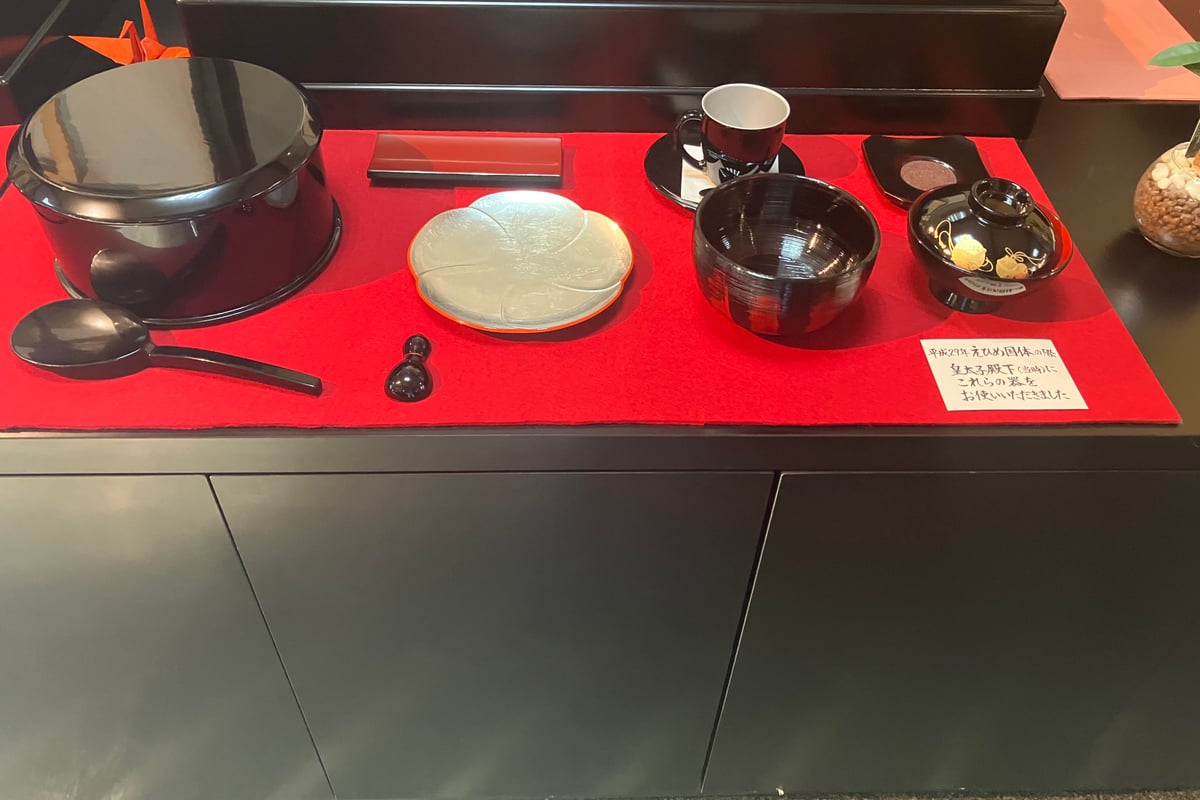
Image: Wikimedia Commons
Sakurai Lacquerware (Sakurai Shikki) is lacquerware made in the Sakurai district of Imabari City, Ehime Prefecture. It began not with manufacturing but with selling: in the late Edo period, merchants from Sakurai bought lacquerware from Kuroe in Kishu (present-day Kainan City, Wakayama Prefecture), carried it by ship, and peddled it in Kyushu and elsewhere. These lacquerware peddling ships were called 'wanbune' (bowl boats), and the peddlers became familiarly known in various places as 'Wanya-san' (the bowl sellers). Eventually lacquerware came to be made locally as well, and it became known as sturdy lacquerware thanks to the 'kushizashi' technique, in which the four corners of tiered boxes are interlocked like the teeth of a comb. Layers of lacquer are applied over a high-quality hinoki (Japanese cypress) wood base, and pieces are finished with maki-e or chinkin. The credit sales and installment sales that began at the peddlers' destinations are even said to be the origin of today's credit business. It is a Traditional Specialty Product (designated by Ehime Prefecture), and at 伊予桜井漆器会館 (Iyo Sakurai Shikki Kaikan) in Imabari City, visitors can pick up products and choose for themselves.
Origin
In 1765 (Meiwa 2), most of the Sakurai area changed from Matsuyama domain territory to tenryo (land under the direct control of the shogunate), and shipping merchants arose to transport rice paid as tax. In the first half of the 19th century, at the suggestion of Osaka merchants, they began buying lacquerware from Kuroe in Kishu. After a period of 'mixed peddling,' in which they sold Karatsu and Imari ceramics in the Kansai region in spring and, in autumn, sold in Kyushu the lacquerware bought on the way back, they shifted to wanbune peddling dealing in lacquerware alone.
History
Around the Tenpo era (1830-1844), lacquerware manufacturing is said to have begun in Sakurai because making it locally was more profitable. Some sources cite a manufacturing record from 1828 (Bunsei 11), and there are various theories about when it began and who founded it. In the Meiji period, craftspeople were invited from other production areas to raise quality, and in the mid-Taisho period there are said to have been more than 400 peddlers. Afterward, it declined with the development of land transportation and changes in materials, and by the early Showa era its scale had shrunk greatly.
Features
High-quality hinoki is used for the wood base, and lacquer is carefully applied in many layers. When manufacturing first began, pieces are said to have been made with the shunkei-nuri technique, which brings out the wood grain. Its representative product is the jubako (tiered box), and its sturdy construction, with corners reinforced by kushizashi, has been highly regarded. Even today, it is described as offering many reasonably priced items among Japan's lacquerware production areas.
Techniques
Kushizashi (Comb-Tooth Joint)
A technique in which comb-tooth-like projections and notches are made at the four corners, the most fragile part of a tiered box, and interlocked to join them. It is said to have been devised by Tsukihara Kyushiro and was established in the Tenpo era. Thanks to this technique, Sakurai Lacquerware became known throughout Japan as sturdy and affordable.
Maki-e and Chinkin
The surface of vessels coated with layers of lacquer is decorated to finish them. Maki-e is a technique in which gold powder or the like is sprinkled onto patterns drawn in lacquer, and chinkin is a technique in which patterns are carved into the surface and filled with gold leaf or the like. Sakurai Lacquerware uses both.
Materials Used
| Main Production Areas |
|
|---|
Artisans & Workshops
伊予桜井漆器会館
A company that manufactures and sells Sakurai Lacquerware, opened in 1989 (Heisei 1). The ancestors of its representative, 鳥井亮良, are said to have worked with lacquerware in Wakayama. Viewing the aging of craftspeople as a challenge, it is working to carry on the tradition, with cooperation with other production areas also in view.
How to Buy
- 伊予桜井漆器会館 (Iyo Sakurai Shikki Kaikan)
- It exhibits and sells a large number of lacquerware items, and because the products are not kept in display cases, visitors can pick them up and choose directly. It is described as offering many reasonably priced products among Japan's production areas. Admission is free.Where to buy →PR
Hands-on Experiences
伊予桜井漆器会館
愛媛県今治市長沢甲340-1
Visitors can see the manufacturing process, and at the attached cafe 花ぬり (Hananuri), drinks and food can be enjoyed in lacquerware. A travel booking site lists a painting experience plan from 3,800 yen per person. It is open from 10:00 to 18:00 and closed on Tuesdays (or the following day if Tuesday is a national holiday).
View details →FAQ
Q. What is 'wanbune'?
A. Wanbune were peddling ships loaded with lacquerware that traveled from place to place selling it. A boss, five or six sellers and a boatman were on board, and they toured various parts of western Japan. Most of the sellers were farmers from around Sakurai, and their income is said to have been determined by the quantity sold and the price.
Q. What is the connection between Sakurai Lacquerware and installment sales?
A. The main customers of the wanbune were farming villages. At first, goods were sold for cash, but sales shifted to credit payable after the harvest, semiannual payments and monthly installments. Shops for collecting payments were set up in various places, and these are said to have developed into installment department stores. It is also said that Tasaka Zenshiro, a businessman from Sakurai, devised the method of installment sales.
Q. What was the relationship with Kuroe in Kishu?
A. Kuroe, with its large output, was the largest supplier for the Sakurai peddlers. At its peak, it was reportedly even said that the movements of the Iyo merchants could sway Kuroe's economy. As direct trade between Kuroe and Kyushu progressed, peddling declined, and the Iyo wholesalers in Kuroe disappeared after 1942 (Showa 17).