Image: Wikimedia Commons
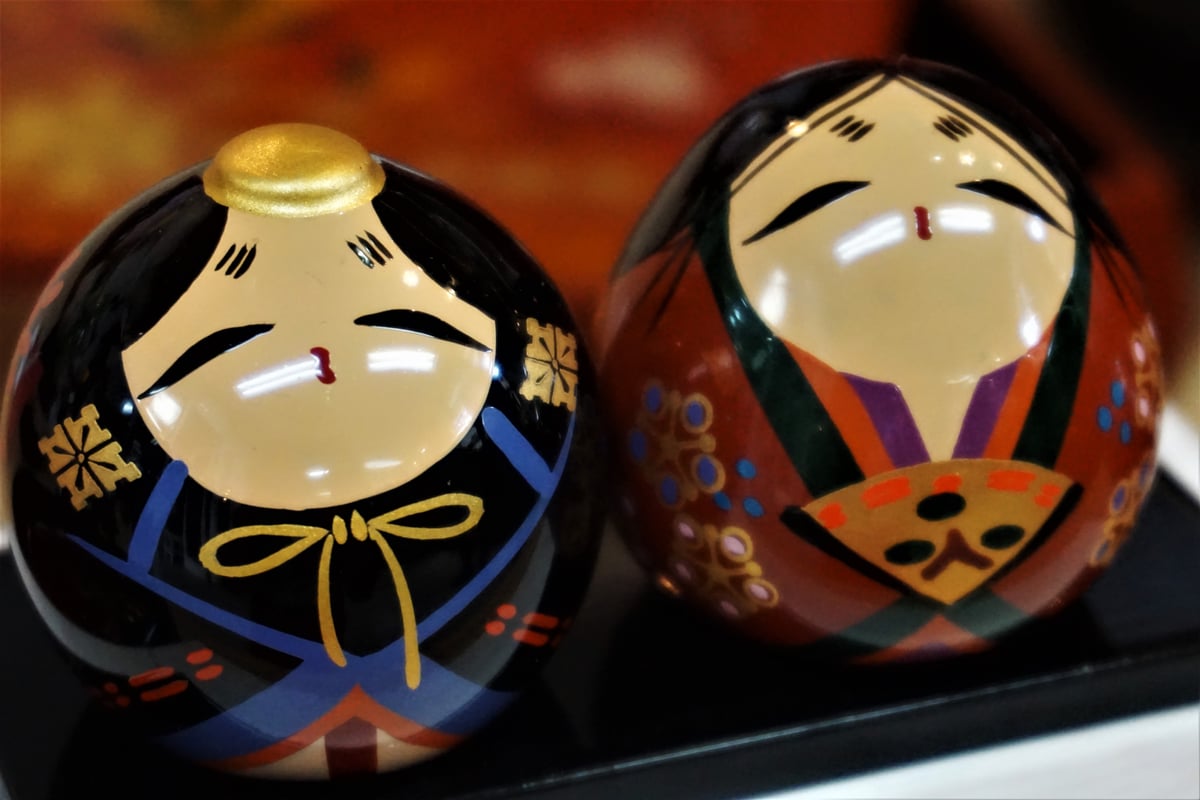
Ouchi dolls (Ouchi ningyo) are lacquered dolls made in Yamaguchi City, Yamaguchi Prefecture, and finished with the techniques of Ouchi-nuri (Ouchi lacquerware). They are a male-and-female pair of hina dolls made of round wood, coated with lacquer and finished with gold leaf and gold powder, and they are sold in paulownia boxes. They are characterized by a gentle expression: a round face, long narrow eyes and a small pursed mouth. The name comes from the Ouchi clan, which ruled Yamaguchi in the Muromachi period. According to legend, Ouchi Hiroyo summoned doll makers from the capital to comfort his wife, whom he had welcomed from Kyoto, and the dolls are cherished as a symbol of marital harmony. The present form of the Ouchi doll is said to be based on a design devised at Yamaguchi Prefecture's industrial testing station in the Taisho era. When Ouchi-nuri was designated a Traditional Craft by the Minister of Economy, Trade and Industry in 1989 (Heisei 1), the dolls were added to the designated items. They range from small pieces a few centimeters in diameter to large ones, and they are also displayed in place of hina dolls. At 長州苑 (Choshuen), near the five-storied pagoda of Ruriko-ji Temple, visitors can try painting Ouchi dolls.
Origin
The following legend is told about the origin of Ouchi dolls. In the mid-14th century, Ouchi Hiroyo built his residence in Yamaguchi and began developing the town in the image of the capital, Kyoto. Hiroyo took as his wife a princess from the Sanjo family of Kyoto, but it is said that she longed for the capital and did nothing but weep. So Hiroyo summoned many doll makers from the capital and decorated his residence with dolls to comfort her. It is said that the townspeople called the residence the 'Ningyo Goten' (Doll Palace).
History
Today's Ouchi dolls are said to be based on dolls devised around 1923 (Taisho 12) by 安藤広吉 of the Yamaguchi Prefectural Industrial Testing Station. There is also a record that when the Crown Prince visited Yamaguchi in 1926 (Taisho 15), the prefectural industrial testing station devised Ouchi dolls and presented them to him. Prewar dolls were colored with doro-enogu (opaque earth-based paints), and it was after the war that lacquered dolls began to be made. When Ouchi-nuri was designated a Traditional Craft in 1989 (Heisei 1), the dolls were included among the designated items at the suggestion of the Ministry of International Trade and Industry. As demand for serving trays (zen) and bowls declined, Ouchi dolls, together with chopsticks, became the mainstay products of Ouchi-nuri.
Features
Ouchi dolls are a male-and-female pair made by coating a nearly spherical wooden core with lacquer and finishing it with gold leaf and gold powder. Their gentle expression, with a round face, long narrow eyes and a small pursed mouth, is said to put viewers at ease. They have been regarded as a symbol of harmony between man and woman and as guardians of household peace. Sizes vary from handy ones about 4.5 cm in diameter to large ones. In recent years, they are increasingly displayed in place of hina dolls, combined with bonbori lanterns and folding screens. Items modeled on Ouchi dolls, such as chopstick rests and straps, are also made.
Materials Used
| Main Production Areas |
|
|---|
Artisans & Workshops
桑原大内塗大内人形製作所
A long-established maker founded in 1933 (Showa 8) that carries on the tradition of the Ouchi doll devised in the Taisho era. It sells dolls directly at its shop on the Dojomonzen shopping street in Dojomonzen 1-chome, Yamaguchi City, and in its workshop visitors can watch the decoration process of Ouchi-nuri. The dolls come in paulownia boxes and in a variety of sizes.
Official site →中村民芸社
An Ouchi-nuri workshop at 4138 Ouchi-Mihori, Yamaguchi City, which makes Ouchi dolls as well as chopstick-rest dolls, straps and seasonal dolls. Size No. 1 Ouchi dolls start from about 4,400 yen, and sizes over 6 cm in diameter are available on consultation. It also offers an accessory-making experience using Ouchi-nuri techniques.
Official site →Ouchi夫婦(大内塗漆器振興協同組合)
A new, made-to-order style of Ouchi doll produced by the 大内塗漆器振興協同組合 (Ouchi-nuri Lacquerware Promotion Cooperative). Customers can choose the facial features, patterns and colors when ordering, and initials or a family crest can also be added. It takes about 3 months from order to completion.
Official site →How to Buy
- 長州苑 (長州おみや)
- A local specialty shop at 1-6 Kimachi, Yamaguchi City, right next to the five-storied pagoda of Ruriko-ji Temple, a National Treasure. It claims the largest selection of Ouchi dolls in the prefecture and also carries original goods with Ouchi doll motifs. The shop is open from 8:30 to 17:00, every day of the year.Where to buy →PR
- 桑原大内塗大内人形製作所 (online shop)
- It carries Ouchi dolls by size number (a male-and-female pair in a paulownia box), ranging from about 7,900 yen for size No. 15 to about 160,000 yen for size No. 40. There are also hina doll sets combined with folding screens and cases, but many items are out of stock. Notices of price revisions due to rising material costs have also been posted.Where to buy →PR
Hands-on Experiences
長州苑(大内人形の絵付け体験)
山口県山口市木町1-6
An experience in which you color an Ouchi doll with acrylic paints to create your own 'My Ouchi Doll'. The fee is about 1,100 yen for either the lord (tono) or the princess (hime), and about 2,200 yen for a set of both. It is held twice a day, from 9:30 and from 14:30, and takes about 50 minutes to 1 hour. Reservations are required, and groups of 20 or more must apply at least one month in advance.
View details →FAQ
Q. How are Ouchi dolls meant to be displayed?
A. Ouchi dolls are a symbol of harmony between man and woman and are regarded as guardians of household peace, and they are popular as souvenirs and gifts. In recent years, some people combine them with bonbori lanterns and folding screens and use them in place of hina dolls. 中村民芸社 offers a hina doll set with 6 cm diameter dolls for about 22,000 yen.
Q. Are there any sweets associated with Ouchi dolls?
A. 山口風月堂 in Yamaguchi City sells 'Ouchi Monatan' (大内もなたん), a monaka wafer sweet shaped like Ouchi dolls (about 880 yen for 2 pieces). There is also 'Nikotan-to' (にこたん糖), a dry confection made of wasanbon sugar. A premium set is also available, in which 8 Monatan come with a pair of Ouchi dolls made by a workshop in the city.