Image: Wikimedia Commons
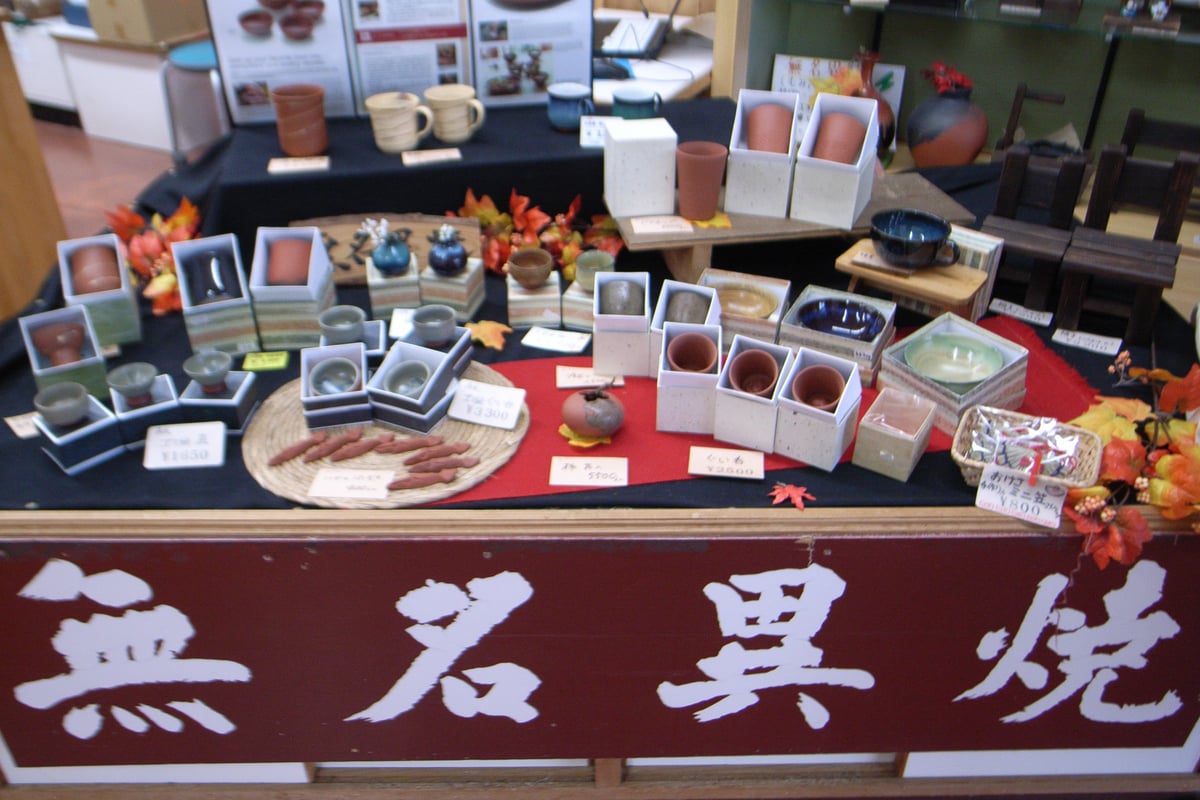
Mumyoi-yaki is pottery made mainly in the Aikawa district of Sado City, Niigata Prefecture. 'Mumyoi' refers to a red clay rich in iron oxide that is produced at the Sado Gold and Silver Mine, and in the past it was also used as a medicine, for example to stop bleeding. When this mumyoi is used in the clay body and fired hard at high temperatures, it shrinks by as much as about 30 percent between forming and drying, and the finished piece is extremely hard. It is characterized by the clear metallic sound it makes when tapped and by a luster that increases the more it is used. Its beginnings are traced to 1819 (Bunsei 2), when raku ware using mumyoi was fired, and the present technique of firing it hard at high temperatures was established in the Meiji era. In 2003 it was designated a national Important Intangible Cultural Property, and Ito Sekisui V was recognized as its holder (Living National Treasure). Further, in October 2024, it became a Traditional Craft Designated by the Minister of Economy, Trade and Industry under the name 'Sado Mumyoi-yaki.' Some kilns on the island offer pottery wheel experiences.
Origin
Mumyoi is a red clay rich in iron oxide produced inside the tunnels of the Sado Gold Mine. In the past it was used as a medicine to stop bleeding and to treat palsy (chufu), and it circulated much like a traditional Japanese-Chinese herbal medicine. Mumyoi-yaki is said to have begun in 1819 (Bunsei 2), when raku ware was fired using this mumyoi. At first, it was a red raku ware mixed with mumyoi. Raku ware is fired at relatively low temperatures, and it differed in character from the hard Mumyoi-yaki of today.
History
In 1857 (Ansei 4), Ito Tomitaro began hon-yaki (high-temperature firing), and in 1878 (Meiji 11), Ito Sekisui and the first Miura Jozan succeeded in high-temperature firing at around the same time. The first Jozan is said to have perfected shushidei-yaki, a hard ware fired at high temperatures. In 2003, Mumyoi-yaki was designated a national Important Intangible Cultural Property, and Ito Sekisui V was recognized as its holder. On October 17, 2024, it was designated a national Traditional Craft, the first in Sado City.
Features
The clay body containing mumyoi is an extremely fine-grained clay from which sand and impurities have been removed through suihi (elutriation: a refining method of dissolving the clay in water and extracting only the fine particles). As a result, its shrinkage rate is high: whereas typical pottery shrinks by about 10 to 15 percent, it shrinks by as much as about 30 percent between forming and drying. Vessels fired hard at high temperatures of 1,200 to 1,250 degrees Celsius are very hard and give off a clear metallic sound when tapped. The more they are used, the deeper their color becomes and the more a subdued sheen emerges.
Techniques
Nama-migaki and post-firing polishing
While the formed vessel is still half-dry, its surface is burnished with a stone or iron spatula to bring out a luster. After firing, it is polished further by sand polishing using materials such as slag from refining at the Sado Gold Mine, drawing out its distinctive sheen.
Yohen (kiln transformation)
An expression that makes use of the phenomenon in which a vessel's color changes due to factors such as how the flames strike it during firing. Ito Sekisui V established a new mode of expression with yohen works in which black discolored areas appear on red mumyoi vessels.
Neriage (layered colored clay)
A technique in which clays of different colors are layered to make a block like a sushi roll, which is then sliced and the cross-sections arranged to form a vessel. The works of Ito Sekisui V are known for the distinctive striped patterns and flower motifs created with neriage.
Materials Used
Production Process
- 1
Refining the clay
Mumyoi and clay are elutriated (suihi), and sand and impurities are removed with a fine sieve.
- 2
Forming
The vessel is shaped on a potter's wheel or by other means.
- 3
Nama-migaki (burnishing)
Before it has fully dried, the surface is burnished with a stone or iron spatula.
- 4
Main firing
The vessel is fired hard at high temperatures of 1,200 to 1,250 degrees Celsius.
- 5
Polishing
The fired vessel is polished further to bring out its luster.
| Main Production Areas |
|
|---|
Artisans & Workshops
赤水窯(伊藤赤水)
A traditional kiln in Aikawa, opened in the Tenpo era. Ito Sekisui V was recognized as a Living National Treasure in 2003 and changed his name to Ito Sekijin in 2024. The name Ito Sekisui was inherited by the sixth generation in 2023.
Official site →玉堂窯元
A Mumyoi-yaki kiln in Kubota, Sado City. It makes tea utensils, sake vessels, tableware, flower vases, and more, and also gives pottery wheel demonstrations in its shop. It is one of the kilns where visitors on a trip can easily watch and try pottery-making.
Official site →How to Buy
- 伊藤赤水作品展示館(赤水窯)
- The main store in Aikawa Ichichome and the Shimo-Aikawa store carry Sekisui Kiln bowls, tea bowls, plates, flower vases, incense burners, and more. Prices range widely, from the 4,000-yen range to around 300,000 yen.Where to buy →PR
- 玉堂窯元
- The kiln's shop sells Mumyoi-yaki such as tea utensils, cups, tableware, sake vessels, flower vases, and tea ceremony utensils. Open 8:30 to 17:30 from March to November and 9:00 to 16:00 from December to February.Where to buy →PR
Hands-on Experiences
玉堂窯元(ろくろ体験)
新潟県佐渡市窪田122-1
An experience making a vessel about the size of a teacup or cup on an electric potter's wheel starts at around 3,000 yen per person (firing fee included; shipping and consumption tax extra). Reservations are required by the previous day, and it takes about two months for the piece to be fired and finished.
View details →相川技能伝承展示館
新潟県佐渡市相川北沢町2
Visitors can make a Mumyoi-yaki vessel on a potter's wheel with demonstrations and guidance from craftsmen. According to a 2019 article, the fee was around 1,530 to 1,830 yen (shipping extra), with reservations required at least 3 days in advance.
View details →FAQ
Q. Why does Mumyoi-yaki make a metallic sound when tapped?
A. Clay containing mumyoi has fine particles and is characterized by large shrinkage, shrinking by as much as about 30 percent between forming and drying. Because it is then fired hard at high temperatures, the finished piece is extremely hard and gives off a clear metallic sound when tapped.
Q. Are 'Mumyoi-yaki' and 'Sado Mumyoi-yaki' different things?
A. They refer to the same pottery. 'Sado Mumyoi-yaki' is the name used when it became a Traditional Craft Designated by the Minister of Economy, Trade and Industry in 2024, while as a national Important Intangible Cultural Property it is designated under the name 'Mumyoi-yaki.'