Image: Wikimedia Commons
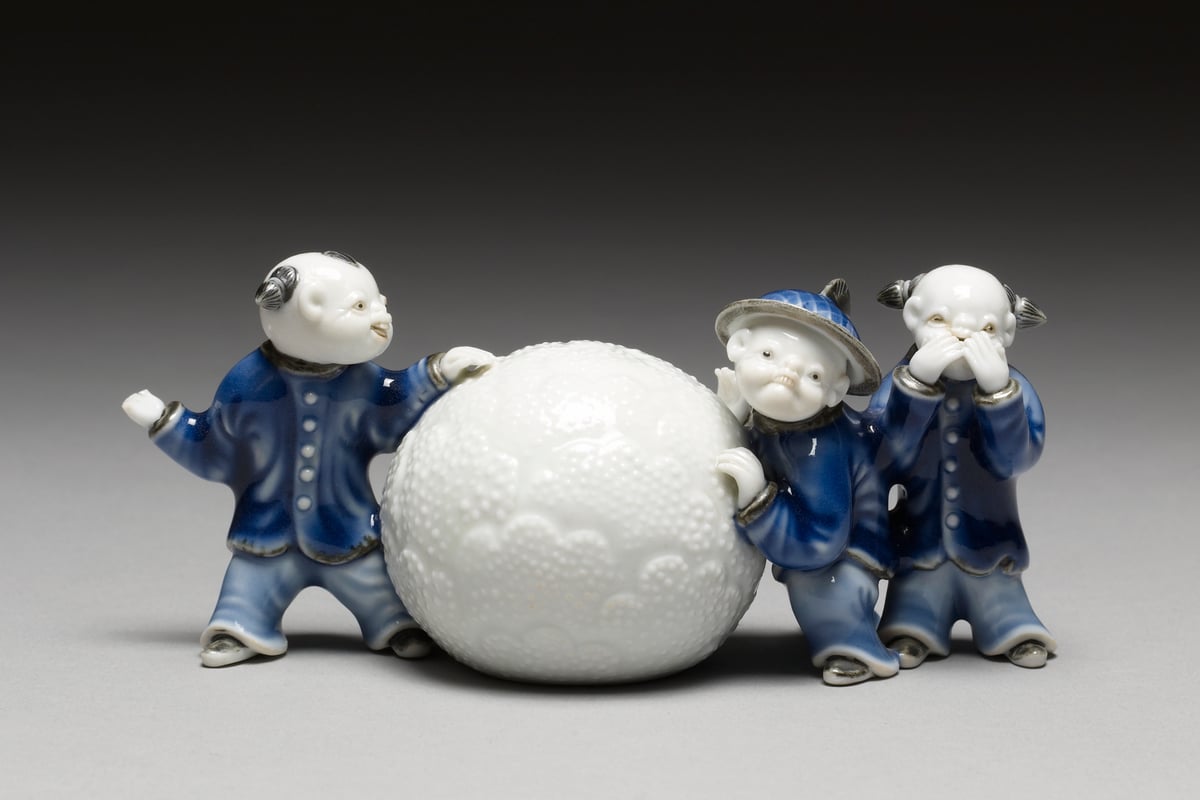
Mikawachi ware (Mikawachi-yaki) is porcelain made in the Mikawachi area of Sasebo City, Nagasaki Prefecture. It is said to have begun in 1598 (Keicho 3), when potters brought back from Korea by Matsura Shigenobu, lord of the Hirado domain, opened a kiln on Hirado Island. They later moved to Mikawachi in search of good raw materials, and in 1637 (Kan'ei 14) an official kiln of the Hirado domain was opened there. Under the domain's generous patronage, tribute pieces were made with no regard for cost, and the craft is described as having refined its high level of skill in this way. It is characterized by delicate sometsuke (underglaze blue) painted with gosu (cobalt pigment) on almost translucent white porcelain. The 'karako-e' design, showing karako (Chinese children) at play, is a representative motif. It is also known for fine crafted pieces such as 'rankakude' (eggshell porcelain), so thin that light shines through, openwork carving, and chrysanthemum ornament work (kikka kazari zaiku). In 1978 it was designated a Traditional Craft by the Minister of Economy, Trade and Industry, and today a dozen or so kilns carry on the tradition.
Origin
After the Bunroku-Keicho campaigns (Japan's invasions of Korea), Matsura Shigenobu, lord of the Hirado domain, brought back Korean potters. It is said to have begun in 1598, when the potter Koseki opened a kiln at Nakano on Hirado Island on the lord's orders. Good porcelain stone could not be obtained on Hirado, so the potters moved in search of raw materials. In 1633, the second-generation Sannojo is described as having discovered Ajiro porcelain stone and moved on to porcelain making.
History
In 1637, the Hirado domain opened an official kiln at Mikawachi and had it fire tribute pieces for the imperial court and the shogun's family. The third-generation Imamura Yajibei is said to have introduced Amakusa porcelain stone and perfected pure white porcelain. From the late Edo period, it was also exported overseas under the name 'Hirado ware.' After losing the domain's backing in the Meiji era, the kilns fell on hard times, but in 1899 (Meiji 32) 豊島政治 founded the 'Mikawachi Ceramics Design Training School' (三川内陶磁器意匠伝習所), and the techniques were passed on.
Features
Its hallmark is delicate indigo sometsuke painted with gosu on pure white porcelain. Because pieces were made under the domain's protection without concern for cost, time-consuming techniques such as thin potting, openwork carving and crafted pieces developed. In 2016 it was also recognized as a constituent cultural property of the Japan Heritage 'Hizen, the Home of Japanese Porcelain' (日本磁器のふるさと 肥前). There are said to be about 14 to 15 kilns today, balancing traditional techniques with contemporary tableware making.
Techniques
Karako-e (karako design)
A design depicting 'karako,' children in Chinese-style clothing, at play, and the representative motif of Mikawachi ware. The number of karako is said to carry meaning: according to tradition, seven were for tribute pieces to the shogun's family or the imperial court, five for court nobles and daimyo families, and three for ordinary people.
Rankakude (eggshell porcelain)
Porcelain as thin as an eggshell, so thin that light shines through it. It was perfected by Ikeda Yasujiro and others in the Tenpo era (1830–1843) and gained a reputation in Europe, where it was called 'eggshell.' The technique was lost for a time, but is described as having been revived in 2006 by 藤本岳英.
Openwork carving and okiage
Openwork carving (sukashibori) is a technique of carving patterns right through the body so that they are pierced, and is used for items such as incense burners. Okiage is a technique of building up clay with the tip of a brush to create patterns that look like relief carving, and is said to have been perfected around 1680.
Chrysanthemum ornament work (kikka kazari zaiku)
A crafting technique of applying ornaments shaped like chrysanthemum flowers to vessels. The 'Hirado chrysanthemum ornament work' (平戸菊花飾細工) handed down at 平戸洸祥団右ヱ門窯 is designated an Intangible Cultural Property of Nagasaki Prefecture. A chrysanthemum insect cage is described as having been presented as a gift on the occasion of the Emperor's enthronement.
Materials Used
| Main Production Areas |
|
|---|
Artisans & Workshops
平戸洸祥団右ヱ門窯
A Mikawachi ware kiln said to have been founded in 1622. The 17th generation, 中里一郎, was certified as a holder of a Nagasaki Prefecture Intangible Cultural Property for the technique of 'Hirado chrysanthemum ornament work,' and the 18th generation, 中里太陽, is described as now heading the kiln. It also makes tableware for everyday use.
Official site →嘉久房窯(平戸窯悦山)
A kiln said to descend from the early potters of Mikawachi ware. The 14th-generation 平戸悦山 (今村均) developed the technique of hineri zaiku (hand-modeled work), and in 2021 he was designated a holder of the Nagasaki Prefecture Intangible Cultural Property 'Mikawachi crafting techniques' (三川内細工技術). It is known for the 'Shitadashi Sanbaso' doll (a Sanbaso dancer sticking out his tongue), which has been made since the Edo period.
Official site →How to Buy
- Mikawachi Pottery Fair and Hamazen Festival
- The Mikawachi Pottery Fair is held every year in late November, and the 2026 fair is described as scheduled for November 20–23. Shuttle buses run to the venues from 三川内焼伝統産業会館 (Mikawachi-yaki Traditional Industry Hall). The 'Hamazen Festival' is also held every year from May 1 to 5.Where to buy →PR
Hands-on Experiences
三川内焼伝統産業会館(三川内焼美術館)
長崎県佐世保市三川内本町343
It displays masterpieces of white porcelain from the Edo to Meiji periods, as well as works by contemporary artists and Certified Traditional Craftsmen. Visitors are described as being able to try painting on plates or teacups and openwork carving on items such as pen stands. Free admission, open 9:00–17:00, closed over the New Year holidays.
View details →嘉泉窯
長崎県佐世保市三川内町
A kiln said to have been founded in the Azuchi-Momoyama period, which continues to this day after serving as an official kiln of the Hirado domain. In a workshop not usually open to visitors, you can choose a teacup or plate and try painting it with gosu. The booking site lists 3,000 yen per person, taking 2 to 3 hours. Prices are subject to change.
View details →FAQ
Q. How thin is rankakude?
A. Some rankakude cups made for export are about 1 mm thick, so thin that light shines through them. It is said to have been created in pursuit of the domain's request for 'a bowl lighter than chopsticks,' and is described as being made only from Ajiro porcelain stone from Hario Island and formed by hand.
Q. Is Mikawachi ware also called 'Hirado ware'?
A. Yes. Mikawachi ware developed as an official kiln of the Hirado domain, and from the late Edo period into the Meiji era it was also known overseas under the name 'Hirado ware.' Works made at the domain kiln in the Edo period are described as generally also being called 'Ko-Hirado' (Old Hirado).