Image: Wikimedia Commons
Kurayoshi Gasuri is a kasuri (ikat) that has been woven in Kurayoshi City in central Tottori Prefecture since the late Edo period. It is known for its elaborate e-gasuri (pictorial kasuri), which weave in motifs such as flowers, birds and landscapes, pine, bamboo and plum, and cranes and tortoises as if they were paintings. Tottori Prefecture materials say that about 200 years ago, 稲嶋大助 wove e-gasuri depicting flowers, birds and landscapes and spread the craft. It was woven extensively in the Meiji era, and kasuri exhibited by the 船木 and 桑田 factories won awards at world's fairs overseas. In the early Meiji era, the technique is said to have spread to the Mimasaka region, giving rise to Sakushu Kasuri in Okayama Prefecture. It later declined, pushed aside by machine-made textiles. After the war, the dyeing and weaving artist Yoshida Tasuku deciphered old instruction manuals and revived the complex futsu-ori (double weave). Today, 倉吉絣保存会 (the Kurayoshi Gasuri Preservation Society) carries on the techniques and holds demonstrations and exhibition sales at 倉吉ふるさと工芸館. It is one of the Tottori Prefecture Local Crafts designated by the Governor of Tottori Prefecture.
Origin
Kurayoshi Gasuri is said to have originated in the late Edo period. Tottori Prefecture materials say that about 200 years ago, 稲嶋大助 wove e-gasuri depicting flowers, birds and landscapes and popularized it. Kurayoshi was a town that prospered through commerce from the mid-Edo period through the Meiji era. It is described as having spread the town's name throughout Japan through Kurayoshi Gasuri, together with the inakoki senba (a tool for threshing rice).
History
In the Meiji era, Kurayoshi Gasuri was woven extensively and sold in many places, mainly in western Japan. Kasuri exhibited by the 船木 and 桑田 factories won awards at world's fairs in various countries, earning a high reputation. From the Taisho era onward it declined, pushed aside by machine production, and after the war the number of people able to weave complex structured weaves nearly died out. Around Showa 30, the dyeing and weaving artist Yoshida Tasuku obtained an instruction manual from an old family, and through repeated trial weaving restored futsu-ori and other weaves. 倉吉絣保存会 was later formed, and the techniques continue to be passed on.
Features
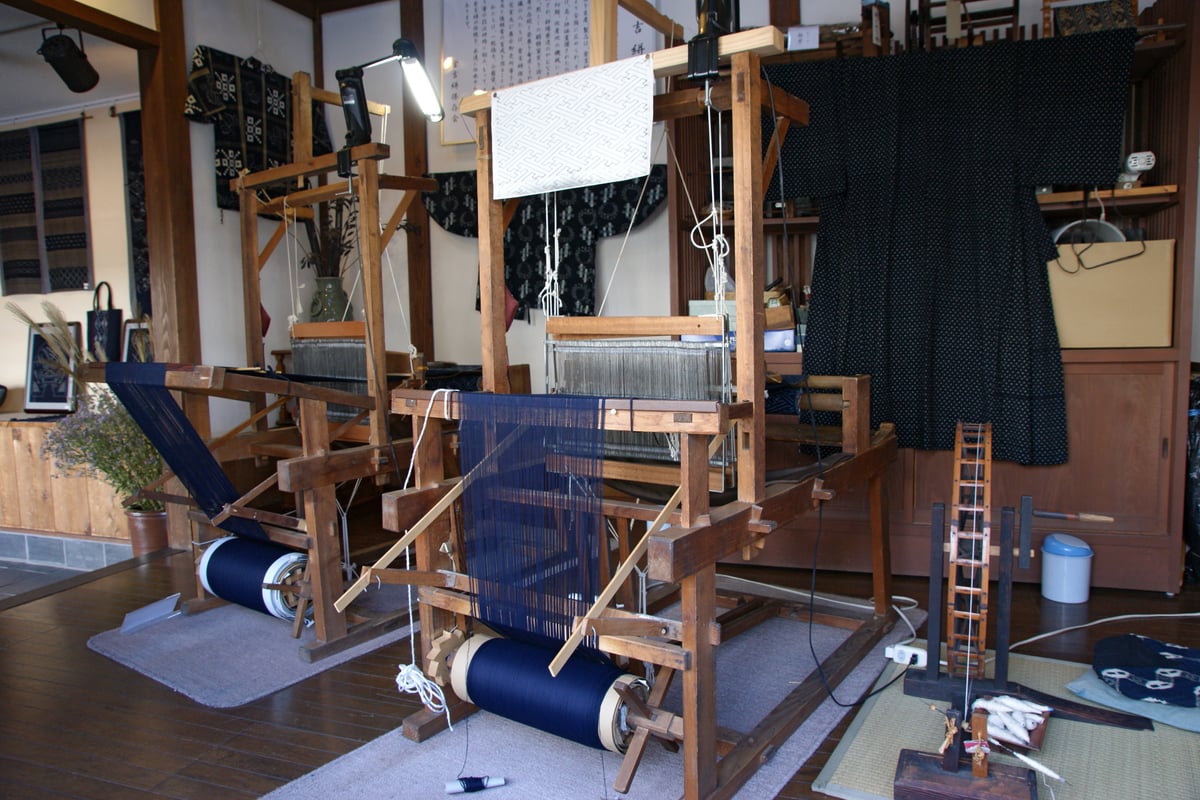
A major feature of Kurayoshi Gasuri is its elaborate e-gasuri, which looks as if pictures have been woven into it. Tottori Prefecture materials list patterns such as asanoha (hemp leaf), kikko (tortoiseshell), landscapes, and pines and cranes. Kasuri threads, which are bound and dyed in sections beforehand, are used, and the cloth is woven by hand while the patterns are aligned thread by thread. Besides e-gasuri, structured weaves such as futsu-ori, which use many heddles (soko, tools that raise and lower the warp threads), have also been handed down, and it was once called a 'phantom textile'.
Techniques
E-gasuri (pictorial kasuri)
A technique in which parts of the threads are bound according to the design to resist dye, and patterns are woven with the kasuri threads dyed in sections. By aligning the pattern thread by thread while weaving, flowers, birds and landscapes, pine, bamboo and plum and other motifs are expressed like paintings. It is said that the more complex the pattern, the more expensive the cloth was.
Futsu-ori (double weave)
A double-layered weave woven with four or more heddles while the threads of the front and back are switched. Instruction manuals for futsu-ori and soshiki-ori have been handed down in Kurayoshi, and Yoshida Tasuku revived the techniques through repeated deciphering and trial weaving.
Materials Used
| Main Production Areas |
|
|---|
Artisans & Workshops
倉吉絣保存会
An organization based in 倉吉ふるさと工芸館 in 東仲町, Kurayoshi City. The kasuri researcher 福井貞子 was involved in its founding and, as its chair and adviser, worked to revive kasuri and to train successors. 福井貞子 (1987) and 牧幸子 (1998) have been certified as Tottori Prefecture Certified Traditional Craftspeople.
吉田たすく手織工房
A workshop in 鍛冶町, Kurayoshi City. The dyeing and weaving artist Yoshida Tasuku (吉田祐), who was first introduced to weaving through Kurayoshi Gasuri, deciphered instruction manuals for futsu-ori and soshiki-ori and attempted multi-heddle weaves. Based on those techniques, the workshop produces ayatsuzure-ori.
How to Buy
- 倉吉ふるさと工芸館
- A craft hall at 東仲町2606, Kurayoshi City. 倉吉絣保存会 exhibits and sells its own kimono fabric, noren curtains, bags, wallets, table runners and more. Open from 9:00 to 17:00; closed on Wednesdays. It is easy to stop by while sightseeing at the Shirakabe Dozogun (white-walled storehouses).
Hands-on Experiences
倉吉ふるさと工芸館(機織り実演の見学)
鳥取県倉吉市東仲町2606
You can watch weaving demonstrations by 倉吉絣保存会. Tottori Prefecture's workshop guide states that hands-on experiences are not available, so visits center on watching. The hall also displays pottery from kilns in central Tottori Prefecture and materials on the Utsubuki celestial maiden legend.
鳥取短期大学 絣美術館
鳥取県倉吉市福庭854
An art museum on the campus of 鳥取短期大学 (Tottori College), opened in 1998 to preserve and exhibit Kurayoshi Gasuri. It displays Kurayoshi Gasuri from the Meiji to Taisho eras and kasuri products from overseas. Admission is free, and it is open from 10:00 to 16:00. It is best to check closing days in advance.
FAQ
Q. Is Kurayoshi Gasuri a national Traditional Craft?
A. No. Kurayoshi Gasuri is a Tottori Prefecture Local Craft designated by the Governor of Tottori Prefecture. Among the kasuri of Tottori Prefecture, Yumihama Gasuri from the western part of the prefecture is designated a national Traditional Craft.
Q. Is it related to Sakushu Kasuri of Okayama Prefecture?
A. It is said that in the early Meiji era, the techniques of Kurayoshi Gasuri spread to the Mimasaka region (the northern part of present-day Okayama Prefecture), giving rise to Sakushu Kasuri. Influenced by Kurayoshi Gasuri, Sakushu Kasuri spread as an indigo cotton kasuri.
Q. Where can I see Kurayoshi Gasuri?
A. At 倉吉ふるさと工芸館, you can see exhibition sales of works by 倉吉絣保存会 and watch weaving demonstrations. At the Kasuri Art Museum of 鳥取短期大学 (Tottori College), Kurayoshi Gasuri from the Meiji to Taisho eras is on display.