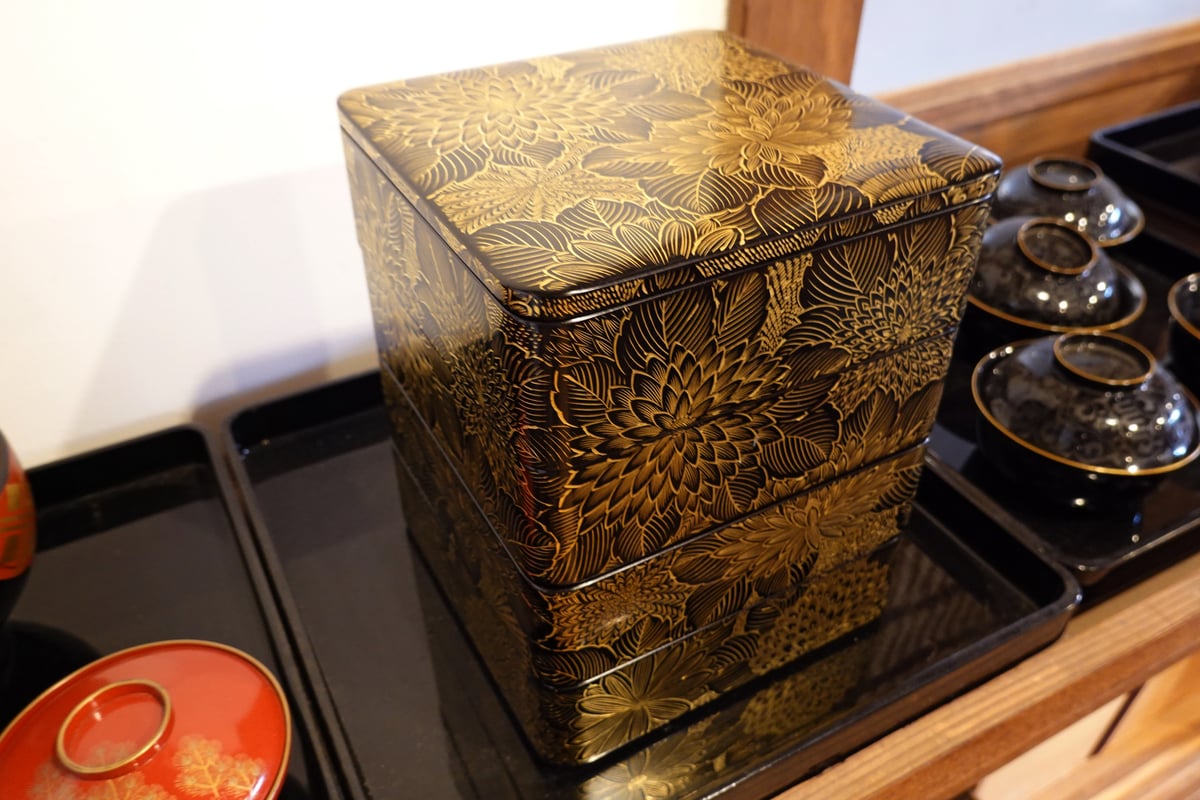
Image: Wikimedia Commons
Kishu Shikki is lacquerware made mainly in the Kuroe district of Kainan City, Wakayama Prefecture, and also in Wakayama City and Kimino Town. Because Kuroe was the center of production, it is also called 'Kuroe-nuri'. Its origins are said to date back to the Muromachi period, beginning when kijishi (wood-turners) of the Omi lineage made bowls from Kishu wood. Another theory holds that craftspeople who had made Negoro Nuri at Negoro-ji in Iwade City moved to Kuroe after Toyotomi Hideyoshi's attack on Negoro in 1585. In the Edo period, under the protection of the Kishu Domain, it developed as a production area for everyday bowls and trays through a division of labor in which craftspeople shared the work of wood bases, coating and decoration. From the Meiji era onward it adopted chinkin and maki-e techniques, and after the war it was quick to take up plastic bases and synthetic coatings. It is one of Japan's leading lacquerware production areas, alongside Aizu and Yamanaka, and in 1978 (Showa 53) it was designated a Traditional Craft by the Minister of Economy, Trade and Industry.
Origin
The origins of Kishu Shikki are said to date back to the Muromachi period. It is said to have begun when kijishi (wood-turners) of the Omi lineage settled in Kuroe and made bowls from Kishu's abundant timber. The early bowls were 'shibuji-wan', which used persimmon tannin (kakishibu) rather than urushi lacquer for the undercoat. There is also a theory that lacquer craftspeople of Negoro-ji left the temple during the attack on Negoro in 1585, moved to Kuroe and passed on their skills.
History
In the Edo period, Kuroe bowls were recorded in books such as 'Kefukigusa' and came to be shipped to provinces across the country. The Kishu Domain protected the production area, and in Bunsei 9 (1826) the technique of kataji (hard-undercoat) flat lacquerware (itamono) was also introduced. In the Meiji era exports overseas began, and the decorative skills were refined with chinkin in 1879 and with maki-e artists invited from Kyoto in 1898. After the war, the area expanded its markets with plastic bases and chemical coatings, and in 1978 Kishu Shikki was designated a national Traditional Craft.
Features
Kishu Shikki is characterized by its many sturdy, easy-to-handle vessels for everyday use. The production area has a wide range of expression, from Negoro Nuri-style finishes in which vermilion is layered over a black undercoat so that the black shows through with use, to the brilliant decoration of maki-e and chinkin. It developed through a division of labor in which separate craftspeople handle the wood base, undercoating, coating and decoration, and it has flexibly taken on new materials and coatings. Lacquerware shops and the houses of lacquerers (nushi) still remain in the townscape of Kuroe.
Techniques
Shibuji
The technique of the shibuji-wan bowls said to mark the beginning of Kishu Shikki. Instead of using urushi lacquer for the undercoat, a sturdy undercoat is made with persimmon tannin and animal glue (nikawa), and urushi lacquer is applied over it to finish. It produced affordable, durable vessels and laid the foundation for their spread as everyday goods for ordinary people.
Togidashi (Negoro Nuri-style finish)
A finish in which vermilion is layered over a black undercoat and the surface is polished so that the black shows through here and there. It is regarded as an expression that carries on the tradition of Negoro Nuri. In recent years, new lacquerware has also appeared in which extruded aluminum or metal polyhedrons are coated and their edges polished out.
Maki-e and chinkin
Maki-e is decoration in which gold and silver powder is sprinkled onto patterns drawn in urushi lacquer, while chinkin is decoration in which the lacquer surface is engraved and gold is inlaid into it. In the Meiji era, Kishu adopted the techniques of chinkin (1879) and of maki-e by maki-e artists from Kyoto (1898).
Spray coating
After the war, Kuroe was early to adopt spray coating, in which coating material is sprayed on. Using cashew-based coatings and other materials, it efficiently produces an even coating film. At Expo 2025 Osaka, Kansai, this technique was used to coat the exterior of a 4 m tall video tower.
Materials Used
Production Process
- 1
Wood base making
The wood bases that form the shapes of bowls and trays are made. Kishu Shikki began with bowl making using Kishu timber. Today, in addition to wood, bases of synthetic resin, aluminum and other materials are also used.
- 2
Undercoating
The wood base is reinforced and the foundation for coating is prepared. Kishu Shikki has long handed down the shibuji technique, which uses persimmon tannin and animal glue to make the piece sturdy.
- 3
Mid-coating and top coating
Coats are layered over the undercoat, and the piece is finished while the surface is smoothed. In addition to brush coating, Kuroe was early to adopt spray coating.
- 4
Decoration
Patterns are added with maki-e, chinkin and other techniques. In Kuroe, a division of labor developed in which specialized craftspeople handle the wood base, coating and decoration separately.
| Main Production Areas |
|
|---|
Artisans & Workshops
株式会社島安汎工芸製作所
A Kishu Shikki maker in 大野中, Kainan City, founded in 1916 (Taisho 5). It is a rare manufacturer nationwide in that it carries out the wood base, undercoating, mid-coating and final coating all in-house. In the Showa 50s (1975–1984), it is said to have been the first in the lacquerware industry to advertise on television.
有限会社橋本漆芸
A lacquerware maker in 岡田, Kainan City. It serves as the secretariat of the lacquerware brand 'KISHU+', launched together with 島安汎工芸製作所, 中西工芸, 若兆 and 山家漆器店. It applies maki-e to lighting and digital products and has also exhibited at trade shows in France.
田倉漆芸株式会社
A Kishu Shikki manufacturer in 岡田, Kainan City. Its representative director is 田倉裕璽. At Expo 2025 Osaka, Kansai, it finished the exterior of the 4 m tall video tower 'Totem' with the spray coating cultivated through Kishu Shikki.
How to Buy
- 紀州漆器伝統産業会館(うるわし館)
- A facility of the Kishu Shikki cooperative (紀州漆器協同組合) at 船尾222, Kainan City. Admission is free, and lacquerware is sold on site. It also displays table settings using lacquered everyday items, as well as historical materials. Open from 10:00 to 16:30.
- 池庄漆器店
- A lacquerware wholesaler at 黒江692, Kainan City, founded in Meiji 9 (1876). It is a long-established shop that still handles Kishu Shikki within the old townscape of Kuroe. You can stop by while strolling through the townscape, about a 10-minute walk from JR Kuroe Station.
- Kishu Shikki Festival (紀州漆器まつり)
- A festival of the production area held every year on the first Saturday and Sunday of November. A large lacquerware market is held around the venue, where you can pick up and choose lacquerware for everyday use. In 2026 it will be held on November 7 and 8 in front of the 海南ハレアメ芝生広場 in 大野中, Kainan City.
- Kainan City hometown tax donations (furusato nozei)
- Kainan City's hometown tax donation program offers Kishu Shikki as return gifts. A set of five half-moon trays about 33 cm long, coated in black and vermilion on both sides and given a non-slip finish, is available for donations from about 19,000 yen.
Hands-on Experiences
紀州漆器伝統産業会館(うるわし館)蒔絵体験
和歌山県海南市船尾222
A maki-e experience held every Saturday and Sunday; reservations are required. Choose from a round tray, an oval tray or a lunch box, apply coating along the underdrawing, and finish by sprinkling gold, silver or colored powders. It takes about one hour, and you can take your piece home the same day. Because a lacquer substitute is used, there is no worry about lacquer rash.
FAQ
Q. Are Kishu Shikki and Kuroe-nuri the same thing?
A. Kuroe-nuri is a name taken from Kuroe in Kainan City, the central production area of Kishu Shikki. Besides Kuroe, Kishu Shikki is also made in Wakayama City and Kimino Town.
Q. Did Kishu Shikki originate from Negoro Nuri?
A. There is a theory that craftspeople of Negoro-ji moved to Kuroe after the attack on Negoro in 1585, and Kishu Shikki is also said to carry on the tradition of Negoro Nuri. On the other hand, there is also a theory that kijishi (wood-turners) of the Omi lineage began making bowls, so its origins are not clear.
Q. What are the highlights of the Kuroe townscape?
A. Along 川端通り, houses with lattices called Kishu renko line the street, and in the back streets a row of houses set at staggered angles like the teeth of a saw remains. This is said to be because square houses were built on parallelogram-shaped plots of reclaimed land.