 1 / 2
Image: Wikimedia Commons
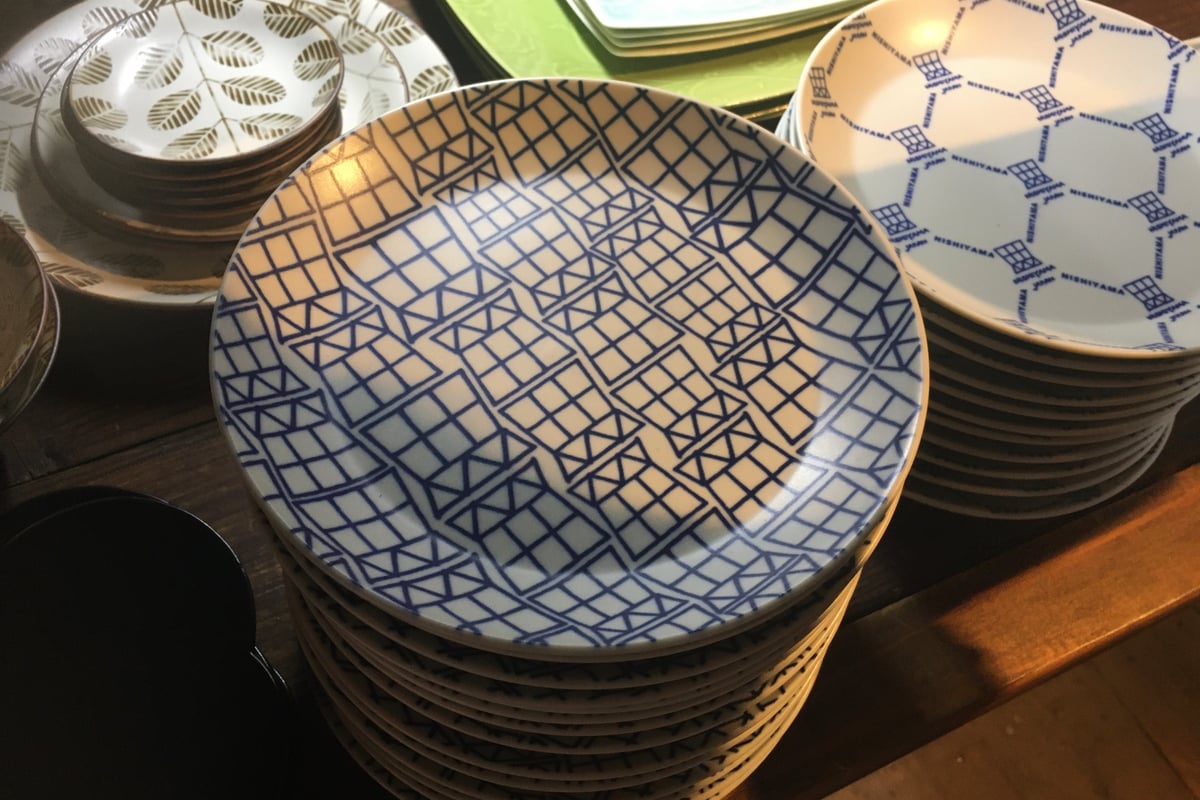
Hasami ware (Hasami-yaki) is porcelain made in Hasami Town, Higashisonogi District, Nagasaki Prefecture. It is said to have begun in 1598 (Keicho 3), when Omura Yoshiaki, lord of the Omura domain, brought Korean potters back with him and built climbing kilns the following year. At first the kilns fired pottery, but after raw materials for porcelain were found, production shifted to porcelain centered on white porcelain with indigo sometsuke (underglaze blue) and on celadon. During the Edo period, the area mass-produced 'kurawanka bowls' for ordinary people and 'Konpura bottles' for export. It is described as having become Japan's largest producer of sometsuke porcelain in the late Edo period. For a long time it was sold under the name of Arita ware, but when rules on labeling the place of origin became stricter in the 2000s, the area began building its own brand as Hasami ware. Today it is popular as tableware and household goods for everyday use. In 1978 it was designated a Traditional Craft by the Minister of Economy, Trade and Industry.
Origin
In 1598, Omura Yoshiaki, lord of the Omura domain, who had taken part in Toyotomi Hideyoshi's invasions of Korea, brought back Korean potters, including the brothers of Ri Yukei. In the following year, 1599, climbing kilns were built at three sites, Hatanohara, Furusaraya and Yamanita, and pottery making is said to have begun. At the Hatanohara kiln site, the remains of a Korean-style multi-chamber climbing kiln can still be seen today.
History
At first the main products were glazed pottery, but after porcelain stone was found at Mitsunomata in the southeast of the town, production shifted to sometsuke and celadon porcelain. From around 1690, the kilns began mass-producing vessels for ordinary people, such as kurawanka bowls. Around the end of the Edo period, the Konpura trading company (金富良商社) is said to have filled Konpura bottles with sake and soy sauce and shipped them overseas from Dejima. In 1987, 'Warenikka' tableware, a hard-to-break line for school lunches, was also developed.
Features
The basic style is sometsuke, in which indigo patterns are painted with a pigment called gosu (cobalt pigment) on a smooth white porcelain surface. Its hallmark is said to be that, since the Edo period, it has continued to produce affordable vessels for daily use. A division-of-labor system, in which specialized craftspeople and companies share tasks such as forming, painting and firing, has supported mass production. Today there are also many pieces with Scandinavian-style or modern designs, and they are widely sold at general goods shops and elsewhere.
Techniques
Kurawanka bowls
These are said to be the vessels used on the 'kurawanka boats' that sold food and drink from boats on the Yodo River in Osaka during the Edo period. They are thick-walled with a sturdy foot ring (the base of the vessel), a shape that is easy to use even on a rocking boat. Many of them are described as having been made in Hasami.
Konpura bottles
White porcelain bottles that were filled with sake or soy sauce and exported overseas. On the surface, the words 'JAPANSCH ZOYA' (Japanese soy sauce) or 'JAPANSCH ZAKY' (Japanese sake) are written in Dutch with gosu. The name is said to come from 'comprador,' meaning a middleman or broker.
Giant climbing kilns
Hasami had giant climbing kilns with firing chambers lined up along a slope. The Oshin Climbing Kiln site is about 170 m long with 39 chambers and is said to be among the largest in the world. The Nakaowa Climbing Kiln site, built in 1640 (about 160 m, 33 chambers), is described as having been used for about 300 years.
Materials Used
Production Process
- 1
Preparing the clay body
Amakusa porcelain stone is crushed and dissolved in water, and only the fine particles are taken out in a process called suihi (elutriation). This is kneaded thoroughly to make the porcelain clay body called haido.
- 2
Forming
Pieces are shaped using machine wheels, hand wheels, roller machines, or ikomi (slip casting), in which liquid clay is poured into plaster molds. A distinctive feature is the frequent use of molds.
- 3
Bisque firing and underglaze painting
After bisque firing at 800–950°C, patterns are painted with gosu. Besides painting by brush, printed decoration is also used.
- 4
Glazing and main firing
Glaze is applied and the pieces are given their main firing at a high temperature of about 1,300°C. This produces white, hard porcelain.
- 5
Overglaze painting and inspection
When colored enamels are added, they are painted with overglaze pigments after the main firing and fired on at 750–850°C. Finally, the pieces are inspected and finished.
| Main Production Areas |
|
|---|
Artisans & Workshops
西海陶器
The company is described as having started in 1946, when 児玉薫 began peddling ceramics with a single handcart, and as having established a general trading company for ceramics 11 years later. In 2005 it acquired the site of a former pottery factory and revived it as 'Nishinohara,' an area with shops and cafes.
Official site →マルヒロ
A local wholesaler that began selling Hasami ware as a street vendor in 1957. It runs brands such as 'HASAMI,' 'BARBAR' and 'ものはら' (Monohara). Monohara also has a series of vessels called the 'Kurawanka Collection.' Its head office is in Yumuta-go, Hasami Town.
Official site →白山陶器
A pottery said to have been founded in An'ei 8 (1779). The 'G-type soy sauce dispenser' designed by the designer Mori Masahiro is known as its signature work, which received the Good Design Award in 1960. Its head office showroom is in Yumuta-go, Hasami Town.
Official site →How to Buy
- 西の原 (Nishinohara)
- An area that makes use of the roughly 1,500-tsubo grounds of the former Fukuko Pottery factory. Along with cafes and galleries, it has shops such as 南創庫 (Minami Soko), which carries several Hasami ware brands, and is described as a place where you can enjoy choosing tableware and strolling at the same time.Where to buy →PR
- 陶郷 中尾山 (Nakaoyama pottery village)
- A mountain village where kilns are clustered together, described as having 16 kilns. The Nakaoyama Koryukan (exchange hall) displays materials on Nakaoyama and original works from each kiln. You can look for tableware while touring the kilns.Where to buy →PR
Hands-on Experiences
波佐見町陶芸の館(観光交流センター)・くらわん館
長崎県東彼杵郡波佐見町井石郷2255-2
くらわん館 (Kurawankan) on the first floor sells vessels from kilns and trading companies in the town, and the second floor is a museum on the history of Hasami ware. Painting is listed from 1,100 yen for a teacup, wheel throwing at 4,400 yen and tatara slab molding at 3,300 yen (tax included, reservations required at least one week in advance). Prices are subject to change.
View details →中尾山伝習館
長崎県東彼杵郡波佐見町中尾郷
According to the Hasami Ceramics Industry Cooperative, hand-building a rice bowl or plate starting from the clay is 5,000 yen (shipping extra, reservations required), and painting using decal transfer or washi dyeing starts from 2,000 yen. Closed on Tuesdays. Prices are subject to change.
View details →FAQ
Q. What is the difference between Hasami ware and Arita ware?
A. They come from neighboring production areas and are both Hizen porcelain. Hasami ware was long sold under the name of Arita ware, but since the 2000s, when labeling of the place of origin became stricter, it is said to have built its own brand as Hasami ware. Its distinctive point is that it has continued to make everyday tableware at affordable prices.