Image: Wikimedia Commons
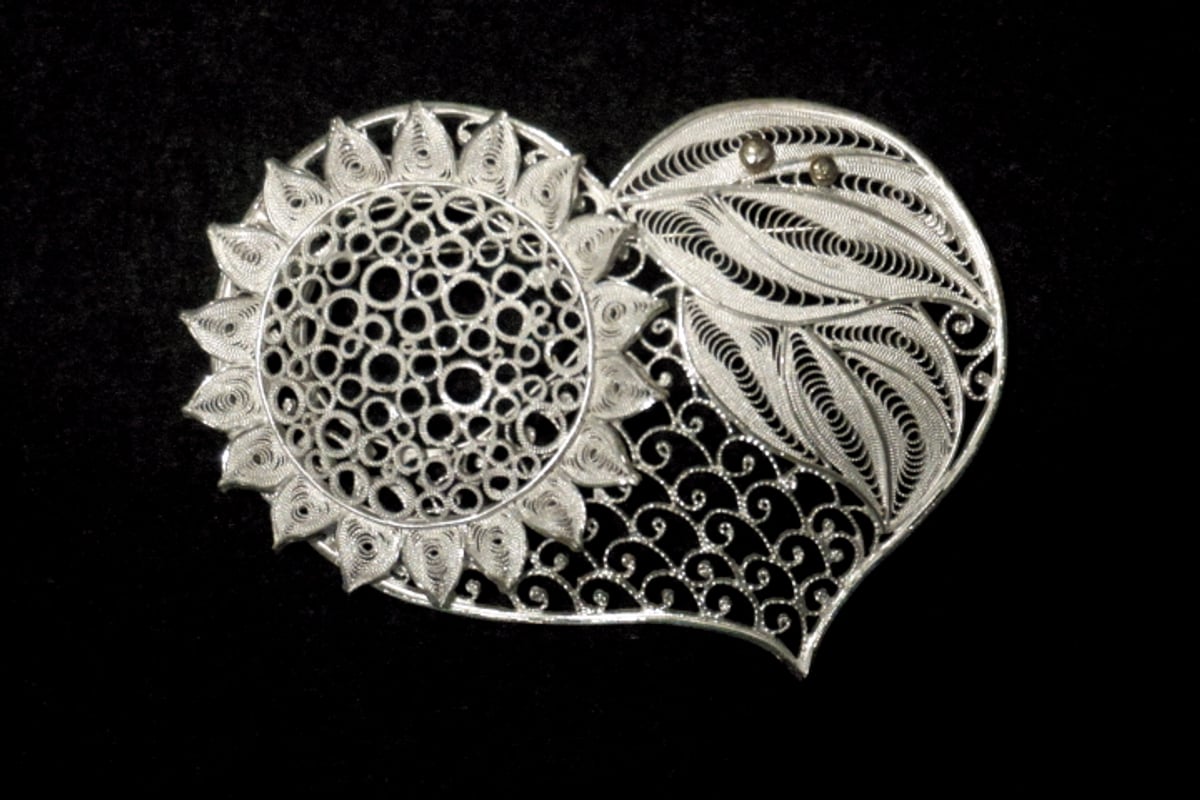
Akita Ginsen Zaiku is a metalwork craft in which high-purity silver is drawn into fine wire about 0.2 to 0.3 millimeters in diameter, twisted together, and shaped into swirl- or arabesque-patterned parts called 'hirado,' which are then set into a silver frame and assembled. Its origin is traced to 1602 (Keicho 7), when Satake Yoshinobu brought gold- and silversmiths with him as he moved from Hitachi Province to Akita, and the craft developed as a technique for sword fittings and decorative metal hardware under mining development in Akita, including the Innai Silver Mine, and the protection of successive lords of the Satake clan. From the Meiji era onward, as demand from the samurai class declined, its use expanded into accessories such as brooches and pendants, and it established its own distinctive style by incorporating the 'Hirado-zaiku' technique said to have been introduced by Portuguese ships. Its greatest appeal lies in the composed luster unique to pure silver and the delicate designs created by its intricate wirework; it was selected as a national Intangible Cultural Property in 1955 (Showa 30), and today it is carried on as a Traditional Craft of Akita Prefecture and a City-Designated Intangible Cultural Property of Akita City.
Origin
The origin of Akita Ginsen Zaiku is said to lie in 1602 (Keicho 7), when Satake Yoshinobu, the first lord of the Kubota domain (Akita domain) of Dewa Province, moved to Akita from Hitachi Province and brought gold- and silversmiths with him. The filigree technique itself is thought to trace back to 'Hirado-zaiku,' said to have been introduced when Portuguese ships called at Hirado in 1550, with the leading theory holding that it then spread from Edo to Akita. The abundant silver produced by mining development in Akita, including the Innai Silver Mine, also provided fertile ground for gold- and silversmithing to take root in the region.
History
In the Edo period, a craftsmen's district formed in the castle town of Kubota, and under the protection and encouragement of successive lords of the Satake clan, the filigree technique was refined for sword fittings such as tsuba (hand guards) and other decorative metal hardware. After the Meiji Restoration, demand from the samurai class fell, and craftsmen shifted their focus to making accessories such as kanzashi (hair ornaments), brooches, and pendants. Selected as a national Intangible Cultural Property in 1955 (Showa 30), it was then designated a Traditional Craft of Akita Prefecture and a City-Designated Intangible Cultural Property of Akita City in 1996 (Heisei 8), and its techniques are carried on to this day.
Features
Pure silver wire drawn to about 0.2-0.3 millimeters in diameter is twisted together in pairs to make 'yorisen' (twisted wire), which is then shaped into a part called 'hirado,' formed into a swirl or arabesque pattern. A defining feature is that this hirado is set into a frame made of thicker silver wire to build up a pattern, which is then joined with silver solder to create a three-dimensional form. Because the pattern is expressed using only silver wire, without any clay or lacquer, the result has a delicate, elegant luster, and the technique is also applied to accessories with contemporary designs.
Techniques
Yorisen and hirado
Two strands of pure silver wire about 0.2-0.3 millimeters in diameter are twisted together to make 'yorisen' (twisted wire), which is then shaped into a part called 'hirado,' rolled into a swirl or arabesque pattern. Combining these hirado parts allows a wide variety of designs to be expressed.
Silver soldering
Hirado parts are set into a frame made of thick silver wire and joined together with silver solder while heating with a gas burner. Controlling the temperature is difficult, making this a finishing process that demands the skill and experience of a seasoned craftsperson.
Materials Used
Production Process
- 1
Wire drawing
A bar of pure silver is drawn out using a specialized tool and processed into fine wire about 0.2-0.3 millimeters in diameter.
- 2
Making yorisen (twisted wire)
Two or more strands of the finely drawn silver wire are twisted together to make 'yorisen,' the twisted wire that forms the basis of the pattern.
- 3
Making hirado
Using tweezers, the yorisen is curled into a swirl or arabesque shape, forming the part called 'hirado.'
- 4
Framing and assembly
A frame forming the outline is made from thick silver wire, and hirado parts are set inside it to build up the pattern.
- 5
Silver soldering and finishing
After heating with a gas burner to join the various parts with silver solder, the piece is polished to finish.
| Main Production Areas |
|
|---|
Artisans & Workshops
金銀線工房しんどう
The workshop of Haruo Shindo, an Akita Ginsen Zaiku craftsman, located in Sakura, Akita City. His works have been presented to the Imperial Household, and as a holder of Akita City's Intangible Cultural Property designation, he continues to pass on the technique.
矢留彫金工房
A workshop located inside the Eitaro Furusato Culture Hall in Omachi, Akita City. Established in 2019, it is where young craftspeople carry on the filigree technique while also offering classes and hands-on craft-making experiences.
Official site →How to Buy
- Takeya Honten
- A long-established shop that carries Akita Ginsen Zaiku brooches, pendants, and more at its Hirokoji store in Nakadori, Akita City, and its store in the Topico building at Akita Station.Where to buy →PR
- Ginsen Zaiku Suto
- A workshop and shop located inside 'Akita Furusato Mura,' a tourist facility in Yokote City. It makes and sells pure silver accessories such as brooches and tie clips.Where to buy →PR
Hands-on Experiences
矢留彫金工房
秋田県秋田市大町2丁目1-11 榮太楼ふるさと文化館1階
Holds metal engraving classes (contact the workshop for details and fees).
View details →FAQ
Q. What kinds of products are made with Akita Ginsen Zaiku?
A. The main products are accessories made by combining silver wire, such as brooches, pendants, tie clips, and cufflinks. In recent years, accessories with contemporary designs have also been made.
Q. Why did filigree work develop in Akita?
A. The background lies in the abundant silver produced through mining development within the Akita domain, including the Innai Silver Mine, and the fact that gold- and silversmithing techniques were nurtured under the protection of the Satake clan.