Image: Wikimedia Commons
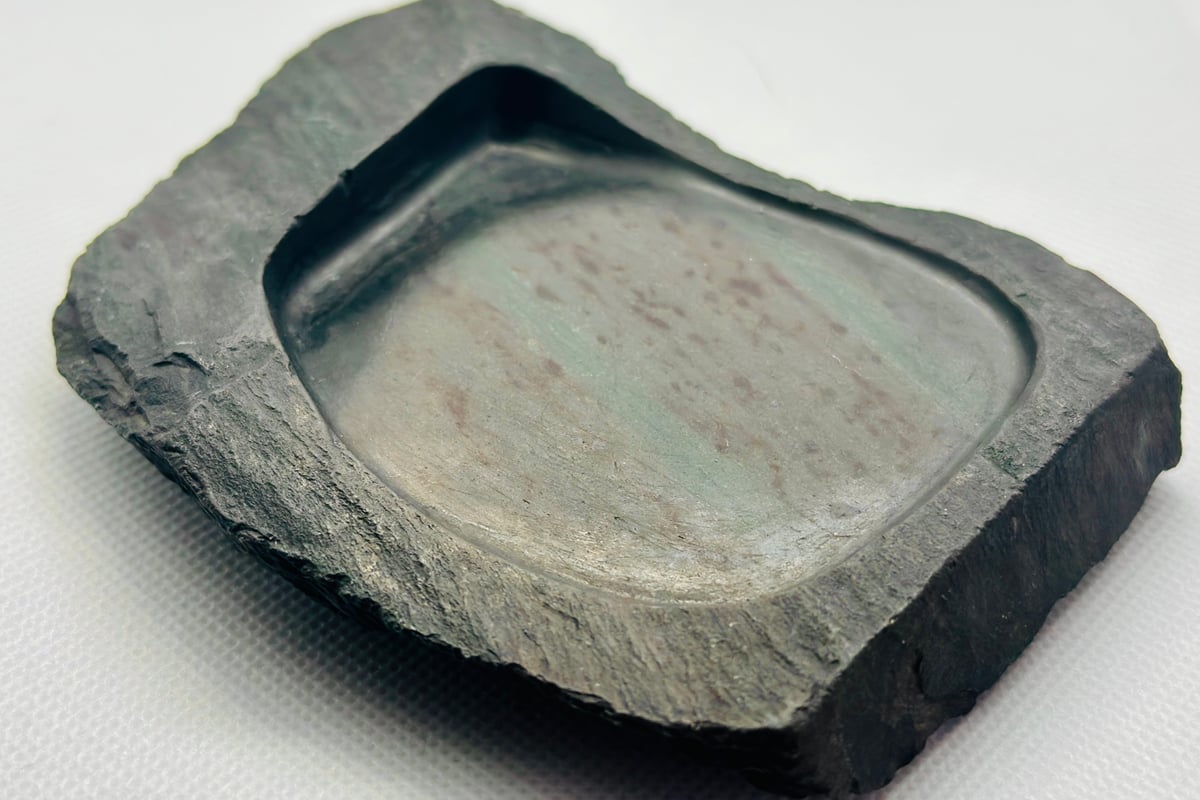
Akama inkstones (Akama suzuri) are inkstones made in Ube City and Shimonoseki City, Yamaguchi Prefecture. The name is said to come from Akamagaseki, the old name for Shimonoseki. The raw material is a reddish-purple stone called Akama stone; it contains a great deal of quartz and iron and is dense and tenacious, which makes it suitable even for fine carving. The surface of the inkstone is densely covered with minute, almost invisible points called hobo (the microscopic grinding points on the stone surface). As a result, ink can be ground quickly, producing ink with good color that spreads well. An inkstone dedicated to Tsurugaoka Hachimangu Shrine at the beginning of the Kamakura period is said to be an Akama inkstone, and the craft is said to have a history of more than 800 years. In the Edo period, it was a renowned product of the Choshu Domain and was also used as a gift. In 1976 (Showa 51), it was designated a Traditional Craft by the Minister of Economy, Trade and Industry. Today, the raw stone is quarried in the Iwataki district of Magura, Ube City, by the craftsmen themselves, who dig tunnels to extract it. Only a handful of craftsmen are said to work all the way from quarrying, making this a precious form of handwork.
Origin
According to Ube City, the inkstone that Minamoto no Yoritomo dedicated to Tsurugaoka Hachimangu Shrine (Kamakura City, Kanagawa Prefecture) in 1191 (Kenkyu 2) is said to be an Akama inkstone, and production is thought to have begun by the end of the 12th century. However, historical documents supporting this origin are scarce; what has been confirmed is that the inkstones were being made by 1395 (Oei 2), in the Muromachi period. At first they were made in Akamagaseki as a renowned product of Shimonoseki, and the name 'Akama suzuri' already appears in documents from the early Edo period.
History
In the Edo period, the Omori family of Akamagaseki was known as inkstone makers who styled themselves 'Tenka-ichi' (the best in the land), and an inkstone bearing that inscription survives in an inkstone box said to have been used by Mori Terumoto. The Kefukigusa, published in 1645, lists it as a renowned product of Choshu alongside Hagi-yaki and others. The domain controlled the source of the raw stone, and ordinary people were forbidden to enter. In the 18th century, the center of quarrying shifted to the Ube City side. From the Meiji era onward, production flourished with the spread of calligraphy practice (shuji), but after the war the number of craftsmen declined sharply.
Features
Akama stone is a reddish-purple stone; some pieces contain green layers, and some show eye-like patterns called sekigan (stone eyes). The type of stone is described both as red shale and as diabase tuff (schalstein). Although hard and dense, it is tenacious, so the rim can be raised thin and openwork carving can be applied. Because its hobo are fine and dense, it grinds the ink finely, producing smooth ink that spreads well.
Techniques
Quarrying by tunneling
Because Akama stone is vulnerable to drying, the craftsmen themselves dig it out from tunnels excavated in the mountains. They pump out the water that has accumulated in the tunnel before entering, and reach the stone layer at a depth of about 5 to 40 m. Of a layer about 10 m thick, only a little over 1 m can be used for inkstones, and the craftsmen sort out usable stone by listening to the sound it makes when struck with a hammer.
Decorative carving
After the oka (land, the area where ink is ground) and the umi (sea, the well where ink collects) have been carved, hand-carved decoration is added with chisels about 2 to 10 mm wide. Techniques include ukashi-bori (relief carving) that makes forms stand out, sukashi-bori (openwork carving) that cuts through the stone, tataki-bori that shows the texture of the stone, and kebori that engraves fine lines; elaborate pieces take several days.
Dressing the surface and lacquer finishing
After polishing with whetstones and waterproof sandpaper, the oka where ink is ground is finished with a dressing stone (metate-ishi) to condition the hobo. Over-polishing makes ink harder to grind, so careful adjustment is required. Areas other than the oka and umi are repeatedly coated thinly with lacquer and wiped off, which protects against weathering while bringing out a luster.
Materials Used
Production Process
- 1
Quarrying and sorting
Akama stone is dug out of the tunnel, and stone suitable for inkstones is chosen by the sound it makes when struck.
- 2
Rough shaping
The stone is roughly shaped with cutters, chisels (tagane) and hammers.
- 3
Jigiri (flattening)
Using water and silica sand as an abrasive, the front and back are ground flat and even.
- 4
Raising the rim
The boundary between the oka and the umi is carved, and the rim of the inkstone is raised.
- 5
Carving
Rough carving creates the oka, the umi and the 'mune' (chest) that connects them, and finish carving removes the tool marks.
- 6
Polishing
The inkstone is polished with whetstones and waterproof sandpaper, and the oka is finished with a dressing stone.
- 7
Lacquering and finishing
Lacquer is applied to areas other than the oka and umi and wiped off repeatedly, and finally the inkstone is polished with a brush to finish.
| Main Production Areas |
|
|---|
Artisans & Workshops
日枝玉峯堂(日枝陽一)
An Akama inkstone workshop in Nishi-Magura, Ube City, which also houses the 山口県赤間硯生産協同組合 (Yamaguchi Prefecture Akama Inkstone Production Cooperative). 日枝陽一, the fourth generation, digs tunnels in the mountains of Ube City and handles everything from quarrying Akama stone 30 m underground to making and selling inkstones. Together with his father, the third-generation 日枝玉峯, he has repeatedly won awards at and been selected for the Japan Traditional Kogei Exhibition.
Official site →堀尾信夫
An inkstone maker in Shimonoseki City and a holder of the technique of 'Akama Inkstone', a Yamaguchi Prefecture-designated Intangible Cultural Property. He has exhibited at the Japan Traditional Kogei Exhibition for many years, and in 2023 the Shimonoseki City Art Museum held a special exhibition titled '赤間関硯 堀尾信夫の挑戦' (Akamagaseki Inkstones: The Challenge of 堀尾信夫). Works by his father, 堀尾卓司, were also introduced.
Official site →FAQ
Q. What is the connection between Akama inkstones and Yoshida Shoin?
A. Akama inkstones were also favored by the shishi (patriotic activists) of the Bakumatsu period at the end of the Edo period. Yoshida Shoin is said to have likened his beloved Akama inkstone to a 'meritorious retainer' (koshin), and that inkstone is enshrined as the object of worship (goshintai) at Shoin Shrine in Hagi City.
Q. Why are there two production areas for Akama inkstones, Shimonoseki and Ube?
A. Akama inkstones were originally made in Akamagaseki (Shimonoseki), but the quarrying site for the raw stone moved in the Edo period, and by the 18th century the center of quarrying had shifted to the Ube City side. Since then, both Ube City and Shimonoseki City have been production areas, and today the raw stone is quarried in the Iwataki district of Magura, Ube City.