Yamakawa (Matsue Red-and-White Pressed Sugar Confection)
Yamakawa (Matsue Red-and-White Pressed Sugar Confection)
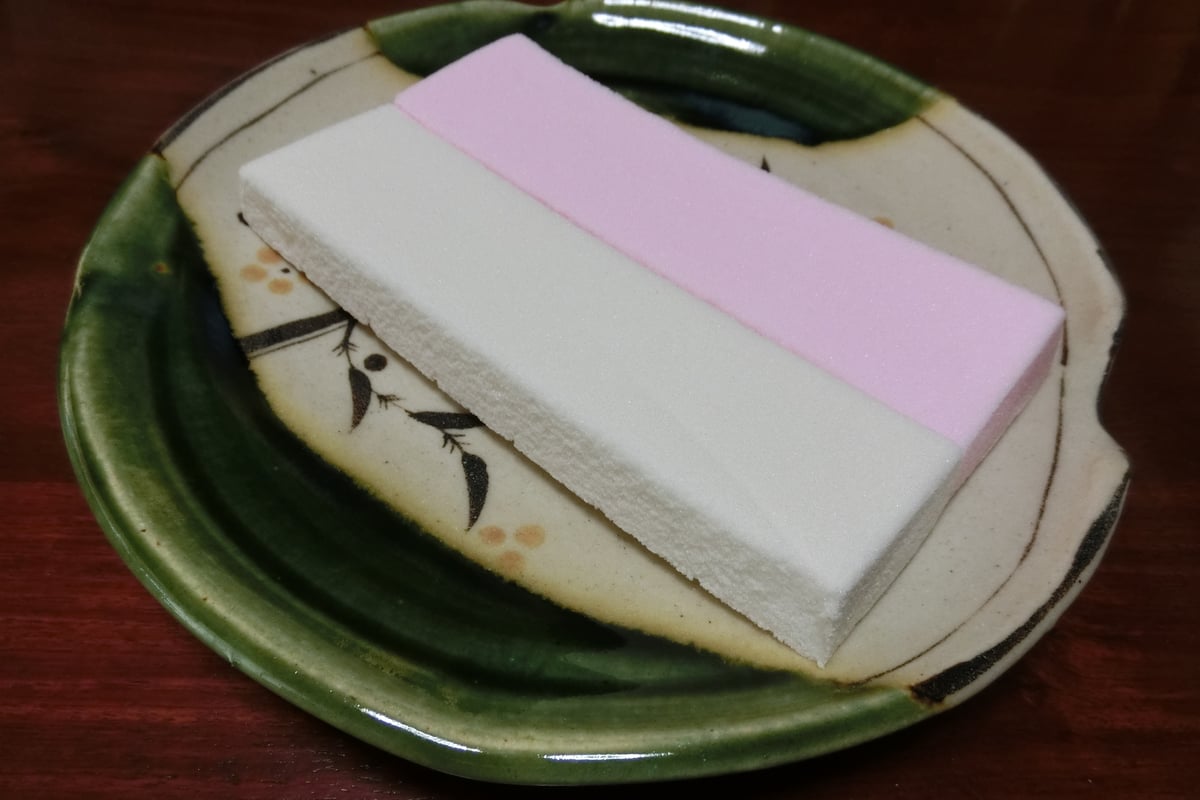
Image: Wikimedia Commons
Yamakawa is a red-and-white paired uchigashi (pressed dry confection) made by 風流堂, a long-established confectionery in Matsue City, Shimane Prefecture. Uchigashi are higashi (dry confections) made by pressing flour and sugar firmly into wooden molds. Along with Choseiden of Kanazawa City, Ishikawa Prefecture, and Koshi-no-yuki of Nagaoka City, Niigata Prefecture, it is counted among Japan's three great confections. It is said to have been a favorite of Matsudaira Harusato (Fumai), the seventh lord of the Matsue domain, who was known as a tea master. Its name comes from Fumai's poem '散るは浮き 散らぬは沈む もみじ葉の 影は高尾の 山川の水' (roughly: 'The fallen float, the unfallen sink: reflections of maple leaves in the mountain-stream waters of Takao'), and the red is said to represent mountains of autumn leaves and the white the water of the river. Made from domestic sugar, kanbaiko (a flour made from glutinous rice), and salt, it is characterized by a moist texture and a faint saltiness. The Edo-period confection was once discontinued, but it is said to have been revived in the Taisho period by the second-generation owner of 風流堂. It is a representative confection of Matsue, where the culture of the tea ceremony lives on, and it is also popular as a souvenir.
Origin
Matsudaira Harusato, the seventh lord of the Matsue domain, was a daimyo tea master who took the name Fumai, and the lord's style of tea has been handed down as the Fumai school (Fumai-ryu). Yamakawa is said to have been a tea confection favored by Fumai. The name comes from a poem by Fumai about Takao, a famous spot for autumn leaves in Kyoto. The poem is said to depict maple leaves floating on the water and those that have sunk. The wording of the poem varies among sources, with differences such as 紅葉 or 高雄.
History
風流堂 is a confectionery opened in Meiji 23 (1890) by its founder, 内藤竹次郎, who had been running a coastal shipping business between Niigata and Matsue and foresaw the development of overland transportation. The discontinued Yamakawa is said to have been revived in the Taisho period by the second-generation owner, 内藤隆平, drawing on Edo-period documents and accounts from tea masters and elders. Meanwhile, the Encyclopedia Nipponica (日本大百科全書) states that it was revived by 内藤竹次郎 in Meiji 20 (1887). In April 2024, 山川古今, a size meant to be finished in one sitting, was released.
Features
It is a moist, soft uchigashi pairing two colors, red and white. The ingredients are domestic sugar, kanbaiko (a flour made from glutinous rice), salt, and safflower coloring. Tradition holds that, depending on the season, the red and white were stacked one above the other or one was sandwiched between, and it was served at tea gatherings. It melts smoothly on the tongue and the sweetness does not linger, so it is said to bring out the flavor of matcha. A faint saltiness is another characteristic.
Main Ingredients
Food Culture
Matsue is known, along with Kyoto and Kanazawa, as a town of tea and confections. According to Matsue City materials, 若草, Yamakawa, and 菜種の里, which were used at tea gatherings in Fumai's time, are still handed down today as Matsue's three great confections. The town has many tea shops and long-established wagashi shops, and tea and confections are also welcomed as Matsue souvenirs.
Famous Shops
風流堂 寺町本店
島根県松江市寺町151
The main store of 風流堂, founded in Meiji 23, about a 7- to 8-minute walk from JR Matsue Station. The store also houses 五風庵. Tourism information sites describe one sheet of Yamakawa at about 756 yen. Since business hours vary by store and season, checking with the shop is recommended.
View details →| 風流堂「山川」 | Red-and-white pairs of Yamakawa packed in boxes, available in boxes from one sheet to six sheets. A large sheet has scored lines for breaking it into seven pieces. There are also Yamakawa (small), which breaks into three pieces, and 古代山川, without scored lines.Where to buy →PR |
|---|---|
| 風流堂「山川古今」 | A Yamakawa sized to be finished in one sitting, released in April 2024, that fits in a box about 7 cm square. It is said to have been developed over about 10 years in response to feedback that the conventional sheet, about the size of a postcard, was too large. |
FAQ
Q. How do you eat Yamakawa?
A. Because it is soft, you break it by hand and eat it. It is also said that breaking it by hand creates irregular shapes that look like mountains and rivers. Fumai is said to have valued breaking it by hand.
Q. What are 'Japan's three great confections'?
A. Generally, the term refers to three: Yamakawa from 風流堂 in Matsue City, Choseiden from 森八 in Kanazawa City, and Koshi-no-yuki from 大和屋 in Nagaoka City. All are dry confections handed down together with the tea ceremony, and these three are named by common consensus.