Wani Ryori (Shark Dishes of Northern Hiroshima)
Wani Ryori (Shark Dishes of Northern Hiroshima)
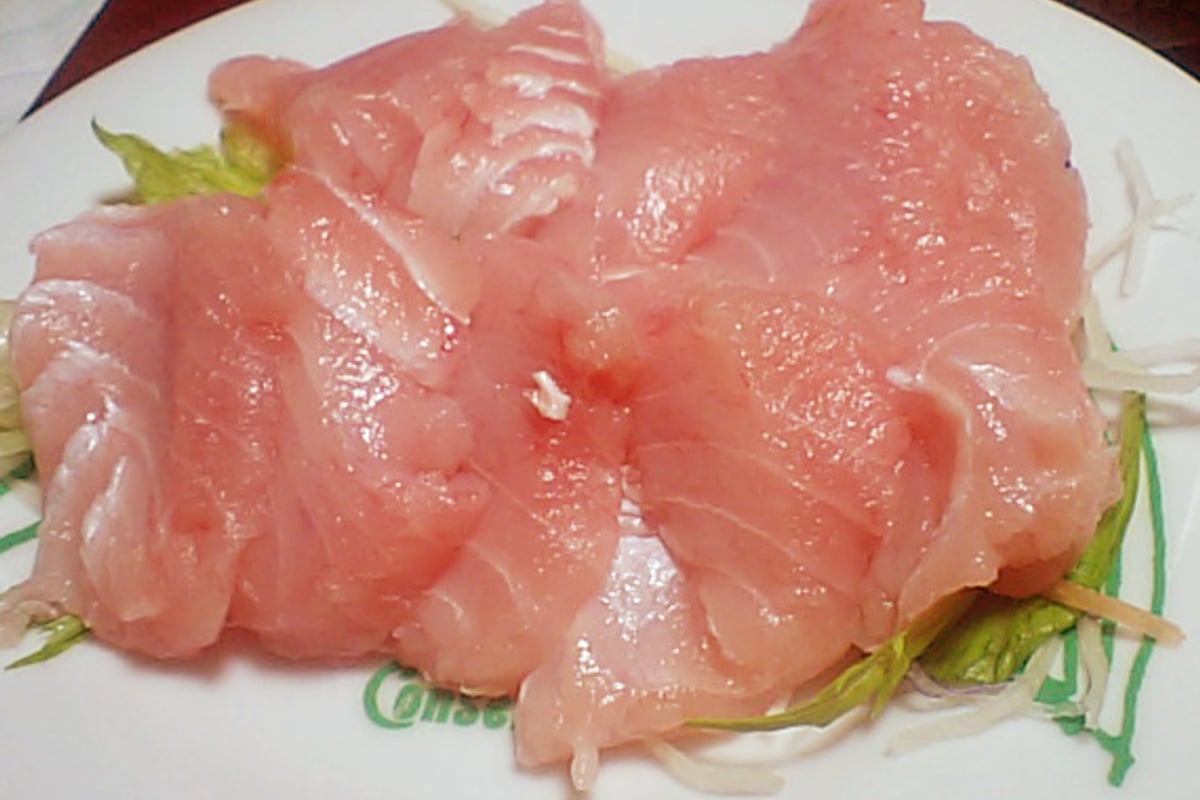
Image: Wikimedia Commons
Wani ryori refers to shark dishes handed down in the Bihoku area of northern Hiroshima Prefecture, especially in Miyoshi City and Shobara City. In this area, sharks have long been called 'wani.' The typical way of eating it is as sashimi, with the pale pink flesh eaten with ginger and soy sauce. Why do people in mountain areas far from the sea eat sea fish as sashimi? The reason lies in the ammonia that shark flesh contains in large amounts. Thanks to the ammonia, the flesh is slow to spoil, so even in the days before refrigeration, sharks carried in from the Sea of Japan coast could be eaten raw. Wani was an essential feast at autumn festivals, at New Year and at celebrations. Even today, with refrigeration and distribution well developed, wani sashimi appears in supermarkets at the end of the year and has become a winter tradition of the area. In recent years, new products that make use of shark meat, such as wani burgers and wani gansu, have also been created.
Origin
In the mountainous areas of the Chugoku region, an old way of calling sharks 'wani' survives. According to materials from the Ministry of Agriculture, Forestry and Fisheries, there are records of merchants from the Sea of Japan coast bringing sharks into this area in the Edo period. It is also said that around Tenpo 5 (1834), 'wani no aburi-gushi' (grilled shark skewers) were sold in Miyoshi. However, there was reportedly not yet a custom of eating shark as sashimi at that time.
History
In the Meiji era, shark fishing to obtain shark fins flourished in the Iwami region of Shimane Prefecture. From the latter half of the Meiji 30s, fishermen from Shimane began bringing sharks to the area, and it is said that shark came to be eaten as sashimi at home as well. Because shark could be eaten as sashimi for about half a month, it was prized in mountain areas where fresh fish was hard to obtain. As festivals approached, 'wani markets' (wani no ichi) are said to have been held in various places, where cut-up sharks were sold. In Showa 61 (1986), a restaurant specializing in wani ryori also opened in Kuchiwa Town (now Shobara City).
Features
About 20 species of shark are eaten in northern Hiroshima Prefecture centered on Miyoshi City, mainly salmon shark, shortfin mako and hammerhead shark. The color of the flesh differs by species, ranging from pale pink to crimson. The flesh is tender and mild, with no strong peculiar taste. Because the smell of ammonia grows stronger as days pass, it is generally eaten with ginger and soy sauce, and some households use soy sauce with sugar. In Miyoshi City it was sometimes called 'Miyoshi kajiki' (Miyoshi marlin), and in Saijo Town, Shobara City, 'Saijo maguro' (Saijo tuna).
Main Ingredients
Food Culture
It was an essential dish at autumn festivals, New Year and celebrations, when many people gathered. In Miyoshi City there is an old expression of hospitality: 'Wani wo hara no hieru made tabete tsukaasai' (please eat wani until your belly gets cold). Besides sashimi, there are many ways of eating it, including simmered dishes, yubiki (briefly blanched), nikogori (jellied broth), tempura and 'wani meshi,' rice cooked together with shark.
Famous Shops
むらたけ総本家
広島県三次市十日市東6-1-8
A Japanese restaurant founded in 1976. It buys whole sharks, and besides sashimi, the most common style in Miyoshi, it also serves aburi-gushi (grilled skewers) and more. A wani-zukushi (all-shark) course of seven dishes, including sashimi and tempura (reservation required), is also introduced. It is closed on Mondays.
FAQ
Q. Is the 'wani' in Wani Ryori the reptile, as in the Japanese word for crocodile?
A. No, it is not the reptile but the shark. In the mountainous areas of the Chugoku region, sharks are called 'wani' or also 'fuka.' This is said to be a remnant of the ancient word for shark, written 和邇 (wani), and the wani that appears in the Kojiki myth 'The White Hare of Inaba' (Inaba no Shirousagi) is also thought to be a shark.