Shodoshima Hand-Stretched Somen
Shodoshima Tenobe Somen (Hand-Stretched Somen of Shodo Island)
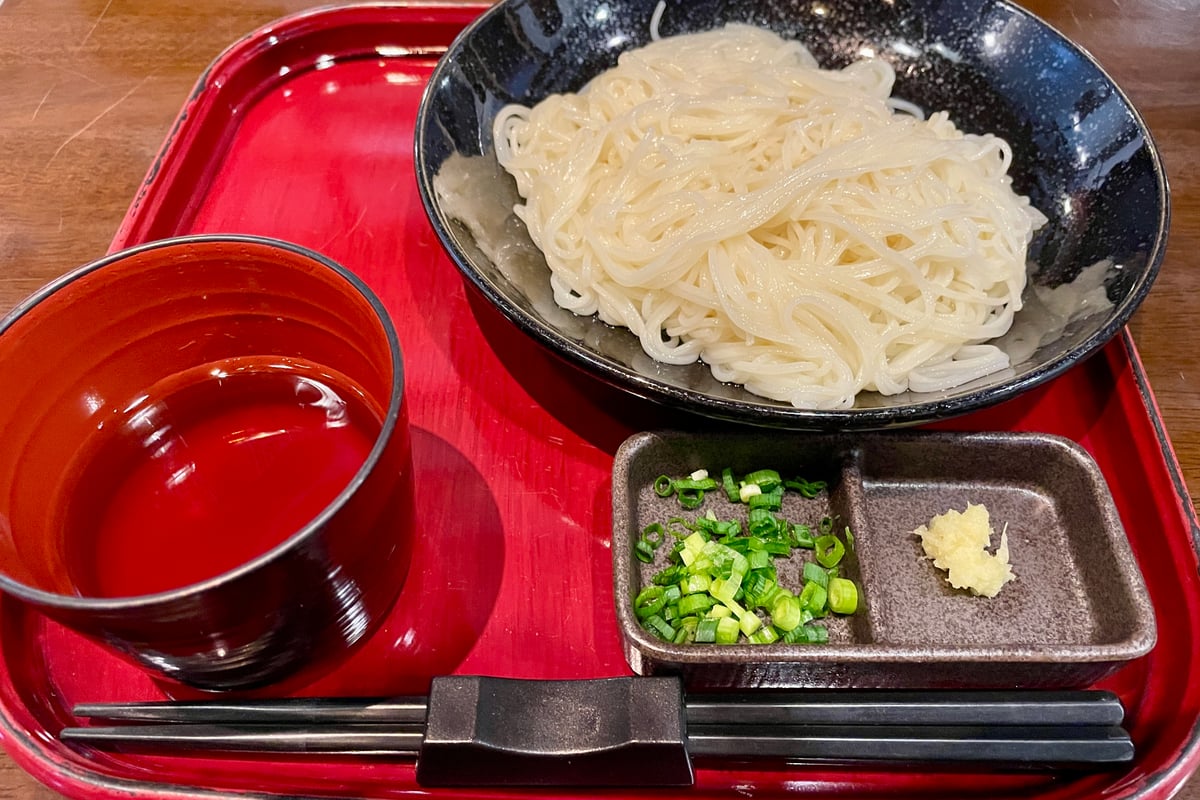
Image: Wikimedia Commons
Shodoshima Hand-Stretched Somen is hand-stretched somen made on Shodoshima Island in Kagawa Prefecture. It is said to have begun about 400 years ago, when islanders returning from an Ise pilgrimage learned the production method in Miwa, Nara, and brought it back with them. The cooperative's products are shipped under the brand name 'Shima no Hikari' and are divided into grades such as Kuro-obi (Black Band) and Aka-obi (Red Band) according to quality. Its greatest feature is the use of sesame oil in the process of stretching the dough thin. It has a strong, springy texture and a faint aroma of sesame oil, and the use of salt from the Seto Inland Sea is also said to be a feature. The noodle ends are sold as 'fushimen' and are also used in island home cooking. Somen made in the cold winter months and dried outdoors on sunny days is regarded as a seasonal sight of the island. It originally began as a side job that farming families made together during the winter off-season. It is reported that there are about 110 noodle makers on the island, many of which are still family-run. In fiscal 2021 (Reiwa 3), it was recognized as a '100-Year Food' by the Agency for Cultural Affairs under the name 'Shodoshima Somen.'
Origin
Some accounts date its beginnings to around 1598 (Keicho 3). According to tradition, islanders from the Ikeda area of Shodoshima Island, on their way back from an Ise pilgrimage, learned the production method in Miwa (present-day Sakurai City, Nara Prefecture), which is regarded as the birthplace of somen, and brought it to the island. It is said to have been taken up on the island because it could be made by family members alone during the winter off-season for farming. However, no reliable records showing the date or the people involved have been found, and it is treated as a tradition.
History
Somen making long continued as a side job for farming families and is said to have developed into an independent industry in the Meiji period. At the 3rd National Industrial Exhibition in 1890 (Meiji 23), the island's soy sauce and somen makers placed advertisements for their exhibits. The cooperative's membership exceeded 250 from the mid-1970s to the early 1980s, but had fallen to 76 by 2023. The cooperative's production in 2022 is said to have been about 1,500 tons a year. There is also a theory that Shimabara somen in Nagasaki Prefecture was started by craftsmen who moved there from Shodoshima Island after the Shimabara Rebellion of 1637.
Features
The ingredients are wheat flour, salt and sesame oil. While vegetable oils such as rapeseed oil are generally more commonly used, the use of sesame oil is a distinctive feature of Shodoshima. Sesame oil is said to keep the noodles from drying out and to give them a distinctive flavor. The dough is formed into ropes while being coated with oil, twisted and stretched thin, and finally hung on drying racks and stretched by hand. Until around 1985 (Showa 60), the noodles were reportedly stretched using long chopsticks. On sunny days they are dried in the sun, and exposure to ultraviolet light is said to make the noodles whiter. Finally, they are cut to about 19 cm in length and gathered into 50 g bundles.
Main Ingredients
Food Culture
Somen making is work that takes advantage of Shodoshima Island's climate, with its runs of clear winter days. The sight of white somen drying under blue skies is regarded as a seasonal sight of the island. The noodle ends cut off during production are sold as 'fushimen' and enjoyed in a soup filled with plenty of ingredients such as eggplant.
Famous Shops
なかぶ庵
香川県小豆郡小豆島町安田甲1385
A hand-stretched somen maker in Yasuda, Shodoshima Town. Its direct sales shop sells about 10 kinds of products, including springy 'nama somen' (fresh somen). A hashiwake (separating and stretching the noodles with chopsticks) experience that includes a factory tour is reported to cost around 600 yen, or around 1,100 yen with a meal (reservations required by the previous day).
小豆島手延そうめん館
香川県小豆郡小豆島町室生1-1(道の駅 小豆島ふるさと村内)
A facility inside the roadside station (michi-no-eki) 'Shodoshima Furusato-mura' where you can observe the hand-stretched somen production process and the skills of the craftspeople. It is reported that on fine afternoons you may be able to see somen drying in the sun up close. It is said to be closed on Mondays (closing days differ in January and February).
| Shima no Hikari Special Grade Kuro-obi (小豆島手延素麺協同組合) | The product regarded as the top grade within 'Shima no Hikari,' the brand of the Shodoshima Hand-Stretched Somen Cooperative (小豆島手延素麺協同組合). It is made only in the cold months of December and January. Its ingredients are wheat flour, salt and sesame oil. The product widely available as the standard grade is said to be the 'Aka-obi' (Red Band), one grade lower. |
|---|---|
| Shodoshima Hand-Stretched Somen, Dried Thin Noodles (マルカツ製麺所) | Hand-stretched somen from a family-run noodle maker in the Ikeda area, which is regarded as the birthplace of Shodoshima somen. Its address is 香川県小豆郡小豆島町池田2389-2. According to a feature article, a pack of 36 bundles of 50 g dried thin noodles (kanmen hosokuchi) costs 3,280 yen (shipping extra), and orders can be placed by phone or online. |
FAQ
Q. What is 'fushimen'?
A. It is the end portions of the noodles that are cut off to even out their length after the somen has been dried. Although it is produced partway through the noodle-making process, it is not thrown away but sold as 'fushimen.' On Shodoshima Island, the standard way to eat it is in a soup with plenty of ingredients, and eggplant is said to be indispensable.
Q. What is the difference between the Kuro-obi (Black Band) and Aka-obi (Red Band) grades of 'Shima no Hikari'?
A. Both are grades of 'Shima no Hikari,' the brand of the Shodoshima Hand-Stretched Somen Cooperative. Kuro-obi is the special-grade product, made only during the cold months of December and January in what is called 'gokkan-jikomi' (production in the depth of winter), and is said to account for about 20% of total production. Aka-obi is one grade below Kuro-obi and is widely sold as standard Shodoshima somen.